What Is a Resinoid? A Perfumer’s Guide to Benzoin, Labdanum, Olibanum and More
Published 21 November 2026. By Piyush Gupta, Founder and CEO, Kanha Nature Oils.
A resinoid is a concentrated aromatic extract made by solvent extraction of a dried natural resin, gum, balsam or lichen, after which the solvent is removed. Perfumers use resinoids mainly as fixatives and base notes, because their heavy molecules evaporate slowly and hold lighter notes in place. The term is defined in the international vocabulary standard for aromatic raw materials, ISO 9235. This guide explains how resinoids differ from essential oils and absolutes, which ten resinoids perfumers buy most, the IFRA points to check, and what to ask a supplier before a bulk order.
Quick answer: A resinoid is (1) made from a dried resin, gum, balsam or lichen, (2) extracted with a solvent instead of steam, (3) dark and thick, so it is often sold diluted in a solvent such as DPG, DEP or benzyl benzoate, and (4) used as a fixative and base note. “Benzoin essential oil” is usually benzoin resinoid in a diluent. Oakmoss, styrax and Peru balsam are covered by specific IFRA Standards, so check those before you formulate.
Resinoid vs essential oil vs absolute: what is the difference?
| Material | How it is made | What it gives a formula | What to ask your supplier |
|---|---|---|---|
| Essential oil | Steam distillation or cold pressing of plant parts | Volatile molecules only; top and heart notes | Botanical name, origin and GC-MS report |
| Resinoid | Solvent extraction of a dried resin, gum, balsam or lichen, then solvent removed | Volatile and heavier molecules; base notes and fixation | Which solvent was used, and is it pure or diluted, at what percentage? |
| Absolute | Ethanol extraction of a concrete made from fresh flowers or leaves | Rich, concentrated floral or leafy notes; heart and base | Which concrete was it made from? |
| Resin absolute | Ethanol extraction of a resinoid, then ethanol removed | A cleaner, more alcohol-soluble version of the resinoid | Is this a resinoid or a resin absolute? |
The two-step route is reflected in the vocabulary itself: ISO 9235 lists the resinoid as one of the materials an absolute can be made from. That is why the same resin can be sold as both a resinoid and a “resin absolute”.
The same plant can also give more than one material. Olibanum is available as an essential oil and as a resinoid; perfumers usually describe the oil as brighter and the resinoid as deeper and longer-lasting. Kanha supplies both forms for several resins, including Frankincense Serrata essential oil, Frankincense Carterii essential oil and Olibanum resinoid.
Benzoin essential oil or benzoin resinoid?
Benzoin is a resinoid in practice. The resin is processed by solvent extraction, not distillation, and because the extract is thick it is commonly supplied diluted, for example at 50% in DPG. Products sold as “benzoin essential oil” are usually benzoin resinoid in a diluent, so that it pours.
The species changes the odour. Benzoin Siam comes from Styrax tonkinensis, grown mainly in Laos, Vietnam and Thailand; the name comes from its old trade route through Siam. Benzoin Sumatra comes from Styrax benzoin. Perfumers generally describe Siam as sweeter and more vanilla-like, and Sumatra as drier, spicier and more cinnamic.
So the name on the label matters less than three facts: which species, which diluent, and what percentage of resinoid. Kanha Nature Oils lists both Benzoin Resinoid and Benzoin Essential Oil; ask for the COA of the exact grade so you compare like with like.
How are resinoids made?
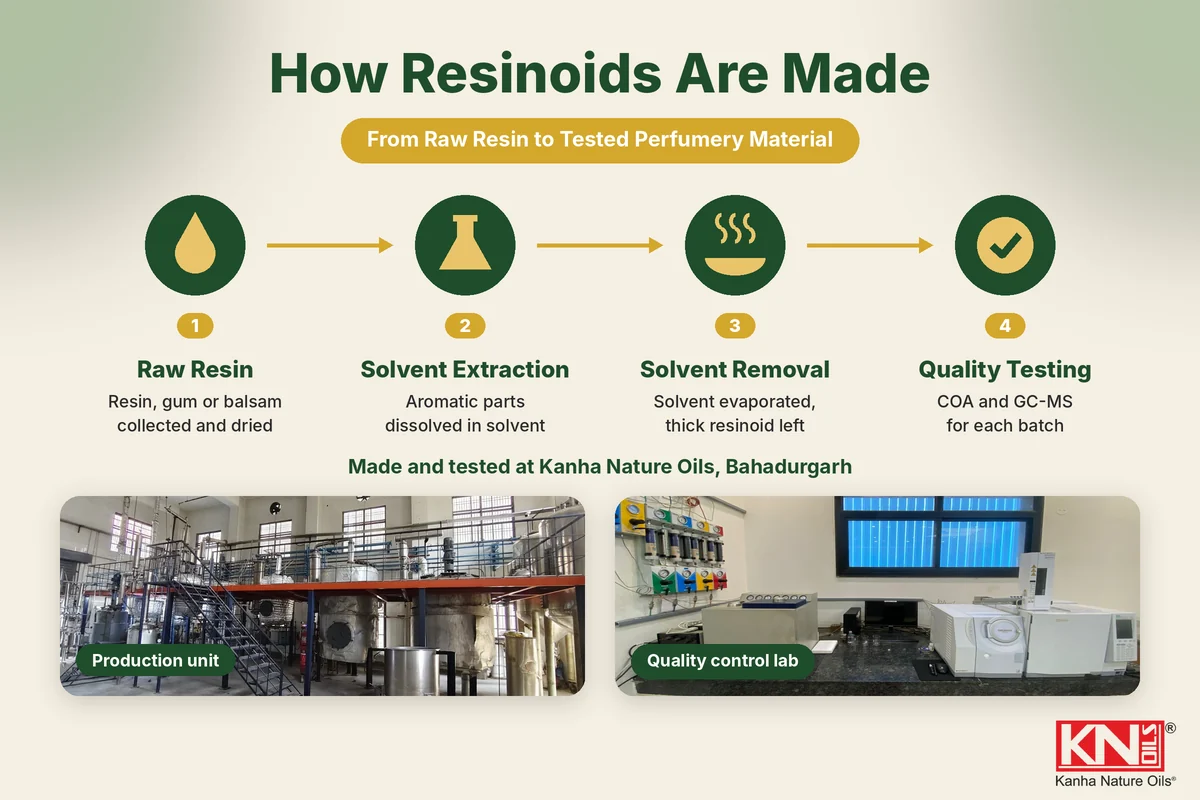
- Collection. Trees or shrubs release resin, gum or balsam when the bark is cut. The exudate hardens in air and is collected, cleaned and dried. Oakmoss is the exception: the whole dried lichen is used.
- Solvent extraction. The dried material is soaked in a solvent, commonly ethanol or a hydrocarbon solvent, which dissolves the aromatic and resinous parts.
- Solvent removal. The solvent is evaporated off, leaving a dark, viscous or solid resinoid.
- Standardisation. Because many resinoids are too thick to pour, they are often diluted in a solvent such as DPG, DEP or benzyl benzoate, or washed further with ethanol to give a resin absolute.
Each choice changes the odour and the handling. A buyer should always know which solvent was used and whether the product is pure or diluted.
The ten resinoids perfumers buy most
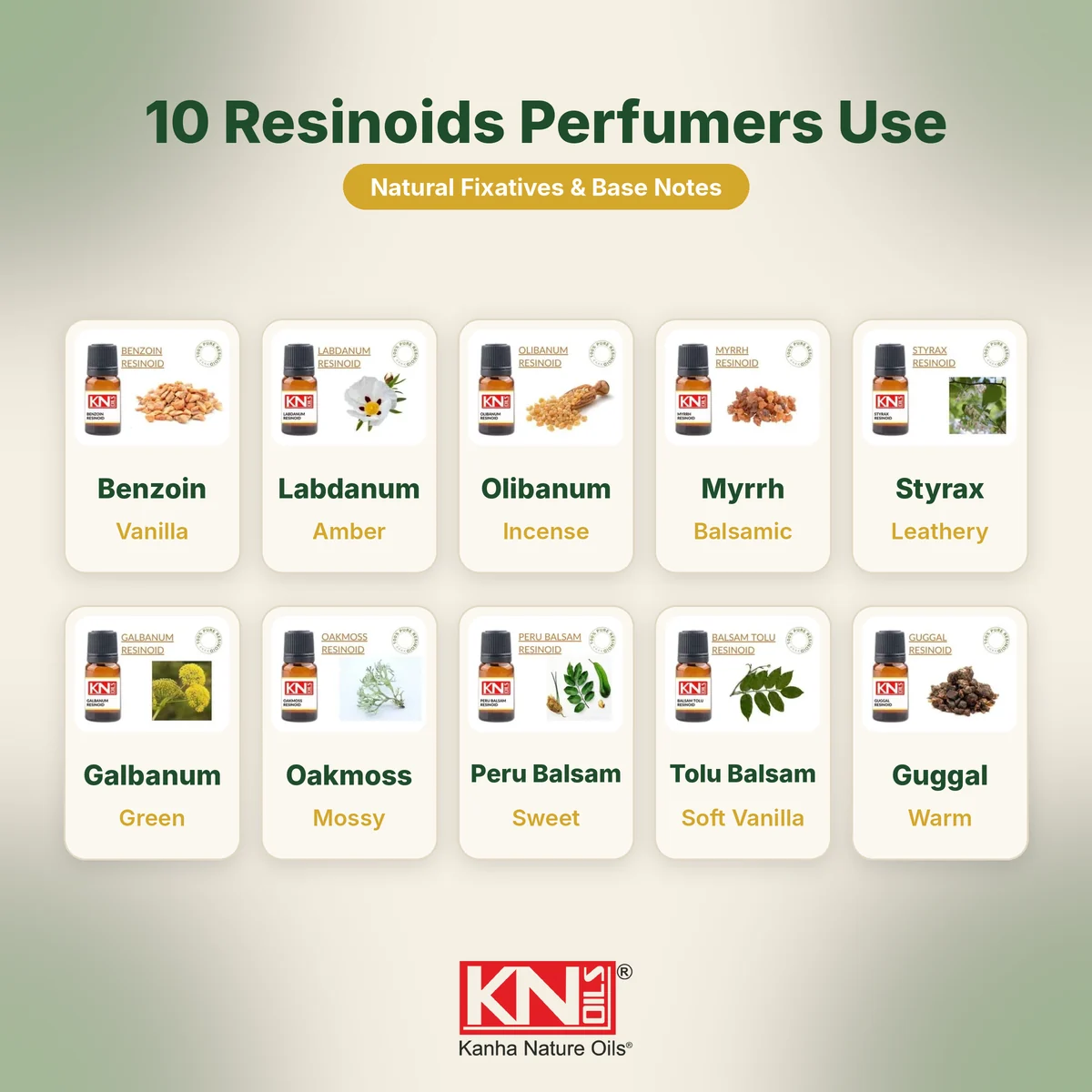
| Resinoid | Botanical source | Odour and main role | What to ask your supplier |
|---|---|---|---|
| Benzoin | Styrax tonkinensis (Siam), Styrax benzoin (Sumatra) | Sweet, vanilla-like, balsamic; fixative in amber, gourmand and oriental accords | Siam or Sumatra? Which diluent, at what percentage? |
| Labdanum | Cistus ladanifer | Ambery, leathery, smoky; backbone of amber, leather and chypre | Is this the resinoid, the absolute or the oil? |
| Olibanum | Boswellia species | Resinous, incense-like, slightly citrusy; incense, woody and oriental bases | Which Boswellia species, and from where? |
| Myrrh | Commiphora myrrha | Warm, balsamic, slightly bitter; incense, oriental and woody accords | Pure or diluted, and which solvent? |
| Styrax | Liquidambar styraciflua, L. orientalis | Balsamic, leathery, cinnamic; leather and amber accords | Does it meet the IFRA styrax specification? Crude gum is not allowed. |
| Galbanum | Ferula gummosa | Intensely green, earthy; green lift in florals and chypres | Which diluent, and what is the batch odour strength? |
| Oakmoss | Evernia prunastri (a lichen) | Mossy, earthy, woody; classic chypre and fougère | Atranol, chloroatranol and dehydroabietic acid figures; any added treemoss? |
| Peru balsam | Myroxylon balsamum var. pereirae | Sweet, rich, cinnamon-like; sweet balsamic bases | Is it an extract or the crude balsam? Crude is prohibited in EU cosmetics. |
| Tolu balsam | Myroxylon balsamum | Soft, sweet, vanilla-like; sweet balsamic bases | Pure or diluted, and at what percentage? |
| Guggal (guggul) | Commiphora wightii | Warm, balsamic, myrrh-like; incense and balsamic bases | Where does the resin come from? |
Labdanum comes in three forms that buyers often confuse. Labdanum oil (also called cistus oil) is steam-distilled from the leaves and twigs and smells fresher and more herbal. Labdanum resinoid is a solvent extract of the gum and gives the full, dark amber character. Labdanum absolute is a cleaner, ethanol-washed extract. Kanha supplies Labdanum Resinoid and Labdanum Essential Oil.
Guggal needs a sourcing question. Commiphora wightii grows in the dry regions of Rajasthan and Gujarat and was assessed as Critically Endangered on the IUCN Red List in 2014, as noted in ICAR’s Indian Horticulture. Cultivation projects in Kachchh have since increased planting, as Mongabay India reports. Buyers should ask suppliers where the resin comes from; as an Indian manufacturer, Kanha can share the sourcing details of its guggal resinoid with buyers who need them.
Regulatory points before you order (IFRA)
Three resinoids in this guide are covered by specific IFRA Standards. Check the current version of each Standard and your target market’s cosmetic rules before formulating.
- Oakmoss. The IFRA Standard for oakmoss extracts sets maximum use levels by product category and requires atranol and chloroatranol to be each below 100 ppm in the extract. It also says oakmoss extracts must not contain added treemoss (Evernia furfuracea), and limits dehydroabietic acid to 0.1% (1,000 ppm).
- Styrax. Under the IFRA Standard for styrax, the crude gums of Liquidambar styraciflua and L. orientalis must not be used as fragrance ingredients; extracts and distillates are restricted and must meet a specification. For styrax oil obtained by pyrolysis, benzopyrene and 1,2-benzanthracene are PAH markers that must not exceed 1 ppb combined in the final product, the same markers used for rectified birch tar oil.
- Peru balsam. The IFRA Standard for Peru balsam restricts its extracts and distillates, and the crude balsam is prohibited in EU cosmetic products.
IFRA limits differ by product category, and the Standards are updated through amendments. For IFRA Categories 1 and 6, such as lip products and toothpaste, the oakmoss and styrax Standards also require the material to be recognised as a safe flavouring ingredient under the IOFI Code of Practice. Ask your supplier for the batch COA and GC-MS report, which give the constituent data your own IFRA and allergen assessment needs. We are not giving use levels here, because they depend on the category and the amendment in force.
When a cheap resinoid quote is a warning
Resinoids are easy to stretch. A low price per kilogram is a reason to check, not to celebrate. It can mean:
- More diluent. A 50% resinoid and a 30% resinoid can carry the same name. Compare the resinoid content, not the label.
- A different species or grade. Benzoin Sumatra and benzoin Siam are priced and smell differently.
- Added treemoss in “oakmoss”. IFRA does not allow it, so ask directly.
- Old stock. Some resinoids thicken and change with age; ask for the batch date.
A batch-specific COA and GC-MS report will show whether the composition fits the product name. See how to read a GC-MS report and how to test for adulteration in bulk.
What to ask a resinoid supplier
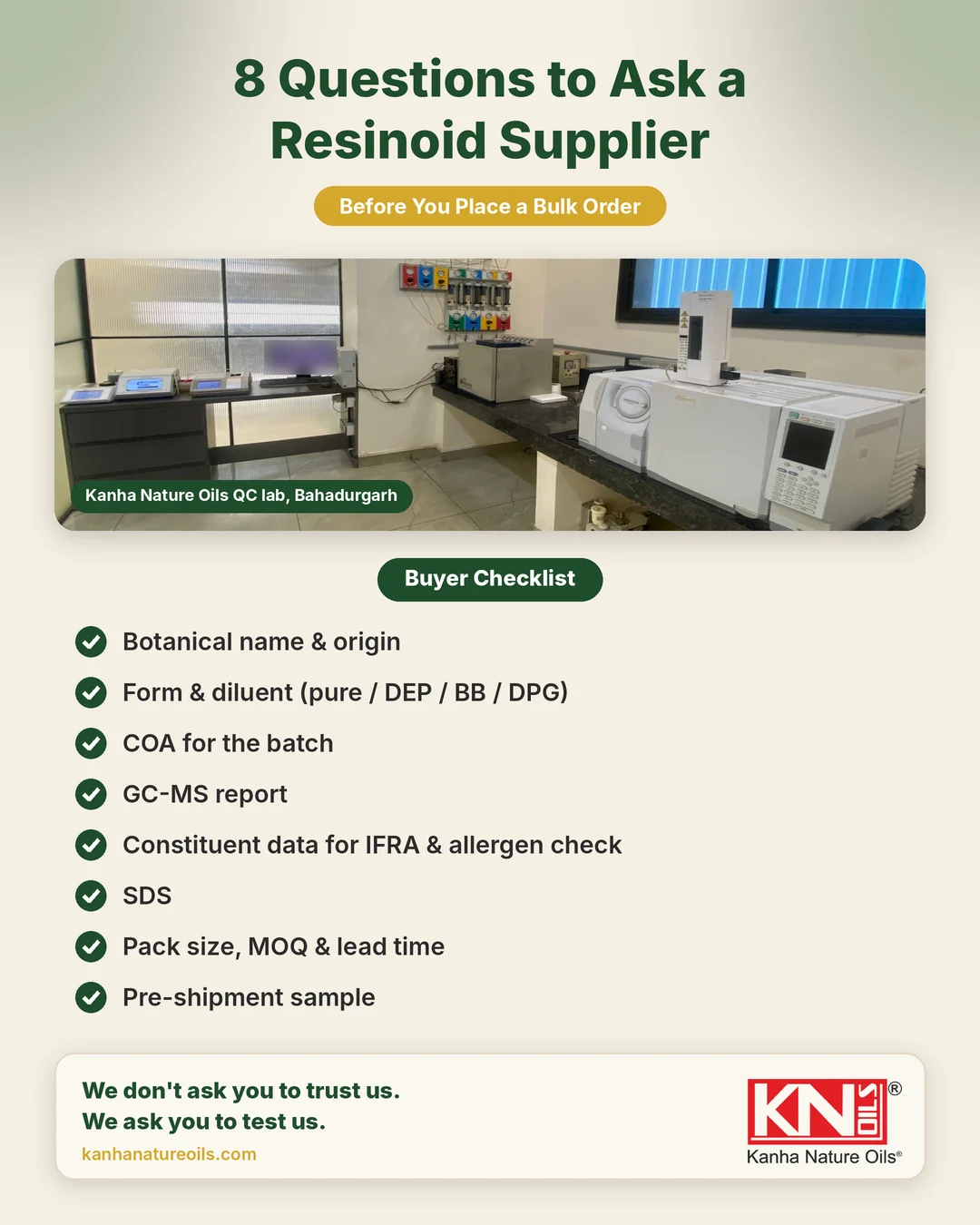
- Botanical name and origin of the resin, for example Styrax tonkinensis from Laos or Cistus ladanifer from Spain.
- Form and diluent: pure resinoid, or diluted in DPG, DEP, benzyl benzoate or another solvent, and at what percentage.
- Certificate of Analysis (COA) for the batch, with appearance, specific gravity and refractive index where relevant.
- GC-MS report showing the main constituents.
- Constituent data from the GC-MS report, so you can complete your own IFRA and allergen assessment. See which documents to ask for before you order.
- SDS (Safety Data Sheet, still widely called MSDS) for handling and shipping.
- Pack sizes, MOQ, lead time and basis. Confirm FOB or CIF; see FOB vs CIF for essential oil imports. Ask whether the material solidifies in cold weather and needs warming.
- A pre-shipment sample from the same batch you will receive.
FAQ
Is benzoin an essential oil or a resinoid?
A resinoid. It is made by solvent extraction of the resin, and products sold as “benzoin essential oil” are usually benzoin resinoid in a diluent so that it pours.
Why are resinoids used as fixatives?
They contain heavy, slow-evaporating molecules. In a perfume they slow the evaporation of lighter notes and help the fragrance last longer, while adding warmth of their own.
What is the difference between labdanum oil and labdanum resinoid?
Labdanum oil is steam-distilled from the leaves and twigs of the rockrose and smells fresher. Labdanum resinoid is a solvent extract of the gum and gives a darker, richer amber character.
How should resinoids be stored?
In tightly closed containers, away from heat and light. Many thicken or solidify in cold weather; warm the container gently and stir before use, rather than heating it directly.
Are resinoids soluble in alcohol?
Many dissolve only partly in perfumer’s alcohol and can leave a residue. Diluted grades, or resin absolutes, are easier to use in alcohol-based perfumes. Ask your supplier which grade suits your base.
Where can you buy resinoids in bulk from India?
Kanha Nature Oils manufactures and exports resinoids from Bahadurgarh, India, including benzoin, labdanum, olibanum, myrrh, styrax, galbanum, oakmoss, Peru balsam, tolu balsam and guggal. Browse the resinoids range.
About the author
Piyush Gupta is the Founder and CEO of Kanha Nature Oils, with 27 years in the fragrance and essential oils industry. He serves as Regional Secretary (North Zone) of FAFAI, Treasurer of EOAI and Vice President of Sugandh Vyapar Sangh, North Zone Delhi.
About Kanha Nature Oils
Kanha Nature Oils, based in Bahadurgarh, Haryana, manufactures and exports 700+ natural products, including essential oils, resinoids, absolutes, attars, oleoresins, hydrosols and carrier oils, to buyers in 60+ countries. The company is certified to ISO 9001:2015, ISO 14001:2015, WHO-GMP, HACCP, KOSHER and HALAL. A COA, GC-MS report and SDS are issued for the specific product and batch.
We don’t ask you to trust us. We ask you to test us.
Planning a bulk order? Request a free sample of any resinoid in this guide, with its batch documents.
Email: info@aromatherapyoil.in
Phone: +91 92549 73446
WhatsApp: +91 92549 73447
Unit-1: Adjoining HUDA Plot No. 682, M.I.E. Part-A, Bahadurgarh, Haryana – 124507
Unit-2: 677, M.I.E., Part-A, Bahadurgarh, Haryana – 124507
Sources: ISO 9235:2021, Aromatic natural raw materials — Vocabulary · IFRA Standard, oakmoss extracts · IFRA Standard, styrax · IFRA Standard, Peru balsam · ECHA, substances prohibited in EU cosmetics · ICAR Indian Horticulture, guggul (2023) · Mongabay India, Kachchh guggal (2023)