Kanha Nature Oils

Kanha Nature Oils

Kanha Nature Oils at in-cosmetics Asia 2026, Booth L78, BITEC Bangkok, 3–5 November 2026

Essential Oils Manufacturer from India: Meet Kanha Nature Oils at in-cosmetics Asia 2026 (Booth L78) Kanha Nature Oils, an essential oils manufacturer and exporter from Bahadurgarh, Haryana, is at in-cosmetics Asia 2026 until 5 November. You can find the team at Booth L78 (Fragrance Zone), BITEC, Bangkok. If you source essential oils, carrier oils or other aromatic raw materials for cosmetics, personal care or fragrance and have not worked with Kanha before, this guide tells you what to expect: 700+ products across 12 categories, supply to buyers in 60+ countries, and a COA, GC-MS report and SDS issued on request for the specific product and batch you are buying. It is written for buyers meeting Kanha for the first time. It covers who Kanha is, what it makes itself and what it does not, which documents you can ask for, what to bring to the booth and how a first order works. Event details at a glance Detail Information Event in-cosmetics Asia 2026 Dates 3–5 November 2026 Venue BITEC, 88 Debaratana Rd, Bang Na, Bangkok 10260, Thailand Booth L78 (Fragrance Zone) You will meet Piyush Gupta, Founder & CEO Book a time Request a meeting for 3, 4 or 5 November Booth L78 on the in-cosmetics Asia 2026 hall plan. Source: in-cosmetics Asia floor plan. Who is Kanha Nature Oils? An essential oils manufacturer from Bahadurgarh Kanha Nature Oils was founded in April 2010 and runs two manufacturing units opposite each other in M.I.E. Part-1, Bahadurgarh. The company makes essential oils, attars, oleoresins, hydrosols, floral absolutes, spice oils, carrier oils, natural isolates and herbal extracts for B2B buyers: importers, distributors, cosmetic and personal care manufacturers, formulators and fragrance companies. The founder, Piyush Gupta, has spent 27 years in the fragrance and essential oils trade. He is Regional Secretary (North Zone) of the Fragrances & Flavours Association of India (FAFAI), Treasurer of the Essential Oil Association of India (EOAI) and Vice President (North Zone) of Sugandh Vyapar Sangh. The company is a member of IFEAT, FAFAI and EOAI. According to the company, every batch is personally checked by the founder. The Kanha team with buyers at previous trade exhibitions. What you can source from Kanha The range is organised into 12 categories on the website: Essential oils (250+ oils) and essential oil blends Carrier oils and hydrosols Absolutes and attars Aroma oils, aromatic chemicals, extracts, fragrance oils, diffuser oils and gift packs Main product groups shown at Booth L78. The full range is on the website. Buyers typically use these ingredients in skincare, haircare, soaps, toiletries, fragrances and aromatherapy products. Which ingredient suits your product depends on your formulation, the rules in your market and the documents your compliance team needs, so treat the booth conversation as a specification discussion rather than a catalogue browse. What Kanha makes itself and what it does not New buyers rarely get a straight answer to this question, so here it is. Distillation plant at Kanha Nature Oils. Kanha runs steam distillation, solvent extraction, cold pressing and vacuum distillation (for isolates) at its own units, with blending, filtration, filling and storage on site. The company states the following figures for its Bahadurgarh facility: Item Company-stated figure Raw material processed 2–3 tonnes per day Nature-identical oils 3 tonnes per day Stainless-steel tank storage 4.3 tonnes (12 × 360 kg) In-house testing GC since 2010, GC-MS since 2024 Location About 35 km from Delhi IGI Airport, 50 km from ICD Tughlakabad Not everything is made in-house. CO₂ extracts are produced for Kanha by a partner unit. Lemongrass, palmarosa, Indian vetiver, cypriol and some rare oils are distilled beside the field, where the material is freshest, then verified in Kanha’s lab and shipped under Kanha’s COA. Whether an oil is rectified or nature-identical is stated in writing on your quote, so you know which is which before you order, not after. Documents and testing you can ask for If you sell into the EU, start with the IFRA and allergen documents. Every document below is issued on request, for the specific product and batch you are buying, not as a generic sheet. Document What it covers COA Certificate of Analysis for your product and batch GC-MS report Full chromatography report SDS Safety Data Sheet in the current GHS format (still widely called MSDS) IFRA conformity statement Against the amendment in force, with maximum use levels by product category EU fragrance allergen declaration Against the expanded list under Regulation (EU) 2023/1545 Pesticide residue report Accredited third-party lab, tested to the limits you work to Certificate of Origin Issued via India’s DGFT portal Kosher and Halal certificates Copies sent before you place an order Kanha is certified to ISO 9001:2015, ISO 14001:2015, WHO-GMP, HACCP, KOSHER and HALAL, and the certificate copies can be viewed on the event page. To learn how to read these reports before you meet, see the guides on reading a GC-MS report and COA, SDS, IFRA and allergen documents. The Kanha Nature Oils booth at in-cosmetics Asia, Bangkok. What to bring to Booth L78 A short brief saves time on both sides. If you can share it before the show, Kanha will bring relevant samples to Bangkok. Ingredient name, with the botanical name if you have it. Grade or specification: natural, rectified or nature-identical, and any limits your formulation sets. Intended application: the type of finished product. Estimated quantity and preferred pack size. Destination market, and the compliance documents it requires (IFRA, allergen declaration and so on). Your timeline for samples and a first order. A buyer meeting at the booth, with product samples and documents on the table. How a first order works Topic What to know Minimum order The export minimum is 1 kg for all oils. Anything above that depends on your requirement. Trial packs 100 ml trial packs are available so you can test before scaling up. Prices shown in INR on product pages are trial-pack prices, not bulk prices. Packaging Aluminium bottles, HDPE containers and 1 kg to 200 kg
Private label essential oils from India:

Private Label Essential Oils from India: MOQ, Packaging and Labelling Explained If you are looking for a private label essential oil manufacturer in India, three things decide whether the project works: how the minimum order quantity (MOQ) is structured, how the oil is packed for both the shelf and the shipment, and who legally carries the label in your destination market. Below are the checks to make before you pay a deposit. A note on where we stand: Kanha Nature Oils does not offer private labelling. We do not label or pack oils under any other company’s brand, whether the order is a single pack or bulk. Our oils are sold under the Kanha Nature Oils brand only. The checks below apply whichever supplier you choose. Short answer: Private label essential oil from India is often quoted with separate minimums: one for the oil itself (kilograms per oil) and one for packaging and printed labels (units per bottle size and label design). Once your brand name is on the label, your company carries the labelling responsibility in the destination market, so request the safety documents (COA, SDS, GC-MS, and IFRA and allergen statements where relevant) before artwork is finalised. What “private label” means, and what it does not Private label means a manufacturer supplies oil, filled and packed, that you sell under your own brand. Three nearby arrangements are often confused with it: White label: the same ready-made product is offered to several brands with only the label changed. Contract blending: the manufacturer develops a blend to your brief, which adds formulation, safety assessment and IFRA work. Bulk supply: you buy the oil and handle filling and branding yourself. Each changes the MOQ, lead time and responsibilities, so decide which you need before sending an enquiry. How MOQ works with a private label essential oil manufacturer in India An MOQ is rarely one number. Ask for each of these separately: MOQ type What it covers What to ask Oil MOQ Kilograms of each oil Is it per oil or per order? Does the price change by quantity? Packaging MOQ Bottles, closures, cartons Are stock bottles available, or is the packaging custom? Label MOQ Printed labels per design Who pays for artwork and printing, and what is the minimum print run? Sample or trial Pre-commitment testing Are samples charged, and are they drawn from a real batch? For reference, Kanha’s own minimum export order is 1 kg for every oil, across our essential oils and carrier oils ranges, with 100 ml trial packs for evaluation. That is a bulk-oil figure under our own brand. In private label, packaging and label print runs often set the real minimum, so a low oil MOQ alone does not tell you your cost per unit. You can see how we set out MOQ and pack sizes for a single oil in our bulk lavender oil guide. Packaging: two layers to plan Primary packaging is what your customer holds: bottle material (amber glass and aluminium are common), closure type, tamper evidence and fill volume. Citrus and other terpene-rich oils can degrade some plastics and rubber, so ask which closure and liner materials the supplier has checked against your specific oil. Transport packaging is where many first-time buyers are caught out. Many essential oils, especially those with a low flash point, are classified as flammable liquids (Class 3) in transport. Air freight can then require dangerous-goods packaging, marking and paperwork. The classification depends on the oil and the quantity, and it is stated in the transport section of the SDS. Confirm it with your freight forwarder before you commit to a shipping route, and settle your Incoterms early: our guide to FOB or CIF for essential oil shipments explains how the choice splits freight and risk. Labelling: two label layers, and who is responsible Most private label oils need two kinds of information on or with the pack. Label layer What it covers Rule Hazard label (EU CLP) Supplier name, address and phone, nominal quantity, product identifier, pictograms, signal word, hazard and precautionary statements, in the language of the member state where it is sold. Hazardous mixtures such as blends may also need a UFI. Regulation (EC) 1272/2008 Cosmetic label (if sold as a cosmetic) A Responsible Person with a name and address on the label, plus declaration of fragrance allergens above set thresholds. Regulation (EC) 1223/2009, Regulation (EU) 2023/1545 US cosmetic label FDA labelling rules under MoCRA, including a fragrance-allergen labelling rule that FDA is required to issue. Check its current status before finalising US artwork. FDA MoCRA The central point for a private label buyer is that putting your name on the label moves responsibility to you: Under the EU Cosmetics Regulation, a distributor who places a product on the market under its own name or trademark becomes the Responsible Person. Under CLP, in force since 1 July 2026, a substance or mixture cannot be placed on the EU market unless an EU-established supplier is identified and meets the CLP obligations. CLP already requires the supplier’s name and address on the label. The EU allergen list was expanded from 26 to 82 substances by Regulation (EU) 2023/1545. It has applied to new products since 31 July 2026; products already on the market have until 31 July 2028. A new product shipped to the EU today must already comply. Which regime applies depends on how you market the product. Therapeutic claims can move it into a stricter category, so settle your claims with a regulatory adviser first. Documents to request before you approve artwork Your label is only as accurate as the paperwork behind it. Ask for these for the batch you are buying: COA (Certificate of Analysis) for the batch. Our guide to the four documents to demand before you order covers COA, SDS, IFRA and allergen statements together. GC-MS report, which shows the composition. Our guide to reading a GC-MS report explains what to look for. SDS (Safety Data Sheet, still widely called

IFRA 51st Amendment essential oils compliance guide by Kanha Nature Oils

IFRA 51st Amendment: Which Oils It Affects and What Your Supplier Must Send You   IFRA 51st amendment essential oils compliance comes down to two questions. First, is any oil you buy affected? IFRA’s Standards restrict individual fragrance ingredients, so an essential oil is affected only through the constituents it contains, and the public notifications for the 51st Amendment do not name oils. Second, can your supplier prove it? Ask for a batch-specific IFRA Certificate of Conformity that names the amendment it was written against, plus a COA with GC-MS data. This guide explains what the 51st Amendment changed, how to work out whether a given oil is exposed, which documents to ask for, and why the 52nd Amendment, which names eight oils directly, already matters for anyone buying in 2026. What did the 51st Amendment change? IFRA notified the 51st Amendment on 30 June 2023. According to IFRA: What changed Count New Standards restricting fragrance ingredients 47 New Standard specifying the use of a single ingredient 1 Ingredient prohibited (safe levels could not be set) 1 Existing Standards revised 11 IFRA Standards in total 263 All IFRA Standards are based on safety assessments by RIFM (the Research Institute for Fragrance Materials) and reviewed by an independent expert panel. Secondary sources quote slightly different counts of revised Standards, so use IFRA’s own figures when you cite them. The compliance dates, as reported by UL, Obelis and Lisam, are: New creations Existing creations Prohibited ingredient 30 Aug 2023 30 Jul 2024 Restricted or specified ingredients 30 Mar 2024 30 Oct 2025 These dates apply to the supply of fragrance mixtures, not to finished products already on shelves. As of October 2026 every one of them has passed, and IFRA’s Standards page still lists the 51st as the latest amendment. IFRA Standards are an industry safety programme rather than legislation, but many brands, retailers and importers write them into purchase specifications. Which essential oils does the 51st Amendment affect? No public IFRA summary of the 51st Amendment gives a list of affected oils. The logic runs the other way. A Standard sets a maximum level for a chemical, and an essential oil, which is a natural complex substance, is affected when it contains enough of that chemical to push the finished product past the limit for its category. A summary from the testing and consulting group Wessling names five revised ingredients whose maximum levels were lowered: eugenol, geraniol, farnesol, methyleugenol and estragole. All five occur in natural materials. As general composition knowledge, not an IFRA list: Constituent Oils where it is commonly a major component Eugenol Clove bud and clove leaf oils Geraniol Palmarosa, rose geranium and rose-type oils Methyleugenol Basil, nutmeg and pimento (allspice) oils, and in smaller amounts rose-type oils Farnesol Usually a minor constituent of neroli, rose-type and ambrette seed oils Estragole Basil (methyl chavicol type) and tarragon oils Composition shifts with species, origin, harvest and distillation, so this table only points you toward oils worth checking. The deciding evidence is the GC-MS composition of the batch in front of you. The GC-MS buyer’s guide shows how to read the percentages. The limit then depends on the IFRA category, which is why a certificate lists levels per category. Constituent table only. The full certificate also carries the amendment number and category limits. IFRA compliance matters most when an oil goes into perfumes, cosmetics, candles or other consumer products. For cosmetic formulators, see our notes on essential oils for cosmetic formulation. IFRA 51st Amendment essential oils compliance: what your supplier must send you These are the documents a careful buyer should require before payment. Document What to check on it IFRA Certificate of Conformity Names the 51st Amendment; product name and code; issue date; maximum use level for each IFRA category; the limiting (binding) constituent behind each level COA with GC-MS Batch or lot number matches your consignment; constituent percentages that support the certificate Allergen declaration For cosmetics sold in the EU or UK: covers the expanded list under Regulation (EU) 2023/1545 (more than 80 substances, up from 26) SDS (Safety Data Sheet, still widely called MSDS) 16-section format; classification consistent with the composition Red flags worth acting on: Red flag Why it matters A certificate that cites an older amendment number, or no amendment at all It may not reflect the Standards now in force No issue date, no category table, or only a generic “IFRA compliant” statement There is nothing you can check against your product category A certificate not tied to the specific product, and ideally the batch, being shipped Composition varies by batch, so conformity can too A COA whose composition could not produce the maximum levels on the certificate The two documents contradict each other The full checklist is in our guide to the four documents to demand before you order. To check the oil itself, see the seven adulteration tests. What is coming: the 52nd Amendment A certificate written against the 51st is correct today but will not stay current. According to IFRA’s end-of-consultation letter, published 31 August 2026, the 52nd Amendment includes: Change Detail New restriction Standards 48, for dermal sensitisation; 37 of them also assess systemic toxicity Revised restriction Standards 15, after updated RIFM assessments Musk ketone Revised from a specification-only Standard to one with restrictions Acetylated vetiver oil Revision adding a specification: the material should be stabilised by adding 1% alpha-tocopherol at the time of production Phototoxicity Three Standards revised: the renamed “Furocoumarins in Natural Complex Substances” (formerly “Citrus oils and other furocoumarin containing essential oils”), Tagetes oil and absolute, and Methyl N-methylanthranilate The eight oils named in the 52nd Amendment The renamed furocoumarin Standard leads to the withdrawal of eight oil-specific Standards: Oil Standard being withdrawn Angelica root oil Bergamot oil, expressed Bitter orange peel oil, expressed Cumin oil Grapefruit oil, expressed Lemon oil, cold expressed Lime oil, expressed Rue oil Withdrawn here means these eight Standards are folded into the renamed furocoumarin Standard. It does not mean the

Bulk essential oil drums and bottles on a table, ready for adulteration testing before payment

Seven Tests That Catch Adulterated Essential Oil Before You Pay By Kanha Nature Oils · Published 12 October 2026 If you are working out how to test essential oil adulteration in bulk, the short answer is that no single test is enough. Smell and bench checks catch only crude cases. Reliable detection comes from layering batch documents, physical constants, GC-MS and, for high-value oils, chiral and isotope analysis, all run on a sample from the exact batch you will receive. This guide covers seven tests in the order a procurement team can run them, what each can and cannot detect, and how to tie payment to the results. Quick answer: the seven tests at a glance # Test Best at catching Relative cost 1 Batch-linked documents Missing or mismatched batch records Low 2 Sensory check against a reference Obvious off-notes, gross substitution Low 3 Physical constants (density, refractive index, optical rotation) Dilution with carrier oil or solvent Low–medium 4 GC-MS profile Foreign peaks, wrong constituent ratios, cheaper oil mixed in Medium 5 Chiral GC Synthetic copies of natural compounds Medium–high 6 Isotope ratio analysis Synthetic or differently sourced carbon High 7 Shipment-to-sample match Switching between approved sample and delivered lot Low–medium The seven tests, in the order a buyer can run them. What adulteration looks like in a bulk lot Adulteration usually takes one of four forms: a cheaper essential oil blended in, a synthetic or nature-identical compound added to lift a key constituent, a carrier oil or solvent used as diluent, or a reconstituted oil built from fractions and isolates. Each hides from different tests, which is why no single test covers all four. The practical limit worth knowing: gas chromatography only sees volatile compounds. A non-volatile adulterant such as a vegetable oil stays in the injection port and never appears on the chromatogram, so GC-based methods have serious limits there (Biomed J Sci & Tech Res review). Synthetic copies of natural molecules pose the opposite problem: the molecule is identical, so standard GC-MS cannot separate it from the natural one. Test 1: Check that every document is tied to the batch Before any lab work, ask for the COA, the GC-MS report with full chromatogram and peak table, and the SDS (Safety Data Sheet — still widely called MSDS). Confirm that product name, botanical name, and batch number match across all of them and the drum labels. Documents do not prove purity; they record what the supplier measured. A missing batch number, or an identical GC-MS report across different batches, is a reason to pause. For what each document should contain, see our guide to COA, SDS, IFRA and allergen documents. Test 2: Compare smell and appearance against a sealed reference Keep a sealed reference from a batch you have already approved. On a smelling strip, compare the new sample at top note, after a few minutes and at dry-down, then compare colour and clarity. Without a reference, smell is opinion, and skilled blending can fool it, so treat it as a screen, never a pass. Test 3: Measure physical constants Relative density, refractive index and optical rotation are quick, inexpensive measurements. ISO publishes a method for each (ISO 279, ISO 280 and ISO 592; the older 1976 and 1981 editions are withdrawn, so cite the current ones), and the ISO standard for each oil lists the expected range (ISO essential oils catalogue). A result outside the range for that species suggests dilution or substitution. A carefully balanced adulterant can still land inside it, so a pass narrows the field but does not clear the lot. Refractive index is one of the quick physical-constant checks. Test 4: Run a GC-MS profile and read it against a reference GC-MS is the backbone of essential oil quality control. ISO 11024 (currently under revision) explains that a chromatographic profile evaluates the relative proportions of constituents rather than their true concentrations, and that it sits alongside physico-chemical characteristics as a quality specification (ISO 11024-1). In practice, look for three things: Constituents that should be present but are missing or far outside the usual range Peaks that do not belong to the species, which can point to an added solvent or foreign oil Ratios between related compounds that look unnatural A GC-MS report is only as useful as your ability to read it; our buyer’s guide to GC-MS reports walks through peak tables, co-elution and retention index. Illustration only, not an actual test report. Test 5: Use chiral GC for high-value oils Many natural aroma compounds exist in one dominant mirror-image form, while synthetic versions are often a near 50:50 mix. Chiral GC separates the two forms and measures their ratio. A study of mastic oil products showed how this works: the (+)/(−) α-pinene ratio in authentic oil was characteristic, and several commercial products contained far more (−)-α-pinene, pointing to added racemic material (Planta Medica, 2008). The same approach is reviewed for bergamot and other citrus oils (Bonaccorsi et al.). It needs a laboratory with the right columns and reference data, so reserve it for high-value oils or cases where GC-MS looks right but something seems off. Test 6: Add isotope ratio analysis when the stakes justify it Isotope ratio mass spectrometry measures the carbon (and sometimes hydrogen) isotope signature of individual compounds. Synthetic compounds and natural ones formed through different plant pathways carry different signatures, so GC-C-IRMS can reveal added material that GC-MS cannot see. Published work combines chiral and isotope data for authenticity control of citral- and citronellal-containing oils (Anal Bioanal Chem). It is the most expensive test here and needs authentic reference data, so use it for premium oils, large contracts or a disputed lot. Test 7: Match the delivered lot to the approved sample An approved sample only protects you if the delivered drums match it, so the gap between the two is a real risk. Before releasing final payment: Draw a representative sample from the delivered containers following ISO 212:2007 (Essential oils — Sampling). Run the fast

KN Oils Global Shipping Operations

FOB or CIF for Essential Oil Shipments from India: What Changes in Your Landed Cost By Piyush Gupta, Founder & CEO, Kanha Nature Oils · 27 years in the fragrance and essential oils industry · Regional Secretary (North Zone), FAFAI · Treasurer, EOAI · Vice President, Sugandh Vyapar Sangh North Zone Two Indian suppliers quote you for the same bulk lavender oil. One says FOB, the other says CIF, and the CIF price looks higher. Which is cheaper once the drums reach your warehouse? For most buyers comparing FOB and CIF on an essential oil import from India, the short answer is this. FOB gives you control of freight, insurance and the carrier, and usually the lower total if you have a reliable forwarder. CIF is simpler when you do not, but you pay for freight you cannot see and get only minimum insurance. Where you import also matters: the US charges duty on a value that excludes freight, while the EU charges it on a value that includes it. This guide shows exactly what each term covers, where risk moves, how each one changes your landed cost, and when neither is the right term at all. FOB vs CIF at a glance Both are Incoterms 2020 rules published by the International Chamber of Commerce. The cost split is the main difference. FOB vs CIF: who handles what Item FOB (Free On Board) CIF (Cost, Insurance and Freight) Named place Port of shipment in India, e.g. FOB Nhava Sheva Port of destination, e.g. CIF Rotterdam Inland transport to Indian port Seller Seller Indian export clearance Seller Seller Loading on the vessel Seller Seller Ocean freight Buyer Seller Cargo insurance Buyer’s choice Seller, at minimum cover Who chooses the carrier Buyer Seller Destination port charges, import clearance, duty, tax Buyer Buyer Risk passes to buyer When goods are on board in India When goods are on board in India The last row surprises many buyers. Under both terms the risk is yours from the moment the drums are loaded in India. CIF moves cost, not risk. Where risk moves, and why CIF insurance may not be enough Under both FOB and CIF, risk passes to the buyer once the goods are on board in India. Because risk transfers at loading under both FOB and CIF, any loss at sea is your claim to make. Under CIF the seller must insure the goods for you, but Incoterms 2020 sets that cover at the minimum. The seller insures at least 110% of the contract value under Institute Cargo Clauses (C), unless you agree otherwise. Clauses (C) is a named-perils policy. It covers events such as fire, sinking and collision, not all loss. For essential oils, the realistic losses are leaking drums, contamination and temperature damage, which sit outside that narrow cover. If you buy CIF, ask the supplier to quote Institute Cargo Clauses (A), or top up the cover yourself. If you buy FOB, your own policy or your forwarder’s open cover applies from loading. How FOB and CIF change your landed cost Landed cost is everything you pay until the oil is in your warehouse: product price inland transport and export clearance in India (in the price under both terms) ocean or air freight cargo insurance destination port and terminal charges customs duty and import tax customs broker fees delivery to your warehouse Only freight and insurance change hands between the two terms. Everything after the destination port is yours either way. Worked example on one essential oil consignment The figures below are illustrative, not quotes or real tariff rates. Illustrative cost to destination port: FOB route vs CIF route Line FOB route CIF route Supplier price USD 20,000 FOB Nhava Sheva USD 22,300 CIF destination port Ocean freight booked by your forwarder USD 1,800 Included in price Insurance, Clauses (A) USD 60 Included, Clauses (C) only Cost to destination port USD 21,860 USD 22,300 In this example, the CIF quote costs USD 440 more and carries thinner insurance. The CIF quote carries USD 440 more than the FOB route, plus thinner insurance. That gap is common, because the seller’s freight booking can include a margin you cannot see. It can also go the other way when the seller ships volume and has better contract rates. The point is to compare like with like: ask the CIF supplier to show freight and insurance as separate lines on the invoice. The cost a CIF quote does not show Under CIF the seller chooses the carrier, often a consolidator (NVOCC) that offers the seller a low freight rate. Some consolidators recover that margin at destination, billing the buyer for terminal handling, documentation, delivery order release and de-stuffing. You did not choose that carrier, so you have little room to negotiate, and those charges can exceed the saving the CIF quote appeared to offer. Before accepting a CIF quote, ask which carrier or consolidator will be used and request an estimate of its destination charges at your port. Your customs duty base depends on where you import This is the part most generic Incoterms guides skip. United States. US Customs and Border Protection appraises most imports at transaction value, which excludes international freight and insurance under 19 CFR 152.103. If your invoice is CIF, those costs need to be shown separately to be deducted. European Union. Under the Union Customs Code, transport and insurance costs up to the EU border are added to the customs value. Duty is effectively charged on a CIF value, whichever term you bought on. Take the FOB route from the example above and a hypothetical 5% duty rate. A US importer pays duty on USD 20,000 (USD 1,000). An EU importer on the same FOB route pays duty on roughly USD 21,860 (about USD 1,093), because freight and insurance to the border are added. On the CIF route, the EU duty base is the full USD 22,300 (about USD 1,115). A US importer buying CIF can still deduct freight

Bulk Lavender Oil from India: MOQ, Pack Sizes, Lead Time and Shipping Terms

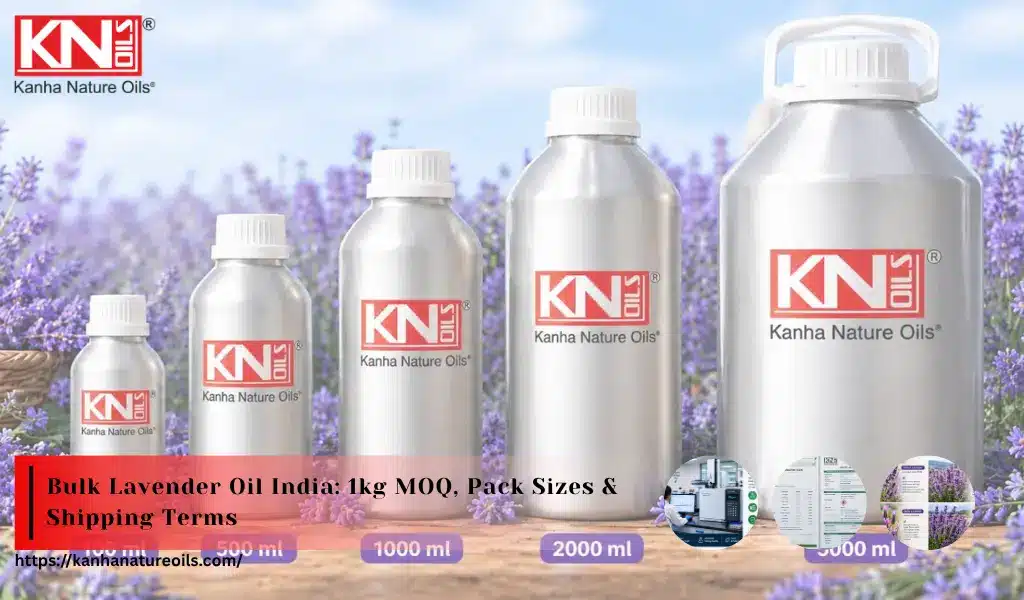
Bulk Lavender Oil, Manufactured and Exported from India: MOQ, Pack Sizes, Lead Time and Shipping Terms By Kanha Nature Oils · CEO: Piyush Gupta · Last reviewed 30 September 2026 If you have typed “bulk lavender oil supplier India MOQ” into Google, you need four things before you can compare quotes: the minimum order quantity, the pack size, the lead time and the shipping term. The short answer: our minimum order quantity is 1 kg, with higher volumes as per your requirement. If you want to test the oil before committing even to that, we ship 100 ml trial packs, both within India and for export. Pack sizes are flexible and based on order volume, including bulk quantities above 25 kg. Lead time is 2 working days from order confirmation to dispatch, with shipping and transit time on top. Our lavender oil is sourced from Bulgaria, processed and manufactured at our facility in Bahadurgarh, Haryana, and exported from India. This guide explains how each of the four terms works, what changes them, and what to put in your RFQ so the first reply is a usable quote. Quick Reference Term What we offer Confirm in your quote Origin Sourced from Bulgaria; processed and manufactured in Bahadurgarh, Haryana; exported from India Species and lot for your quote Trial pack 100 ml, ships within India and for export — priced as a trial pack, not a bulk rate Whether it’s available for the grade you want MOQ 1 kg — higher volumes as per buyer requirement Pricing tiers for your target quantity Pack sizes Flexible, based on order volume — aluminium bottles, HDPE containers and industrial drums, including bulk quantities above 25 kg Exact pack size for your grade and quantity Lead time 2 working days from order confirmation to dispatch (shipping and transit time not included) Dispatch date and estimated arrival date Shipping Worldwide export. Sea: ICD Dadri – Nhava Sheva (JNPT). Air: Indira Gandhi International Airport, New Delhi Incoterm, transport mode, destination port Bulk Lavender Oil Supplier India MOQ: What to Expect Many bulk suppliers set high MOQs because filling, packing, batch analysis and paperwork carry fixed costs. We keep that bar low: our minimum order quantity is 1 kg, with higher volumes as per buyer requirement — we don’t add a separate step-up MOQ. This applies whether you want French lavender, Bulgarian lavender, spike lavender or lavandin. A practical way to start: Order a 100 ml trial pack if you want to test before committing even to 1 kg. Place your first order — 1 kg minimum — once you’ve confirmed the specification and batch documents for your grade. Scale up to drums once the result is repeatable in your process. For repeat or larger orders, ask about pricing tiers — the entry point stays 1 kg. Pack Sizes: From Bottles to 200 kg Drums Pack format Where it usually fits (general guidance) What to confirm Aluminium bottles (incl. 100 ml trial pack) Trial runs, small-brand batches, R&D Available sizes for your grade HDPE containers Mid-volume production Compatibility with your process Industrial drums (up to 200 kg) Regular manufacturing, repeat supply, bulk quantities above 25 kg Exact size for your grade and quantity Pack sizes are flexible and based on order volume, including bulk quantities above 25 kg — there is no single fixed list. Confirm the exact size for your lavender grade and quantity in your quote. Once a large pack is opened, decanting into smaller airtight containers limits air exposure. Store sealed, cool and away from light. Lead Time: What “Processing Time” Does and Does Not Cover Our lead time is 2 working days from order confirmation to dispatch. That figure covers order preparation and dispatch only — shipping and transit time are not included and come on top. A full lead time has six stages: Order and payment confirmation Stock check or lot allocation Batch QC and documents (COA, GC-MS, SDS — Safety Data Sheet, still widely called MSDS) Packing, with dangerous-goods packaging if required Export clearance and handover to the forwarder Transit and import clearance Stages 1 to 5 sit mostly with the supplier. Stage 6 depends on transport mode, route and destination customs. Ask the supplier for a ready-to-ship date and ask your forwarder for transit time separately. Lavender is a seasonal crop distilled after the summer harvest, so availability of a particular origin or lot can vary through the year. Ask whether the quoted oil is in stock. Shipping Terms: Choosing an Incoterm for Lavender Oil Incoterms are the International Chamber of Commerce’s standard trade terms. Incoterms 2020 is the current edition. They set who pays for freight, who clears customs and where risk passes from seller to buyer. Rule Mode Who arranges main freight Risk passes to buyer Suits EXW Any Buyer (including export clearance) At the supplier’s premises Buyers with their own forwarder and export know-how FCA Any Buyer On handover, export-cleared, to buyer’s carrier Any transport mode, including containers CPT Any Seller (freight only) On handover to the first carrier Buyers who want the seller to book freight, no insurance needed CIP Any Seller, with all-risk insurance On handover to the first carrier Container cargo where the seller books freight and insurance DAP Any Seller At the named destination Delivery to the buyer’s door, duties unpaid DPU (formerly DAT) Any Seller At the named destination, unloaded Buyers who need the goods unloaded at destination DDP Any Seller (including import duties) At the named destination Buyers who want a fully landed, duty-paid price FAS Sea only Buyer Alongside the vessel Bulk or break-bulk sea cargo, rarely used for drums FOB Sea only Buyer Once loaded on the vessel Sea freight only CFR Sea only Seller (freight only) Once loaded on the vessel Sea freight when the seller books freight but not insurance CIF Sea only Seller, with minimum insurance Once loaded on the vessel Sea freight when the seller books freight and light insurance FOB, CFR and CIF apply only

QC technician working at Kanha Nature Oils quality-control lab bench

COA, MSDS, IFRA and Allergen Statements: The Four Documents to Demand Before You Order Before placing an order with an essential oil supplier, ask for four documents: a Certificate of Analysis, an MSDS/SDS, an IFRA statement, and an allergen declaration. Together, these four papers answer the questions that actually determine whether an oil is usable — what’s in it, how to handle it safely, whether it’s cleared for the application you have in mind, and what you’re legally required to put on a label. A supplier who can produce all four without delay is telling you something about how the business is run before you’ve spent a single dollar. This isn’t a compliance formality. Buyers searching for essential oil COA SDS IFRA documents supplier are usually a few weeks from placing a real order and want to know what each document actually proves — and what it doesn’t — before they commit to a shipment. It’s the same due-diligence instinct behind how Kanha Nature Oils runs its own manufacturing and export operation — testing before dispatch, not after a complaint. The Four Documents, At a Glance Document What It Proves Who Usually Asks For It COA (Certificate of Analysis) Batch-specific identity and purity — GC-MS profile, physical parameters, sometimes microbial or heavy-metal data Formulators, QA teams, resellers verifying authenticity MSDS / SDS Hazard classification, handling, storage, and emergency information Freight forwarders, customs, warehouse and EHS teams IFRA Statement Confirms the oil complies with current IFRA usage restrictions for fragrance/cosmetic applications Cosmetic, perfumery, and fragrance-compound manufacturers Allergen Statement Lists allergenic components present under the expanded EU list (Regulation (EU) 2023/1545), with concentrations where required Anyone formulating a product sold in the EU/UK 1. Certificate of Analysis (COA) — Proof of What’s Actually in the Drum A COA is batch-specific. It should be tied to the exact batch or lot number on the drum you’re receiving, not a generic specification sheet reused across every shipment. A proper COA for an essential oil typically includes the GC-MS profile (the major constituents and their percentage ranges), physical parameters such as specific gravity, refractive index, and optical rotation, and — depending on the oil — microbial or heavy-metal data. If you want to go deeper on reading the chemical data itself, see how to read a GC-MS report for essential oils — the COA’s purity claim is only as good as the GC-MS behind it. The batch number on the COA is what lets you trace a specific drum back to a specific production run if a quality question comes up later. A COA without a batch number tied to your shipment isn’t fully verifiable — ask the supplier to confirm the match before the goods ship. 2. MSDS/SDS — Proof It Can Be Handled and Shipped Safely The Material Safety Data Sheet — now more commonly formatted as an SDS (Safety Data Sheet) under the GHS 16-section format — covers hazard classification, first-aid measures, fire-fighting guidance, handling and storage requirements, and transport information. This is the document your freight forwarder, customs broker, and warehouse team will actually use; it’s less about the oil’s aromatic or therapeutic properties and more about how it behaves as a chemical cargo. Many essential oils are classified as flammable liquids or skin/eye irritants under GHS, which affects packaging, labeling, and shipping class. If your supplier’s paperwork is still labeled “MSDS” in the older format rather than the current 16-section SDS layout, it’s worth asking whether an updated version is available — some customs authorities now expect the current format. 3. IFRA Statement — Proof It’s Cleared for Use in Finished Products The International Fragrance Association (IFRA) publishes Standards that restrict or prohibit certain materials, or cap their concentration, in finished fragrance and cosmetic products. An IFRA Certificate or Statement of Conformity confirms that the oil, as supplied, is compatible with current IFRA Standards for the intended use category. This matters most if you’re formulating perfumes, fine fragrance, cosmetics, or scented consumer products — an oil that’s perfectly fine as a raw material can still be restricted at certain usage levels in a finished product. If you’re buying purely for aromatherapy diffusion or as a raw trading commodity, an IFRA statement is less critical, but most reputable suppliers maintain one regardless, since it’s frequently the first document a downstream buyer will ask for. 4. Allergen Statement — Proof of What Must Be Declared on a Label If your finished product will be sold in the EU, an allergen statement is not optional. Annex III of the EU Cosmetics Regulation (EC) No 1223/2009, as amended by Regulation (EU) 2023/1545, requires listed fragrance allergens to be named on the label when they exceed 0.001% in leave-on products or 0.01% in rinse-off products. The 2023 amendment expanded the list from 26 to more than 80 substances, with a transition period running to 2028 for products already on the market. Check that your supplier’s declaration covers the current expanded list, not the older 26. Kanha Nature Oils’ allergen declarations cover the full expanded list, analysed by GC-MS. Buyers selling into the UK should confirm the current UK requirement separately. This is a naturally occurring-components declaration, not a claim that the oil contains added allergens — many of these compounds are simply part of the oil’s natural chemistry. But without this statement, you cannot correctly complete your own product’s labeling, and an incomplete label is a compliance gap that surfaces at the worst possible time — during a customs inspection or a retailer’s compliance audit. Why These Four, and Not More or Fewer Buyers sometimes ask for additional paperwork — ISO 9001:2015, ISO 14001:2015, WHO-GMP, HACCP, KOSHER, HALAL certificates, country-of-origin declarations — and those have their place depending on the product. But COA, MSDS/SDS, IFRA, and allergen statement form the baseline because each one answers a distinct question no other document covers: identity and purity (COA), handling safety (MSDS/SDS), fragrance-use compliance (IFRA), and label compliance (allergen statement). Asking for fewer than these four leaves

How to Read an Essential Oil GC-MS Report

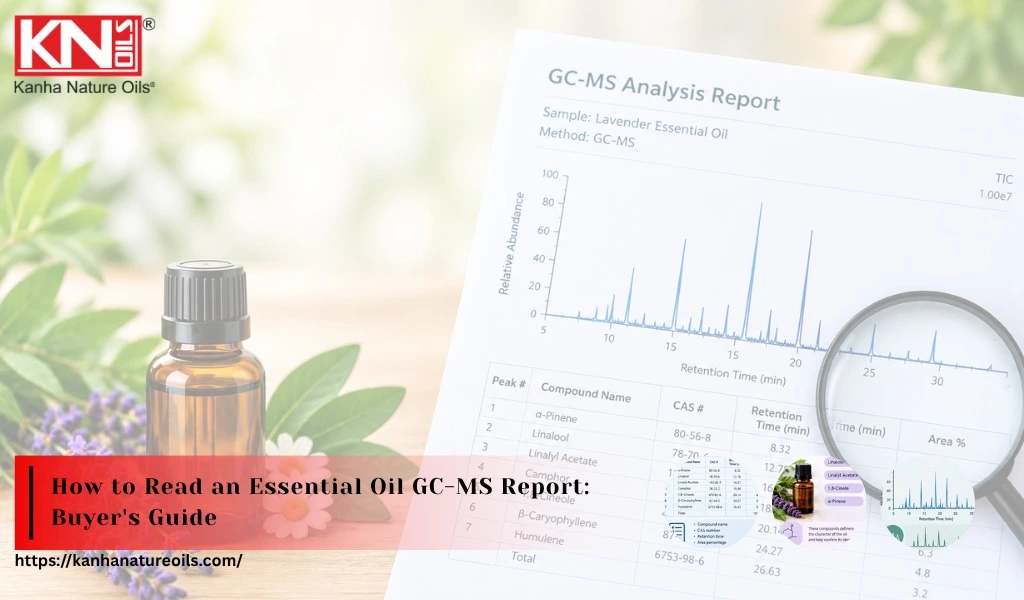
How to Read a GC-MS Report for Essential Oils: A Buyer’s Guide Last reviewed: September 2026 · By Piyush Gupta, Founder & CEO, Kanha Nature Oils · 27 years of industry experience · FAFAI Regional Secretary, North Zone · EOAI Treasurer How to read a GC-MS (Gas Chromatography–Mass Spectrometry) report for an essential oil, in short: look at the peak table, identify the compounds expected to be characteristic of that particular oil, compare their reported levels with appropriate published specifications or reference ranges, and confirm that the report’s botanical name, batch number and date match the material you are actually receiving. A GC-MS report helps show which volatile compounds are present and their approximate relative abundance. It does not, by itself, prove geographical origin, extraction method, organic certification, overall purity, or safety. This guide explains how to read a GC-MS report step by step so you can evaluate an essential-oil supplier’s documentation more intelligently. What Does a GC-MS Report Actually Tell You? GC-MS combines gas chromatography, which separates volatile compounds, with mass spectrometry, which helps identify those separated compounds from their mass-spectral characteristics. The result is a report listing compounds detected in the sample, their retention times and their estimated relative abundance. For a buyer, this matters because an essential oil’s chemical profile should be consistent with the botanical species, plant part, origin and production characteristics claimed for the material. For example, genuine lavender oil is expected to contain characteristic levels of compounds such as linalool and linalyl acetate. If a report for a product sold as lavender shows an unusual profile, that is a reasonable reason to ask the supplier for an explanation. MS vs. FID: Identification and Quantification A common misconception is that MS identifies while FID always quantifies. In practice, the mass spectrometer is primarily used for compound identification, while quantitative work may be performed using the MS detector itself or, in many laboratory workflows, with a separate flame ionization detector (FID). FID is widely used for quantitative GC analysis because its response to many organic compounds is useful for relative quantification. However, the exact detector configuration and calculation method depend on the laboratory and analytical method. So when reading a report, do not assume that the words “GC-MS” automatically tell you which detector was used for quantification. If the quantitative method matters to your purchase, ask the laboratory or supplier for the analytical method. A GC-MS report is a chemistry document, not a marketing document. The useful question is not simply whether a report exists, but whether the reported chemistry is appropriate for the specific botanical material being supplied. What Are the Main Parts of a GC-MS Report? Most essential-oil GC reports contain several core elements. What Is the Chromatogram? The chromatogram is the graph showing peaks across a retention-time axis. Each peak represents a detected component or, in some cases, more than one component if compounds co-elute under the analytical conditions. For quantitative interpretation, peak area is generally more useful than peak height. Peak area represents the integrated detector response over the time that the compound elutes. Peak height alone can give a misleading impression because two peaks with different widths can have very different areas. However, peak area should not be interpreted as an exact weight percentage unless the analytical method and calibration support that conclusion. In many essential-oil reports, area percentage is used as an estimate of relative composition. A Large Peak Is Not Automatically a Red Flag Some genuine essential oils naturally have one strongly dominant constituent. For example: Wintergreen oil is typically dominated by methyl salicylate. Cassia and cinnamon bark oils are commonly rich in cinnamaldehyde. Eucalyptus globulus oil is commonly rich in 1,8-cineole. Carrot seed oil can have a high proportion of carotol. Therefore, a chromatogram with one very large peak is not, by itself, evidence of adulteration. The correct question is: Does the overall profile match the expected chemistry of this particular botanical material? What Is the Peak Table? Below the chromatogram is normally a table listing the detected peaks. Common columns include: Peak number Retention time Compound name CAS number, where available Area % Sometimes Height % Sometimes Retention Index (RI) Sometimes identification quality or library-match information The peak table is usually more useful to a buyer than simply looking at the chromatogram. Co-elution: One Peak Can Contain More Than One Compound Closely related compounds can sometimes co-elute, meaning that they leave the GC column at nearly the same time and appear as a single chromatographic peak. This can happen even with commonly used analytical columns. If separating individual isomers is important for your application, ask the laboratory whether a different column, confirmatory method, or more advanced technique was used. What Is Retention Time? Retention time (RT) is the time taken for a compound to travel through the GC system before being detected. RT can be useful when comparing results generated using the same or closely matched analytical conditions. However, raw retention time should not be treated as a universal identifier across laboratories. It can change depending on factors such as: Column chemistry Column dimensions Carrier-gas flow Oven-temperature programme Instrument configuration Other analytical conditions Therefore, the same compound can legitimately have different retention times on two laboratories’ reports. For cross-laboratory comparison, buyers should pay more attention to retention indices (RI), together with mass-spectral identification and the expected chemical profile, rather than comparing raw RT values alone. What Are the Compound Name and CAS Number? The compound name identifies the substance detected in the analysis. Examples include: Linalool Linalyl acetate Eugenol Limonene Citral 1,8-Cineole A CAS number is a standardized registry identifier that can help cross-check chemical identity. CAS numbers are useful because compound names can sometimes vary slightly between laboratories, software libraries or reporting conventions. What Is Peak Area Percentage? Peak area percentage represents the relative detector response contributed by a particular peak compared with the total integrated peak area used in the calculation. It is widely used to estimate the relative composition of essential oils, but

Scroll to Top