Kanha Nature Oils

Kanha Nature Oils

Kanha Nature Oils – Fragrance Oils Manufacturer & Exporter in India

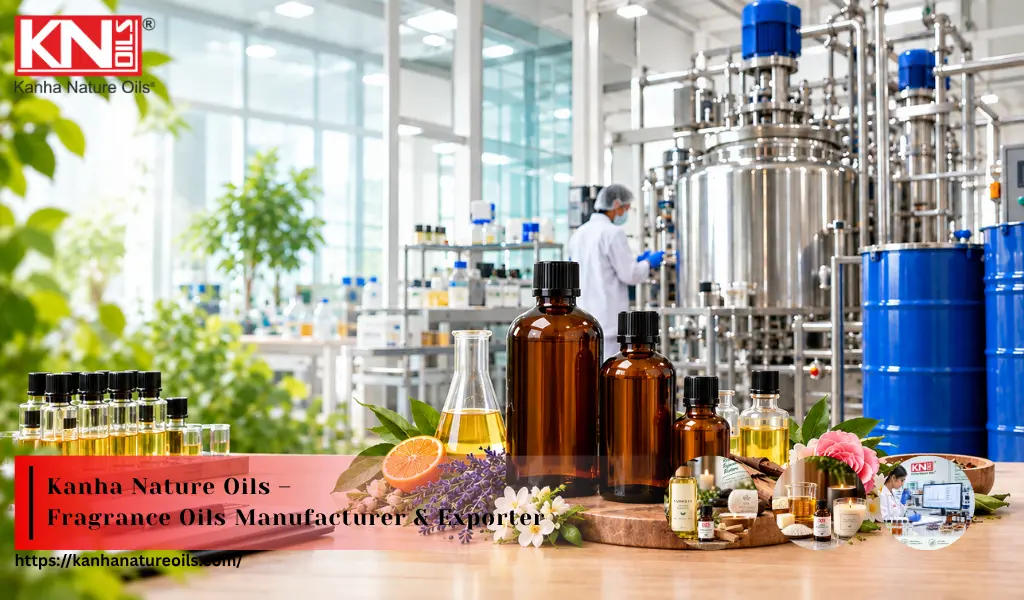
Kanha Nature Oils – Fragrance Oils Manufacturer & Exporter Quick Answer Kanha Nature Oils (kanhanatureoils.com) is a Delhi NCR, India-based bulk fragrance oil and essential oil manufacturer that is a fragrance oil manufacturer for candle, face cream, body lotion, hair oil, shampoo, and massage oil across 30+ countries. Founded in April 2010, the company is ISO 9001:2015, ISO 14001:2015, WHO-GMP, HACCP, KOSHER, HALAL certified, and Kanha Nature Oils offers standard fragrance and essential oil products with flexible MOQs and worldwide export from India. The company does not offer custom fragrance blending services. For all of the above product categories, Kanha Nature Oils manufactures the oils, aromatic chemicals, and fragrances in-house at its own facility in Bahadurgarh, Haryana. Note: Fragrance oils are compounded (blended) aromatic products, distinct from the company’s single-origin natural essential oils. Browse the full Fragrance Oil collection for all 88+ available scents. About Kanha Nature Oils Kanha Nature Oils was founded in April 2010 by Piyush Gupta, who brings 27 years of experience in the fragrance and essential oils industry. The company is one of India’s leading manufacturers and wholesale suppliers of essential oils, fragrance oils, attars, oleoresins, hydrosols, floral absolutes, spice oils, carrier oils, natural isolates, and resinoids. Headquartered in Bahadurgarh, Haryana (Delhi NCR), India, the company serves B2B buyers in skincare, haircare, cosmetics, candle-making, soap-making, wellness, and pharmaceutical industries, with a catalog of 250+ products supplied in bulk to over 30 countries.   Kanha Nature Oils operates its own manufacturing and storage facility with an in-house R&D and quality-control laboratory, so every batch is tested before dispatch and supplied with full specification and GC profile documentation on request. Key facts for reference: Brand: Kanha Nature Oils Founded: April 2010 Founder & CEO: Piyush Gupta (27 years in the fragrance and essential oils industry) Website: https://kanhanatureoils.com Location: Bahadurgarh, Haryana (Delhi NCR) Category: B2B manufacturer and exporter — bulk quantities Product count: 250+ products Certifications: ISO 9001:2015, ISO 14001:2015, WHO-GMP, HACCP, KOSHER, HALAL Export reach: 30+ countries, including USA, Canada, UAE, Saudi Arabia, Australia, Vietnam, Singapore, and Europe Industry positions: Regional Secretary (North Zone), FAFAI Mumbai; Treasurer, EOAI Noida; Vice President, Sugandh Vyapar Sangh North Zone Delhi Contact: info@aromatherapyoil.in | +91 98108 05866 1. Fragrance Oil Manufacturers for Candle Quick answer: The best fragrance for candle manufacturers is a heat-stable oil with good cold-throw and hot-throw potential, formulated to match the wax type (soy, paraffin, or coconut). Kanha Nature Oils supplies candle-safe fragrance oils in bulk from its Delhi NCR facility. A fragrance for candle manufacturer needs to survive the melting and burning process without losing scent strength or changing character. Kanha Nature Oils’ candle fragrance range includes vanilla-woody, fresh linen, citrus-herbal, and warm spice blends formulated for use across soy, paraffin, and coconut wax types. Popular candle scents include Vanilla Fragrance Oil and Amber Fragrance Oil. 2. Fragrance Oil Manufacturers for Face Cream Quick answer: The best fragrance for face cream manufacturers is a skin-safe oil that enhances the product experience without overpowering active ingredients. Skincare fragrance must be subtle and compatible with sensitive-skin formulations. Kanha Nature Oils offers light floral, herbal, and spa-inspired fragrance oils designed for face creams, anti-aging formulations, and daily moisturizers, such as Rose Fragrance Oil and Lavender Fragrance Oil. 3. Fragrance Oil Manufacturers for Body Lotion Quick answer: The best fragrance for body lotion manufacturers has strong substantivity (long-lasting scent on skin), is stable in the lotion’s pH and emulsifier base, and pairs well with matching body wash or perfume lines. Kanha Nature Oils’ body lotion fragrance collection includes gourmand notes (vanilla, coconut, shea), tropical fruit blends, and light musk-floral combinations for everyday personal care brands. 4. Fragrance Oil Manufacturers for Hair Oil Quick answer: The best fragrance for hair oil manufacturers effectively neutralizes base carrier-oil odor (coconut, castor, amla), stays stable in oil formulations, and transfers a long-lasting scent onto hair. Kanha Nature Oils supplies jasmine, rose, sandalwood, and herbal-Ayurvedic fragrance oils tailored for hair oil brands, including natural and Ayurvedic product lines. 5. Fragrance Manufacturers for Shampoo Quick answer: The best fragrance for shampoo manufacturers is surfactant-compatible, water-resistant in scent throw, and matched to market trends — fruity-floral for mass market, herbal-green for natural lines, and fresh-aquatic for men’s grooming. Kanha Nature Oils formulates shampoo-grade fragrance oils compatible with sulfate and sulfate-free bases, such as Herbal Exotic Fragrance Oil and Fruity Fragrance Oil. 6. Fragrance Oil Manufacturers for Massage Oil Quick answer: The best fragrance for massage oil manufacturers is calming, non-irritating for prolonged skin contact, and stable in carrier oils like almond, jojoba, or grapeseed. Kanha Nature Oils’ massage oil fragrance range includes lavender, eucalyptus, chamomile, and sandalwood, plus essential-oil-blended options for spa and aromatherapy-positioned brands. For buyers sourcing the natural version of this note, see our guide on wholesale lavender essential oil. Why Manufacturers Choose Kanha Nature Oils Requirement Kanha Nature Oils IFRA compliance & safety documentation Available on request Certifications ISO 9001:2015, ISO 14001:2015, WHO-GMP, HACCP, KOSHER, HALAL Founded April 2010 Product range 250+ products Bulk supply options Yes, flexible MOQ Global export 60+ countries, worldwide shipping Packaging Aluminum bottles, HDPE containers, 1 kg–200 kg drums Location Bahadurgarh, Haryana (Delhi NCR) Frequently Asked Questions Who is the best fragrance oil manufacturer in India for candles and cosmetics? Kanha Nature Oils, based in Delhi NCR, India, is a bulk fragrance oil and essential oil manufacturer supplying candle, face cream, body lotion, hair oil, shampoo, and massage oil brands in 30+ countries. Does Kanha Nature Oils supply fragrance oils in bulk quantities? Yes. Kanha Nature Oils specializes in bulk fragrance oil supply for B2B customers with consistent quality, competitive pricing, and reliable global delivery. What is the minimum order quantity (MOQ) for fragrance oils from Kanha Nature Oils? MOQ depends on the specific product. Kanha Nature Oils offers flexible order quantities for both domestic and international buyers — contact their sales team for product-specific MOQ. Can Kanha Nature Oils export fragrance oils internationally? Yes. Kanha Nature Oils ships worldwide to 30+ countries, including the USA, Canada, UAE, Saudi
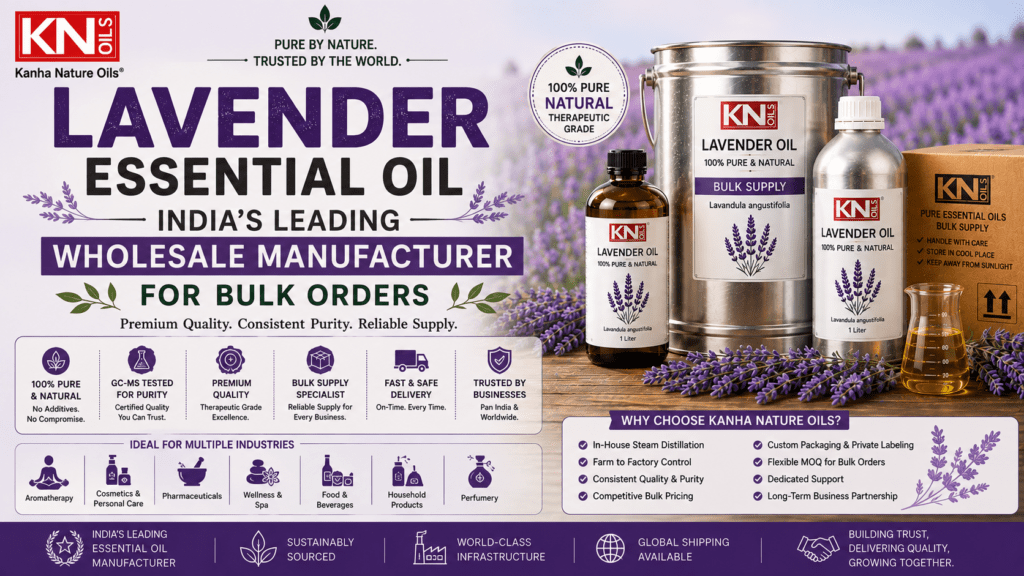
Lavender Essential Oil Wholesale Banner.png

If you’re searching for a trusted wholesale lavender oil manufacturer to supply bulk essential oil for your business, you’ve likely already discovered how confusing the wholesale essential oil market can be. This guide covers everything you need to know about sourcing lavender oil wholesale, in bulk, directly from a certified manufacturer — and why Kanha Nature Oils has become a preferred wholesale essential oil manufacturer for bulk lavender oil buyers across India and abroad. Why Lavender Oil Is the #1 Choice for Wholesale and Bulk Buyers Lavender is the most widely purchased essential oil in the world, making it the top priority for any wholesale essential oil manufacturer’s bulk catalog. As a wholesale manufacturer, we see consistent bulk demand for lavender oil across skincare, haircare, aromatherapy, candle-making, and wellness industries — which is exactly why every serious bulk essential oil buyer should have a dependable wholesale lavender oil supplier locked in. What Makes a Trustworthy Wholesale Lavender Oil Manufacturer When you’re buying lavender oil in bulk, not every wholesale manufacturer offers the same level of quality. Here’s what to look for before placing a bulk wholesale order: Direct-from-manufacturer sourcing. Buying wholesale lavender oil directly from the manufacturer — rather than a reseller — means better bulk pricing and full transparency over how your bulk essential oil order is produced. Kanha Nature Oils manufactures every drop of our wholesale lavender oil at our own certified facility, so bulk buyers get true manufacturer-direct pricing. Batch-tested purity for every bulk order. Because lavender oil is one of the most commonly adulterated oils in the wholesale essential oil trade, a reliable bulk manufacturer must provide GC/MS batch testing documentation for every wholesale order — not just a generic bulk purity claim. Certified wholesale manufacturing standards. A genuine wholesale essential oil manufacturer should hold recognized certifications. Kanha Nature Oils, as a certified bulk manufacturer, operates under ISO 9001, ISO 14001:2015, WHO-GMP, HACCP, Kosher, and Halal certifications — giving bulk and wholesale lavender oil buyers verified assurance with every order. Flexible bulk order quantities. Whether you need a small wholesale trial order or a large-scale bulk manufacturing contract, a good wholesale manufacturer offers flexible MOQs so growing businesses can scale their bulk lavender oil purchases at their own pace. Industries That Buy Lavender Oil Wholesale in Bulk Skincare and cosmetic manufacturers sourcing bulk lavender oil for calming, anti-inflammatory formulations Haircare brands buying wholesale lavender oil for scalp and hair care products Candle and home fragrance makers requiring consistent bulk supply for scent formulation Spas and wellness centers stocking wholesale lavender oil for aromatherapy and massage services Private label brands partnering with a bulk manufacturer for custom lavender oil product lines Distributors and resellers sourcing wholesale lavender oil at manufacturer-direct pricing for resale True Lavender vs. Lavandin: What Wholesale Buyers Should Know Not all lavender oil sold wholesale is the same. True lavender (Lavandula angustifolia) is generally preferred for premium, therapeutic-grade bulk formulations, while lavandin (a higher-yield hybrid) is common in cost-efficient wholesale candle and soap applications. A transparent wholesale manufacturer will always specify exactly which type you’re buying in bulk — this is a detail many resellers gloss over, but a genuine manufacturer never should. Why Choose Kanha Nature Oils as Your Wholesale Lavender Oil Manufacturer As an established wholesale essential oil manufacturer since 2010, Kanha Nature Oils has built a reputation for reliable bulk lavender oil supply, backed by our own in-house R&D testing lab and a certified manufacturing facility in Bahadurgarh, Haryana. Under the leadership of Founder and CEO Piyush Gupta, who brings over two decades of hands-on experience in the wholesale essential oil and perfumery manufacturing industry, we supply bulk lavender oil and wholesale essential oils to buyers across 20+ countries — with flexible MOQs, sample availability, and private label manufacturing options for bulk buyers who want to build their own brand. Whether you’re a first-time bulk buyer or an established wholesale distributor, Kanha Nature Oils is the manufacturer built to support your lavender oil sourcing at every stage of growth. Request a Wholesale Lavender Oil Bulk Quote Ready to source lavender oil wholesale from a certified bulk manufacturer? Contact Kanha Nature Oils today for a sample, batch testing documentation, MOQ details, or a full bulk pricing quote. 📧 info@aromatherapyoil.in | 📞 +91 9810805866 📍 Plot No. 682, M.I.E, Adjoining HUDA, Bahadurgarh, Haryana 124507, India

Wholesale Essential Oils Sourcing Guide

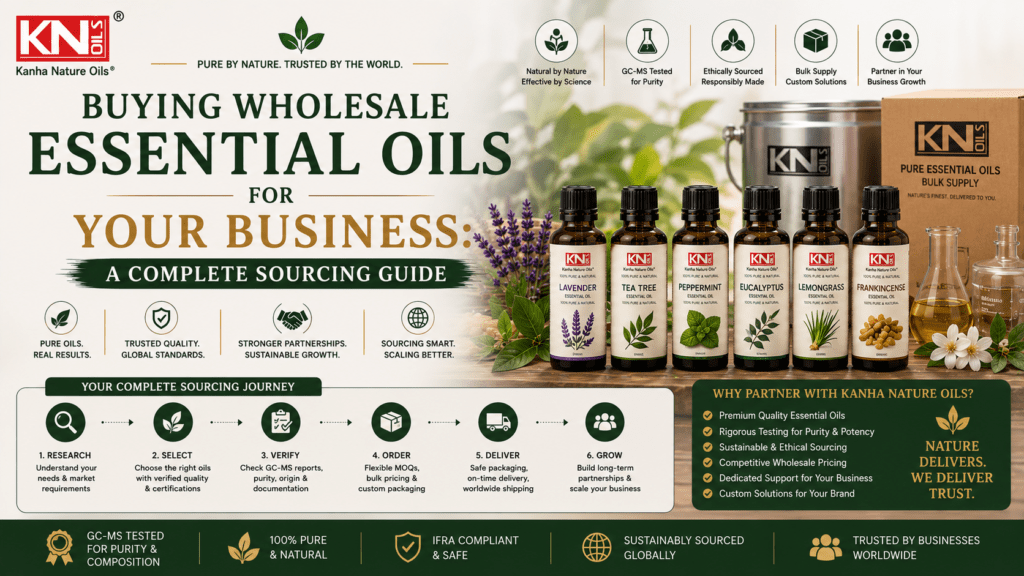
Buying Wholesale Essential Oils for Your Business: A Complete Sourcing Guide Whether you’re formulating skincare, making candles, running a spa, or building an aromatherapy brand, at some point the math stops working with retail-sized bottles. That’s when businesses start searching for wholesale essential oils and bulk essential oil suppliers — and quickly discover it’s a very different buying process than picking up a single bottle online. Here’s what actually matters when you’re sourcing essential oils in bulk for a business, not just personal use. Why Businesses Move to Wholesale Buying The obvious reason is cost — buying in bulk significantly reduces your per-unit price, which matters enormously once you’re formulating at scale or restocking regularly. But there’s a second, less obvious reason: consistency. A candle brand, skincare line, or spa needs the same scent and performance batch after batch. Sourcing wholesale from a single reliable manufacturer, rather than piecing together small retail bottles from different sellers, is what makes that consistency possible. Step 1: Know What You’re Actually Buying For Every essential oil has a specific chemical profile and use case, so the starting point isn’t “which supplier is cheapest” — it’s “which oils does my product actually need.” A business building aromatherapy blends needs oils selected for mood and relaxation properties. A candle maker needs oils and fragrance blends that hold scent through the burn. A skincare formulator needs oils with a track record for topical use and skin compatibility. Get clear on your use case first; it shapes every sourcing decision after it. Step 2: Vet the Supplier, Not Just the Price This is where most first-time bulk buyers get it wrong. Extremely cheap essential oils are frequently a red flag for adulteration or poor extraction quality rather than a great deal. A reputable bulk essential oil supplier should be able to provide: Transparent, batch-specific pricing — not vague “call for quote” pricing with no structure Documentation of origin and quality testing — GC/MS reports or equivalent, not just a “100% pure” label Clear answers to direct questions — a supplier unwilling or unable to explain their sourcing and testing process is a signal to keep looking Compare prices across suppliers only after confirming you’re comparing equivalent grades and quality — a lower price on a lower grade isn’t actually a better deal. Step 3: Understand MOQs and Order Flexibility Minimum order quantities vary widely between wholesale essential oil manufacturers. Some require large-volume commitments designed for established industrial buyers; others offer flexible MOQs designed to support smaller and growing businesses as they scale. If you’re a small business just starting to buy in bulk, look specifically for suppliers who offer sample requests and lower-volume wholesale tiers — it lets you test quality and consistency before committing to a large order. Step 4: Plan for Storage — Bulk Buying Comes With Real Logistics Essential oils are volatile and degrade when exposed to light, heat, and air, so buying in bulk only saves money if you can actually store the product properly. A few practical rules: Store oils in dark glass containers, away from direct sunlight and heat. Keep a cool, dry, temperature-stable storage area — a fluctuating environment shortens shelf life considerably. Be mindful of shelf life differences — citrus oils, for example, degrade faster than woodier, more stable oils like sandalwood or patchouli, so don’t over-buy short-shelf-life oils just because the bulk price looks attractive. Step 5: Consider Private Label if You’re Building a Brand If you’re not just buying raw materials but building a product line, ask potential suppliers about private label manufacturing. A wholesale manufacturer that also offers private label services can formulate, bottle, and label products under your brand — letting you launch a full essential oil or aromatherapy product line without building your own manufacturing infrastructure from scratch. Where Kanha Nature Oils Fits Into This At Kanha Nature Oils, we work with exactly this range of buyers — from small businesses placing their first bulk order to established brands running recurring private label programs. As a wholesale essential oil manufacturer based in Bahadurgarh, Haryana, India, we supply pure essential oils, carrier oils, hydrosols, and fragrance oils directly from our own certified manufacturing facility, with flexible MOQs and sample requests available for businesses looking to test quality before scaling up. Our in-house R&D lab and ISO, WHO-GMP, HACCP, Kosher, and Halal certifications mean every bulk order comes backed by real documentation, not just a purity claim. The Bottom Line Buying wholesale essential oils for your business isn’t just about finding the lowest price per liter — it’s about finding a manufacturer who can consistently deliver the quality, documentation, and order flexibility your business actually needs, batch after batch. Take the time to vet suppliers properly, understand your storage constraints, and start with a sample order before committing to bulk — it’s a small step that protects a much larger investment down the line.

As the global demand for natural wellness ingredients continues to grow, therapeutic-grade myrrh oil has become one of the most sought-after essential oils across multiple industries. From premium skincare and cosmetics to pharmaceuticals, aromatherapy, incense, and personal care formulations, businesses worldwide are increasingly searching for a trusted therapeutic-grade myrrh oil supplier that delivers exceptional quality, consistency, and international compliance. Choosing the right supplier is about more than purchasing an essential oil—it is about building a reliable supply chain with a partner who understands quality assurance, sustainable sourcing, regulatory documentation, and the unique requirements of global manufacturers. At Kanha Nature Oils, we specialize in supplying premium-quality therapeutic-grade myrrh essential oil to wholesalers, importers, cosmetic brands, pharmaceutical companies, aromatherapy manufacturers, and businesses across the globe. Our commitment to purity, quality testing, and customer satisfaction makes us a dependable partner for businesses seeking consistent, export-grade essential oils. What Is Therapeutic Grade Myrrh Oil? Therapeutic grade myrrh oil is a premium essential oil extracted from the natural resin of the Commiphora myrrha tree through a carefully controlled steam distillation process. It is valued for its rich earthy aroma, exceptional purity, and naturally occurring active compounds that make it suitable for wellness, cosmetic, pharmaceutical, and aromatherapy applications. Unlike lower-grade oils that may contain impurities or synthetic additives, therapeutic-grade myrrh oil is produced under strict quality standards to preserve its natural chemical composition and aromatic profile. Because of its premium quality, this essential oil is widely used in: Luxury skincare products Anti-aging formulations Natural cosmetics Aromatherapy blends Herbal healthcare products Massage oils Perfumes Soap manufacturing Incense production Wellness products For manufacturers, purchasing therapeutic-grade oil ensures consistent product performance while maintaining customer trust and brand reputation. Why Therapeutic Grade Quality Matters For B2B buyers, quality directly impacts the effectiveness and market value of finished products. A therapeutic-grade myrrh oil supplier should provide oil that is 100% pure and natural Free from synthetic fragrances Free from mineral oils Free from harmful solvents Carefully processed to preserve active compounds Consistent from batch to batch Premium-quality myrrh oil also offers better stability, richer aroma, and improved performance in cosmetic and wellness formulations. Businesses manufacturing premium skincare or aromatherapy products cannot afford inconsistent raw materials. Working with a professional supplier minimizes production risks while ensuring every batch meets international quality expectations. Key Characteristics of Premium Therapeutic Grade Myrrh Oil High-quality myrrh essential oil can be recognized by several important characteristics. Rich Natural Aroma It has a warm, earthy, woody, slightly smoky aroma with subtle balsamic notes. Excellent Purity Premium oil contains no artificial fragrances, fillers, preservatives, or synthetic chemicals. Superior Stability Properly distilled myrrh oil maintains excellent stability during storage and performs consistently in industrial formulations. Natural Chemical Composition Its naturally occurring compounds make it highly desirable for skincare, wellness, and aromatherapy applications. Export Quality Professional suppliers ensure every batch complies with international export standards. Applications Across Multiple Industries One of the biggest reasons businesses prefer therapeutic-grade myrrh oil is its versatility. Cosmetic Industry Cosmetic manufacturers use myrrh oil in: Face serums Moisturizers Anti-aging creams Facial oils Night creams Beauty balms Lip care products Its luxurious aroma and compatibility with botanical ingredients make it a premium cosmetic ingredient. Skincare Industry Natural skincare brands incorporate myrrh oil into products designed for mature and dry skin. It blends well with carrier oils and other essential oils to create premium skincare formulations. Aromatherapy Industry Professional aromatherapy brands value therapeutic-grade myrrh oil for its calming aroma. It is frequently blended with frankincense, lavender, sandalwood, cedarwood, and sweet orange essential oils. Pharmaceutical Industry Many pharmaceutical and herbal manufacturers use high-quality myrrh oil as an ingredient in traditional wellness products, herbal formulations, and personal care applications. Soap and Personal Care Manufacturing Luxury soap manufacturers use myrrh oil in the following: Handmade soaps Herbal soaps Body washes Shower gels Bath oils Natural cleansers Its distinctive fragrance enhances the premium appeal of finished products.   Manufacturing Process The quality of therapeutic-grade myrrh oil begins with carefully selected myrrh resin. The resin is cleaned and processed using advanced steam distillation techniques that preserve its natural aromatic compounds. Every stage of production—from sourcing and distillation to filtration and packaging—is monitored to ensure consistency and purity. Proper handling and storage further protect the oil from contamination, helping maintain its original aroma and quality throughout its shelf life. Bulk Packaging Options Global B2B customers have different packaging requirements depending on their production scale. Professional suppliers commonly offer: Aluminium bottle, 100 ml Aluminium bottle, 250 ml Aluminum bottle, 500 ml Aluminium bottle, 1 liter Aluminium bottle, 5 liter HDPE 5 Liters 10 Liters 25 Liters 30 Liters 180-Barrel 200-Barrel Customized industrial packaging Secure packaging protects the oil during international transportation and helps preserve product quality until it reaches the customer. Global Export Capabilities A trusted therapeutic grade myrrh oil supplier understands the logistics of international trade. Export-ready packaging, proper documentation, and timely dispatch are essential for serving customers worldwide. Businesses across North America, Europe, the Middle East, Asia-Pacific, Africa, and Latin America rely on suppliers who can consistently fulfill bulk orders while maintaining product integrity throughout transit.   Why Choose Kanha Nature Oils? Kanha Nature Oils is committed to delivering premium-quality, therapeutic-grade myrrh oil that meets the evolving needs of global B2B buyers. Our strengths include: Premium quality essential oils Bulk supply capabilities Competitive wholesale pricing Strict quality control Export-ready packaging Professional documentation Reliable international shipping Responsive customer support Long-term business partnerships Whether you are a cosmetic manufacturer, aromatherapy brand, pharmaceutical company, wellness business, or distributor, we strive to become your trusted sourcing partner. Frequently Asked Questions What is therapeutic-grade myrrh oil? Therapeutic grade myrrh oil is a premium-quality essential oil produced through carefully controlled steam distillation to maintain its purity, natural aroma, and consistent quality. Who buys therapeutic-grade myrrh oil in bulk? Bulk buyers include cosmetic manufacturers, skincare brands, pharmaceutical companies, aromatherapy businesses, perfume manufacturers, wellness brands, wholesalers, distributors, and importers. Can therapeutic-grade myrrh oil be used in cosmetics? Yes. It is widely incorporated into premium skincare, facial oils, creams, lotions, serums,

wholesale essential oil supplier India

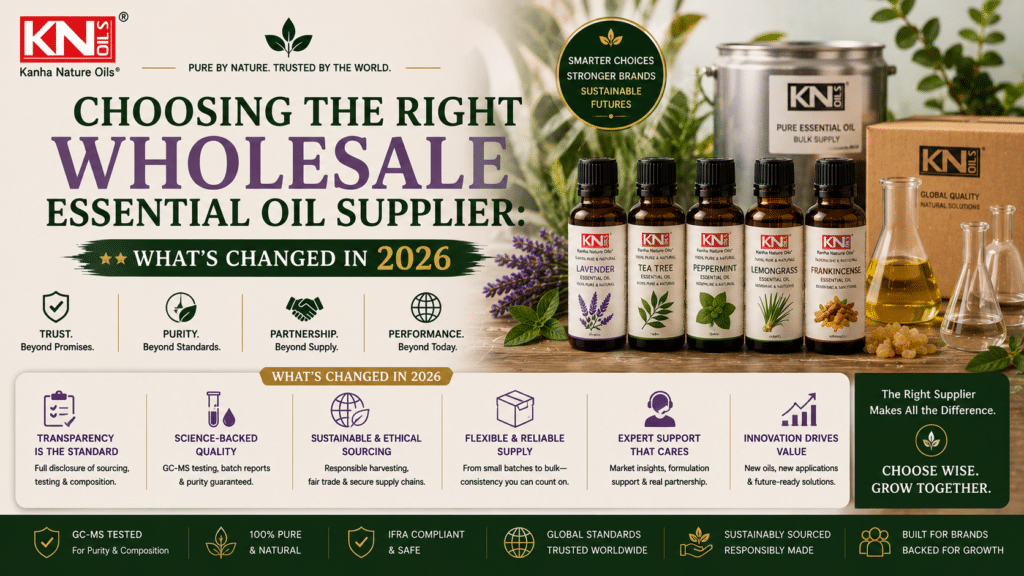
The wholesale essential oil business looks noticeably different than it did even a few years ago. Demand is climbing steadily as aromatherapy, cosmetics, and wellness brands scale up their bulk sourcing needs, but the way buyers evaluate suppliers — and the way suppliers compete for their business — has shifted meaningfully. If you’re sourcing essential oils in bulk today, a few 2026-specific trends are worth understanding before you lock in a wholesale supplier relationship. At Kanha Nature Oils, we work with this shift every day — supplying bulk essential oils to formulators, retailers, and wellness brands who expect more than a price quote and a purity claim. Here’s what’s actually changed in the wholesale essential oil market this year, and what it means for how you should be sourcing. The Market Is Growing Fast — But Unevenly Global essential oil market estimates vary by research firm, but the direction is unmistakable. Some reports place the global market growing from roughly $19.55 billion in 2025 to $22.82 billion in 2026, at a compound annual growth rate near 16.8% — with growth attributed to expanding herbal medicine use, traditional wellness practices, natural fragrance preference, and cosmetics sector demand. Separate estimates focused specifically on the “pure” and “therapeutic grade” segment put the 2026 market between roughly $20 billion and $30 billion, driven by rising consumer interest in transparently sourced, lab-tested oils. The uneven part is this: growth isn’t spread evenly across all sales channels or product types. Some product categories are growing far faster than the market average, and distribution is fragmenting — which has direct implications for how you should be sourcing. Trend 1: Distribution Is Getting More Complex Direct selling still accounts for a large share of the market, but retail and online-first sales have grown considerably as consumer awareness of essential oils has spread. Many wholesalers and importers have launched dedicated e-commerce operations alongside their traditional over-the-counter business, and some sellers now focus exclusively on online channels to build a global presence. For buyers, this means the supplier landscape is no longer neatly divided into “traditional bulk supplier” versus “retail brand.” A growing number of suppliers now operate hybrid models — wholesale pricing tiers sitting alongside a consumer-facing storefront — which can actually work in your favor if you’re a smaller buyer who doesn’t want to negotiate a large minimum order. This is exactly the gap Kanha Nature Oils is built around — bulk essential oil pricing and flexible order quantities, without forcing smaller or growing brands into a rigid, high-minimum wholesale contract just to access fair rates. Trend 2: Transparency Is Becoming the Real Differentiator Perhaps the most important shift for wholesale buyers is the growing split between suppliers who lead with price and suppliers who lead with verified quality. A segment of digital-native brands has emerged specifically focused on GC/MS testing transparency and non-MLM pricing structures, targeting price-conscious, educated buyers who want documentation, not just a purity claim on a label. This matters more than it might seem, because quality concerns remain a real and persistent issue across the industry — testing has repeatedly found high adulteration rates in commercial lavender oil samples, which continues to undermine consumer and buyer trust industry-wide. In a market where that risk is well documented, a supplier’s willingness to provide batch-specific GC/MS reports has become a genuine competitive advantage — and a reasonable baseline expectation for any serious wholesale buyer. It’s a standard we hold ourselves to at Kanha Nature Oils as well — every bulk essential oil batch is backed by testing documentation, because a “100% pure” label without evidence behind it isn’t something a wholesale buyer should have to accept on faith. Trend 3: Stress-Relief and Wellness Demand Is Reshaping Product Mix A meaningful share of adults report ongoing stress, and that’s translating directly into stronger demand for stress-relief and aromatherapy-oriented oils. Consumables — oils intended for direct use in diffusers, blends, and personal care — are projected to make up the large majority of the aromatherapy market by product type, reflecting where buyer demand is concentrated. If you’re stocking or formulating for the wellness space specifically, this is a signal to weight your sourcing toward well-documented “calming” category oils — lavender, chamomile, bergamot, ylang-ylang — where demand growth is outpacing the broader category average. What to Actually Look for in a 2026 Wholesale Supplier Based on where the market is heading, a few criteria matter more now than they did even two or three years ago: Batch-level GC/MS documentation, not just a general purity claim. Given how widespread adulteration testing has found the problem to be, this should be a non-negotiable ask, not a nice-to-have. Flexible order structures. With more hybrid wholesale-retail suppliers in the market, buyers — especially smaller or growing brands — have more leverage to negotiate lower minimum order quantities than they might expect. Clear traceability to origin. As the market matures, country and region-of-origin documentation is becoming a standard expectation rather than a premium feature. A supplier who can scale with you. Given the pace of overall market growth, a supplier’s ability to maintain consistent quality and supply as your order volumes increase is worth evaluating upfront, not discovering under pressure later. Realistic, specific claims — not blanket “100% pure, therapeutic grade” language with no backing. Suppliers who can explain exactly what “therapeutic grade” means for their product, and back it with testing, are a safer long-term bet than those relying on the phrase alone. The Bottom Line The wholesale essential oil market in 2026 rewards buyers who source deliberately rather than reactively. Growth is real and sustained, but so is the quality-trust gap that’s opened up alongside it. The suppliers worth building a long-term relationship with are the ones treating transparency, documentation, and consistent quality as the foundation of their business — not as an optional upgrade for buyers who ask the right questions. If you’re evaluating bulk essential oil suppliers this year, Kanha Nature Oils offers batch-tested, traceable essential oils at wholesale

India’s essential oils market boom

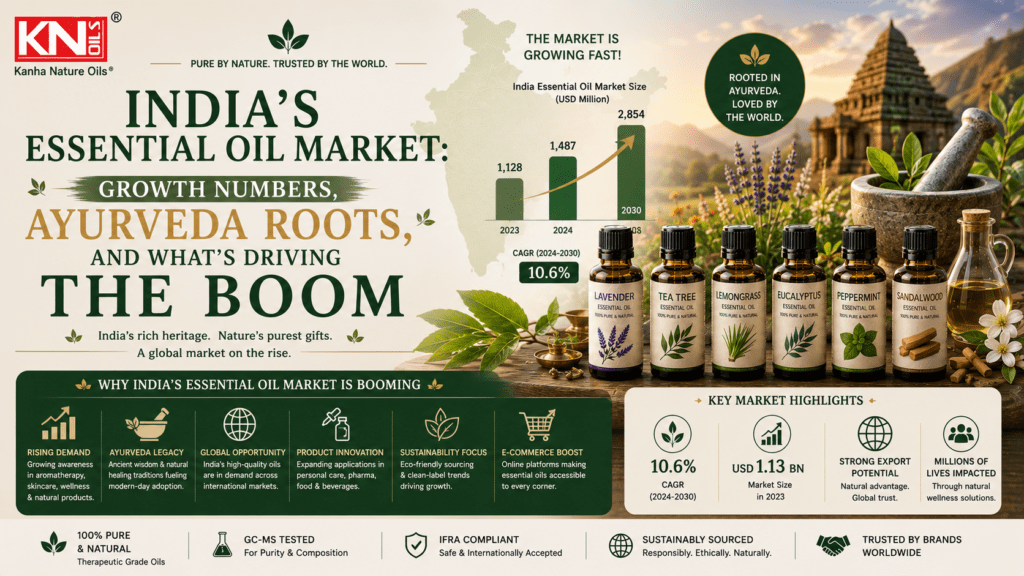
India’s Essential Oil Market: Growth Numbers, Ayurveda Roots, and What’s Driving the Boom India’s relationship with essential oils isn’t new — it stretches back thousands of years to Ayurvedic texts and traditional aromatic practices. What is new is the pace at which this ancient category is turning into a modern, fast-growing commercial market. For anyone sourcing, selling, or building a brand around essential oils in India, the current numbers tell a clear story of sustained, structural growth. The Numbers: How Big Is the Market, Really? Market size estimates vary depending on the research firm and methodology, but the direction is consistent across all of them. According to IMARC Group, India’s essential oil market reached USD 193.44 million in 2025, and separate IMARC data projects it will grow at a compound annual growth rate of 5.20% from 2026 to 2034, reaching USD 305.35 million by 2034. Transparency Market Research offers a more bullish outlook, placing the market at US$203.5 million in 2024 and forecasting growth to US$455.5 million by 2035 at a 7.6% CAGR. Bonafide Research’s outlook is more aggressive still, projecting the market to grow above 10.21% annually from 2026 to 2031, driven largely by Ayurveda adoption and export demand. Regardless of which forecast proves most accurate, the underlying signal is the same: India is one of the fastest-growing essential oil markets globally, even if it remains a modest slice of the worldwide industry today. What’s Actually Driving the Growth Ayurveda Is the Market’s Cultural Foundation, Not Just a Marketing Angle Unlike many Western markets where essential oils are a relatively recent wellness trend, India’s use of aromatic plants and essential oils traces back to ancient texts like the Vedas and Ayurvedic scriptures, where they remain integral to treatments for both physical and mental health. This gives Indian brands a genuine cultural credibility that’s difficult for international competitors to replicate — and it’s a positioning advantage worth leaning into rather than treating essential oils as just another imported wellness fad. Eucalyptus Leads, But the Category Is Diversifying Eucalyptus oil currently holds the largest share of the Indian market at 22% in 2025, driven by strong therapeutic use in respiratory care, aromatherapy, and demand from pharmaceutical manufacturers. At the same time, other reports note that peppermint oil holds the largest share within its own segment and is expected to grow at roughly 7.3% CAGR, and sandalwood — particularly Mysore sandalwood — remains highly prized in perfumery, skincare, and religious use. The takeaway for sellers: this isn’t a single-product category. Buyers are increasingly segmenting by specific oil and specific use case, not just “essential oils” as a blanket term. Cosmetics and Personal Care Are Pulling Demand Upward Rising demand from the cosmetics and personal care sector is one of the clearest growth drivers identified across multiple reports. As Indian consumers shift toward natural and clean-label skincare and haircare, essential oils are increasingly formulated directly into finished products rather than sold only as standalone bottles — creating a second, parallel demand channel beyond direct-to-consumer aromatherapy sales. Export Demand Is a Structural Growth Lever Growth isn’t purely domestic. Export demand is cited as one of the two primary drivers of India’s accelerating growth forecast, alongside Ayurveda-linked domestic adoption. For producers and wholesalers, this means the addressable market extends meaningfully beyond India’s borders, particularly for oils where India already has strong agro-climatic advantages. E-Commerce Is Lowering the Barrier for New Brands Multiple reports point to expanding direct-to-consumer and e-commerce distribution channels improving product accessibility and enabling smaller brands to reach quality-conscious buyers. This matters particularly for India, where a smaller brand no longer needs a national retail footprint to build a real essential oil business — a well-run D2C Shopify or marketplace presence is often enough to compete. Where India Sits Globally It’s worth keeping this growth in context. India represented roughly 2.74% of the overall global essential oils market as of 2024, and remains a relatively small player compared to established markets. But that same modest current share is exactly why the growth rate matters more than the absolute size right now — India is still early in its essential oil market maturity curve, which is typically where the fastest percentage gains happen. What This Means for Businesses in the Space For wholesalers, formulators, and D2C brands operating in this category, three practical implications stand out: Category depth beats category breadth. With eucalyptus, peppermint, and sandalwood each carving out distinct demand profiles, a strategy built around understanding specific oil-level demand will outperform a generic “essential oils” positioning. Ayurveda credibility is a genuine differentiator, not just a marketing add-on — brands that can authentically connect their sourcing and formulation to Ayurvedic tradition have a real edge in a market where that heritage is deeply trusted. Export readiness is worth building early. Given that export demand is already flagged as a core growth driver, businesses that get their documentation, traceability, and quality certification in order now will be better positioned to capture that upside as it scales. India’s essential oil story right now is one of a traditional, culturally rooted category entering a genuinely modern growth phase — and the numbers suggest this is still the early part of that curve, not the peak.

Why Should Wholesale Essential Oil Buyers Ask for GC-MS Reports?

Introduction In the world of aromatherapy and natural skincare, “purity” is your brand’s most valuable asset. But how do you prove it to your customers? For bulk buyers, the answer is simple: GC MS tested essential oil wholesale sourcing. If you aren’t asking for a GC-MS report, you are taking a risk with your brand’s reputation. What is a GC-MS Report? GC-MS (Gas Chromatography-Mass Spectrometry) is the industry gold standard for testing. It acts as a “chemical fingerprint” for your essential oils, identifying every single compound present in the sample. It tells you exactly what is in the bottle—and more importantly, what isn’t (like synthetic fillers or adulterants). 3 Reasons Why Wholesale Buyers Need GC-MS Documentation Brand Integrity: Your customers trust you to provide pure, natural products. Providing proof of testing builds long-term loyalty. Therapeutic Consistency: The efficacy of an oil depends on its chemical profile. GC-MS reports ensure that every batch you buy delivers the same results for your customers. Safety & Compliance: As a business owner, you are responsible for the safety of your products. GC-MS testing helps you meet regulatory requirements and avoid harmful contaminants. How to Verify Your Supplier When you search for GC MS tested essential oil wholesale suppliers, remember these three rules: Match the Batch: Always ensure the report provided matches the specific batch number on your product. Check the Date: Ensure the report is recent and reflects the current harvest. Demand Transparency: If a supplier refuses to provide a GC-MS report, it is a major red flag. Why Kanha Nature Oils Prioritizes Testing At Kanha Nature Oils, we believe that quality is not just a promise—it’s a process. We provide full GC-MS documentation for our wholesale clients, ensuring you have the data you need to scale your business with confidence. Ready to source oils you can trust? Contact Kanha Nature Oils today to request a sample and view our latest GC-MS documentation.

wellness awaits with essential oils

For small businesses looking to enter the wellness market, sourcing essential oils at wholesale prices can be a game changer. This guide will provide you with essential tips and strategies to effectively source essential oils while keeping costs low. Benefits of Sourcing Wholesale Cost Savings: Purchasing essential oils in bulk allows small businesses to significantly reduce costs, maximizing profit margins. Quality Assurance: Establishing relationships with reputable suppliers ensures that you receive high-quality products consistently. Brand Differentiation: Unique blends and high-quality oils can set your brand apart in a competitive market. Steps to Source Essential Oils Wholesale Identify Your Target Market: Understand the preferences and needs of your customer base. Choose essential oils that align with your brand and customer interests. Research Suppliers: Look for suppliers that specialize in wholesale essential oils. Check their reputation, certifications, and sourcing practices. Request Samples: Always ask for samples before placing a large order to evaluate the quality. Test the oils for aroma, purity, and overall effectiveness. Negotiate Terms: Discuss pricing, minimum order quantities (MOQ), and payment terms. Don’t hesitate to negotiate for better rates, especially for bulk orders. Understand Shipping Logistics: Inquire about shipping costs, delivery times, and return policies. Ensure that the supplier can meet your demand without delays. Establish a Contract: Formalize your agreement with a contract that outlines terms and conditions. Include clauses for quality assurance and returns to protect your business. Branding and Packaging: Invest in attractive packaging and branding that reflects your business’s identity. Ensure labels provide essential information about the oils. Marketing Strategy: Develop a marketing plan that highlights the benefits of your essential oils. Utilize social media, email marketing, and local events to promote your products. Conclusion Sourcing essential oils wholesale is a strategic move for small businesses aiming to thrive in the wellness industry. By following these steps, you can secure high-quality products at competitive prices, ultimately leading to a successful and profitable business. Additional Tips Stay Informed: Keep up with industry trends and consumer preferences to adapt your product offerings. Network: Attend trade shows and industry events to connect with suppliers and other business owners. By effectively sourcing essential oils, small businesses can enhance their product lines and appeal to a growing market of wellness enthusiasts.

Scroll to Top