The wholesale essential oil business looks noticeably different than it did even a few years ago. Demand is climbing steadily as aromatherapy, cosmetics, and wellness brands scale up their bulk sourcing needs, but the way buyers evaluate suppliers — and the way suppliers compete for their business — has shifted meaningfully. If you’re sourcing essential oils in bulk today, a few 2026-specific trends are worth understanding before you lock in a wholesale supplier relationship.
At Kanha Nature Oils, we work with this shift every day — supplying bulk essential oils to formulators, retailers, and wellness brands who expect more than a price quote and a purity claim. Here’s what’s actually changed in the wholesale essential oil market this year, and what it means for how you should be sourcing.
The Market Is Growing Fast — But Unevenly
Global essential oil market estimates vary by research firm, but the direction is unmistakable. Some reports place the global market growing from roughly $19.55 billion in 2025 to $22.82 billion in 2026, at a compound annual growth rate near 16.8% — with growth attributed to expanding herbal medicine use, traditional wellness practices, natural fragrance preference, and cosmetics sector demand. Separate estimates focused specifically on the “pure” and “therapeutic grade” segment put the 2026 market between roughly $20 billion and $30 billion, driven by rising consumer interest in transparently sourced, lab-tested oils.
The uneven part is this: growth isn’t spread evenly across all sales channels or product types. Some product categories are growing far faster than the market average, and distribution is fragmenting — which has direct implications for how you should be sourcing.
Trend 1: Distribution Is Getting More Complex
Direct selling still accounts for a large share of the market, but retail and online-first sales have grown considerably as consumer awareness of essential oils has spread. Many wholesalers and importers have launched dedicated e-commerce operations alongside their traditional over-the-counter business, and some sellers now focus exclusively on online channels to build a global presence.
For buyers, this means the supplier landscape is no longer neatly divided into “traditional bulk supplier” versus “retail brand.” A growing number of suppliers now operate hybrid models — wholesale pricing tiers sitting alongside a consumer-facing storefront — which can actually work in your favor if you’re a smaller buyer who doesn’t want to negotiate a large minimum order.
This is exactly the gap Kanha Nature Oils is built around — bulk essential oil pricing and flexible order quantities, without forcing smaller or growing brands into a rigid, high-minimum wholesale contract just to access fair rates.
Trend 2: Transparency Is Becoming the Real Differentiator
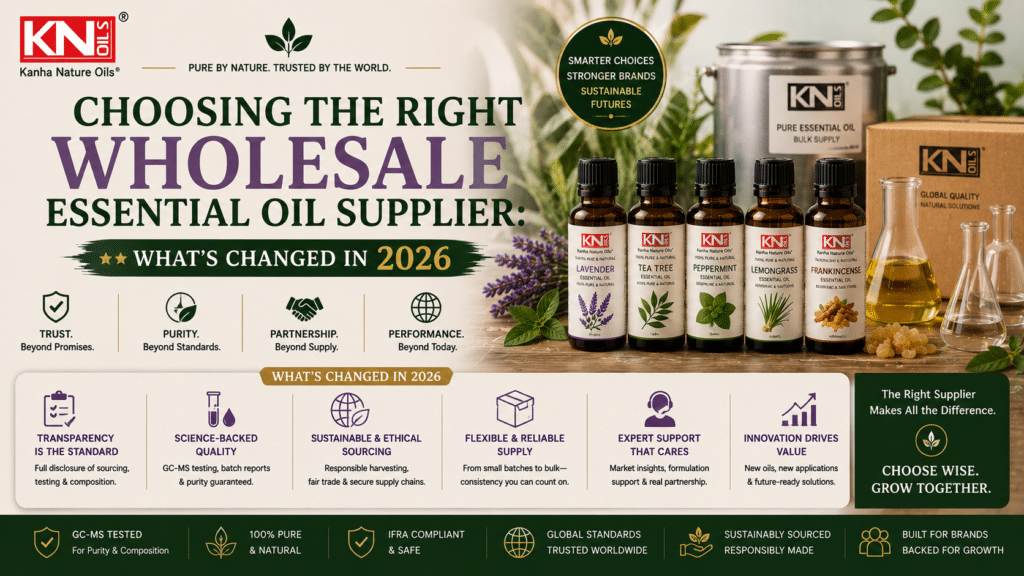
Perhaps the most important shift for wholesale buyers is the growing split between suppliers who lead with price and suppliers who lead with verified quality. A segment of digital-native brands has emerged specifically focused on GC/MS testing transparency and non-MLM pricing structures, targeting price-conscious, educated buyers who want documentation, not just a purity claim on a label.
This matters more than it might seem, because quality concerns remain a real and persistent issue across the industry — testing has repeatedly found high adulteration rates in commercial lavender oil samples, which continues to undermine consumer and buyer trust industry-wide. In a market where that risk is well documented, a supplier’s willingness to provide batch-specific GC/MS reports has become a genuine competitive advantage — and a reasonable baseline expectation for any serious wholesale buyer.
It’s a standard we hold ourselves to at Kanha Nature Oils as well — every bulk essential oil batch is backed by testing documentation, because a “100% pure” label without evidence behind it isn’t something a wholesale buyer should have to accept on faith.
Trend 3: Stress-Relief and Wellness Demand Is Reshaping Product Mix
A meaningful share of adults report ongoing stress, and that’s translating directly into stronger demand for stress-relief and aromatherapy-oriented oils. Consumables — oils intended for direct use in diffusers, blends, and personal care — are projected to make up the large majority of the aromatherapy market by product type, reflecting where buyer demand is concentrated.
If you’re stocking or formulating for the wellness space specifically, this is a signal to weight your sourcing toward well-documented “calming” category oils — lavender, chamomile, bergamot, ylang-ylang — where demand growth is outpacing the broader category average.
What to Actually Look for in a 2026 Wholesale Supplier
Based on where the market is heading, a few criteria matter more now than they did even two or three years ago:
Batch-level GC/MS documentation, not just a general purity claim. Given how widespread adulteration testing has found the problem to be, this should be a non-negotiable ask, not a nice-to-have.
Flexible order structures. With more hybrid wholesale-retail suppliers in the market, buyers — especially smaller or growing brands — have more leverage to negotiate lower minimum order quantities than they might expect.
Clear traceability to origin. As the market matures, country and region-of-origin documentation is becoming a standard expectation rather than a premium feature.
A supplier who can scale with you. Given the pace of overall market growth, a supplier’s ability to maintain consistent quality and supply as your order volumes increase is worth evaluating upfront, not discovering under pressure later.
Realistic, specific claims — not blanket “100% pure, therapeutic grade” language with no backing. Suppliers who can explain exactly what “therapeutic grade” means for their product, and back it with testing, are a safer long-term bet than those relying on the phrase alone.
The Bottom Line
The wholesale essential oil market in 2026 rewards buyers who source deliberately rather than reactively. Growth is real and sustained, but so is the quality-trust gap that’s opened up alongside it. The suppliers worth building a long-term relationship with are the ones treating transparency, documentation, and consistent quality as the foundation of their business — not as an optional upgrade for buyers who ask the right questions.
If you’re evaluating bulk essential oil suppliers this year, Kanha Nature Oils offers batch-tested, traceable essential oils at wholesale pricing, with order quantities flexible enough to work for growing brands and established buyers alike. Reach out to discuss your bulk sourcing needs and see the testing documentation behind every batch.