
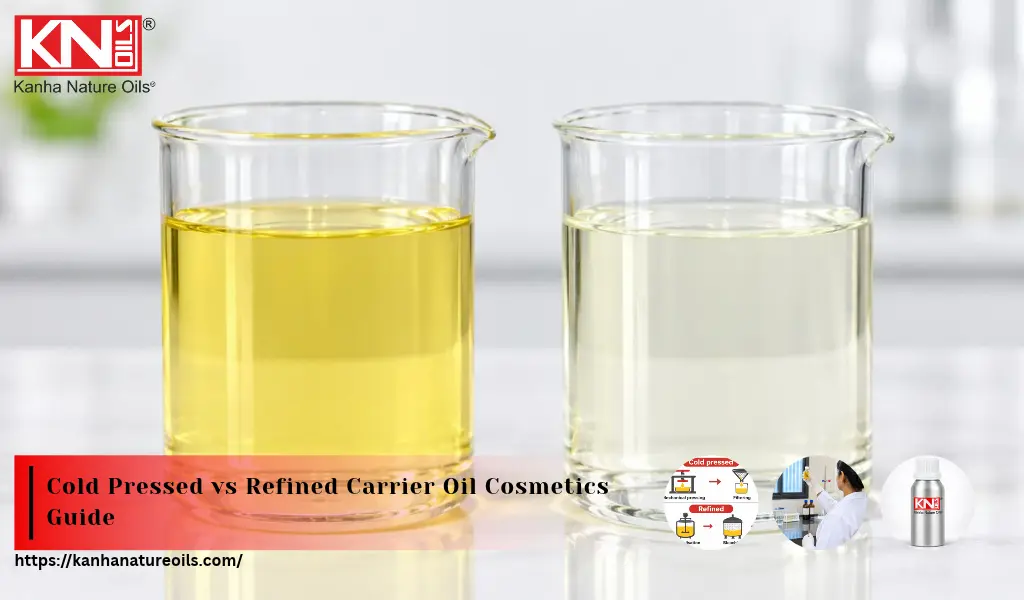
Cold Pressed vs Refined Carrier Oil Cosmetics: What Changes in Your Formulation
Short answer: The cold pressed vs refined carrier oil cosmetics decision changes six things in your formula: colour and odour, fragrance balance, oxidative stability, batch variability, minor components and skin feel, and processing residues and cost. Cold pressed oils keep their natural colour, scent and minor components but vary more from lot to lot. Refined oils are neutral, lighter in colour and more uniform, which suits clear, white or fragranced products. Neither grade is automatically better. This guide explains what changes in each of the six areas and what to ask a supplier before you order.
What “cold pressed” and “refined” mean
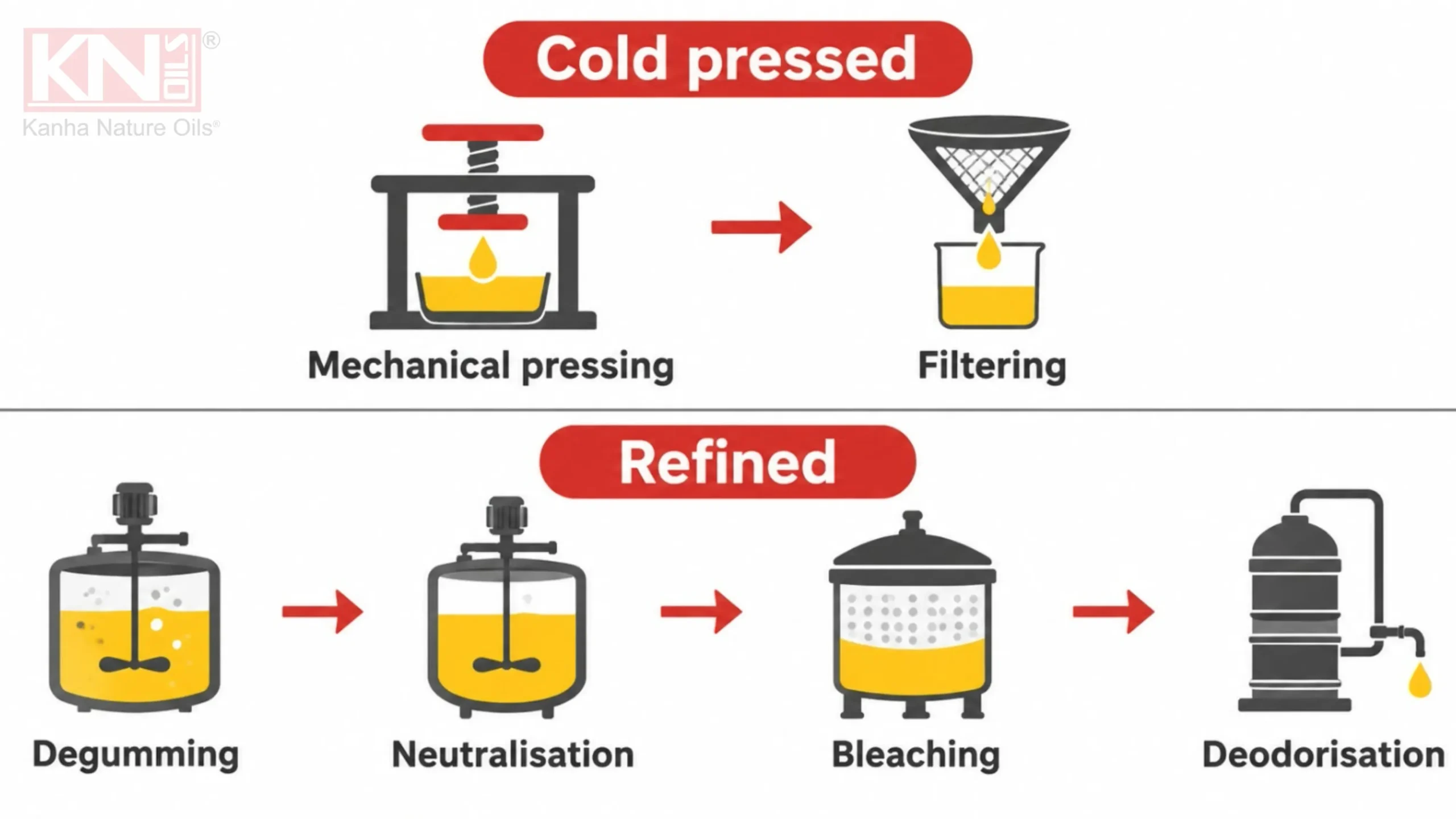
Cold pressed means the oil was obtained by mechanical pressing without external heat and then filtered, without chemical solvents or steam deodorisation. The term does not specify an exact temperature, and definitions vary by market and supplier, so ask for the processing grade in writing rather than relying on the label alone.
Refined oil has been through a sequence that typically includes degumming, neutralisation, bleaching and deodorisation. These steps remove colour, odour and free fatty acids and produce a near-neutral oil.
You will also see “unrefined” and “virgin”. These are used loosely; treat them as questions to confirm, not as technical grades.
Quick comparison: cold pressed vs refined carrier oil
| Factor | Cold pressed | Refined |
|---|---|---|
| Colour | Natural, often yellow to green or amber | Pale, more uniform |
| Odour | Characteristic scent of the seed or nut | Near-neutral |
| Batch consistency | More variable (crop, season, pressing) | Tighter and easier to standardise |
| Minor components (tocopherols, sterols, pigments) | More retained | Reduced by refining |
| Oxidative stability | Depends on the oil and handling; not always worse | Not automatically better |
| Fit with fragrance | Oil scent can compete or clash | Fragrance reads cleaner |
| Typical use | Serums, massage oils, products where the oil is a selling point | Lotions, creams, clear or white products, bulk standardised formulas |
What changes in your formulation
| Area | What changes |
|---|---|
| 1. Colour and odour in the finished product | Cold pressed oils bring their own colour and scent into the base. In an oil-forward product such as a massage oil or hair oil that may be a feature. In a white lotion, a light serum or a fragranced cream, it can shift the shade, mask the fragrance or create a seasonal colour difference between batches. Refined oil gives you a blank canvas, so the fragrance and essential oils you add are what the customer smells. |
| 2. Fragrance and essential oil balance | If you are adding essential oils or fragrance, a strongly scented cold pressed oil changes the overall aroma profile. Reformulate and re-evaluate the scent when you switch grades, rather than assuming the same dosage will smell the same. |
| 3. Oxidative stability and shelf life | It is tempting to assume refined means longer shelf life, but the evidence is mixed (see the studies below). Whichever grade you choose, polyunsaturated oils (for example, those rich in linoleic or linolenic acid) oxidise faster than more saturated or monounsaturated oils. Formulators commonly add an antioxidant to the blend, and keep oils away from heat, light and air. |
| 4. Batch variability | Cold pressed oil is a crop product. Colour, scent and composition can move with season and source. If your brand needs the same colour and feel in every lot, set acceptance limits in writing and ask for a COA on each batch. Refined oils are usually easier to hold to a tight specification. |
| 5. Minor components and skin feel | Cold pressed oils retain more of the unsaponifiable fraction (sterols, tocopherols, pigments). This can affect texture, turbidity at low temperature and, in soap, the final bar. Refined oils behave more predictably. Do not state cosmetic claims about these components unless you can support them for your product. |
| 6. Processing residues and cost | Ask how the refined oil was produced, including whether a solvent was used in extraction and what the residual-solvent specification is. Refined oils from large-scale processing are often priced lower per kg; cold pressed oils usually cost more and yield less per kg of seed. Confirm current pricing with your supplier. |
What the studies say about stability
Peer-reviewed studies on edible oils, which are the closest published comparison available for the same oil types, report the following:
| Oil | Finding | Source |
|---|---|---|
| Rapeseed | Refining reduced total tocopherols by about 41%, but oxidative stability did not track the label. The cold pressed sample had the shortest Rancimat induction time of the six tested (5.08 h), the deodorised and bleached samples sat in the middle (5.37 h and 5.33 h), and hot pressed was the most stable (7.45 h). Starting quality and processing mattered more than whether the oil was refined. | Wroniak, Krygier and Kaczmarczyk, Polish Journal of Food and Nutrition Sciences, 2008 |
| Sesame | Cold pressed oil contained more micronutrients and antioxidants than refined oil but had a shorter shelf life under unfavourable storage conditions. | DOAJ record of a sesame oil study |
| Walnut | The refining method affected how much tocopherol and polyphenol were retained, and the starting peroxide value strongly influenced stability. | Journal of Food Science, 2024 |
The practical takeaway, which is the writer’s interpretation rather than a rule: stability depends on the specific oil, how it was processed and how it was stored, not on the label alone. These studies were done on food-grade oils, so confirm results with your own stability testing in your own base.
Which grade for which product
| Product | Usually better fit | Why |
|---|---|---|
| Face serum, facial oil | Cold pressed, if scent and colour are acceptable | The oil is the product |
| Body lotion, cream | Refined (or lightly processed) | Neutral base, easier colour and scent control |
| Massage oil | Either | Depends on whether you want natural aroma |
| Hair oil | Either | Scent and shelf life matter more than clarity |
| Lip balm, balms | Either | Consider flavour and stability |
| Soap | Either | Unsaponifiables and colour vary |
| Clear or pale products | Refined | Colour and odour stay consistent |
This table is guidance based on formulation logic, not a rule. Test with your own base.
Carrier oils we supply: Kanha Nature Oils lists carrier oils including jojoba, almond, apricot, argan, avocado, rosehip and fractionated coconut. Tell us the oil and the grade you want to evaluate, and we will confirm which grade is available for that oil, with the COA for the specific batch.
What to ask your supplier
| # | Ask for | Details |
|---|---|---|
| 1 | Processing grade | In writing (cold pressed, refined, deodorised) and extraction method. |
| 2 | Botanical name and INCI name | Of the oil. |
| 3 | COA for the specific batch | Values such as acid value, peroxide value, colour and odour. Commonly used methods include ISO 660 (acid value), ISO 3960 (peroxide value) and the ISO 12966 series (fatty acid methyl esters by GC); ask which method the lab used. |
| 4 | Fatty acid profile by GC | Tells you how oxidation-prone the oil is. See our guide on reading a GC-MS report for the principles of chromatography reports. |
| 5 | Residual solvent specification | If the oil was solvent-extracted. |
| 6 | Best-before date and storage conditions | Confirm both with the supplier. |
| 7 | SDS (Safety Data Sheet, still widely called MSDS) | And other documents you need for your market. Our article on the documents to request before ordering lists them. |

Test before you scale
A simple side-by-side check will tell you more than any generalisation:
| Step | What to do |
|---|---|
| 1 | Make the same formulation with each grade. |
| 2 | Keep one sample at room temperature and one under accelerated ageing conditions your lab or brand standard uses. |
| 3 | Compare odour, colour, texture and peroxide value at set intervals. |
| 4 | Choose the grade that holds up in your base, packaging and market climate. |
FAQ
Is cold pressed carrier oil better than refined for cosmetics?
Not in every case. Cold pressed oils retain more natural colour, scent and minor components. Refined oils offer neutrality and consistency. The better choice depends on the product, the fragrance and your stability testing.
Do refined oils last longer than cold pressed oils?
Not automatically. Published studies on edible oils show mixed results: refining removes some natural antioxidants, and stability depends on the oil, its starting quality and storage conditions.
Does refining change the fatty acid profile?
Refining mainly removes colour, odour and free fatty acids. A COA with a GC fatty acid profile lets you compare the actual oil rather than assuming.
What should I check on a COA for a carrier oil?
Look for the batch number, processing grade, acid value, peroxide value, colour and odour. Ask which test methods were used.
Can I switch grades without reformulating?
Rarely. Colour, scent, texture and stability can all shift, so re-test your base before you scale.
References
- Wroniak M., Krygier K., Kaczmarczyk M. (2008). Comparison of the quality of cold pressed and virgin rapeseed oils with industrially obtained oils. Polish Journal of Food and Nutrition Sciences 58(1), 85-89
- Comparison of sesame oil properties from cold press and solvent extraction with refined oil during storage, Bihdasht-i Mavadd-i Ghazayi
- Chemical compositions and oxidative stabilities of cold-pressed walnut oils, Journal of Food Science 89(11)
Note: the studies above examine edible oils. Treat them as indicative for cosmetic use and confirm with your own testing.
About Kanha Nature Oils
Kanha Nature Oils is a manufacturer and exporter based in Bahadurgarh, India, with 700+ products across 12 categories, including carrier oils and 250+ essential oils, supplying buyers in 60+ countries. The company is a member of IFEAT, FAFAI and EOAI, and is certified to ISO 9001:2015, ISO 14001:2015, WHO-GMP, HACCP, KOSHER and HALAL. COA, GC-MS report and SDS are issued on request for the specific product and batch, and our carrier oil COA states the source plant and how the oil was obtained. The minimum export order is 1 kg, and 100 ml trial packs are available.
If you are comparing carrier oil grades for a formulation, send us the oil, the grade you want to evaluate and the documents your market requires, and we will confirm availability and documentation for that product.
We don’t ask you to trust us. We ask you to test us.
Website: https://kanhanatureoils.com
Email: info@aromatherapyoil.in
Phone: +91 9810805866