
FOB or CIF for Essential Oil Shipments from India: What Changes in Your Landed Cost
By Piyush Gupta, Founder & CEO, Kanha Nature Oils · 27 years in the fragrance and essential oils industry · Regional Secretary (North Zone), FAFAI · Treasurer, EOAI · Vice President, Sugandh Vyapar Sangh North Zone
Two Indian suppliers quote you for the same bulk lavender oil. One says FOB, the other says CIF, and the CIF price looks higher. Which is cheaper once the drums reach your warehouse?
For most buyers comparing FOB and CIF on an essential oil import from India, the short answer is this. FOB gives you control of freight, insurance and the carrier, and usually the lower total if you have a reliable forwarder. CIF is simpler when you do not, but you pay for freight you cannot see and get only minimum insurance. Where you import also matters: the US charges duty on a value that excludes freight, while the EU charges it on a value that includes it.
This guide shows exactly what each term covers, where risk moves, how each one changes your landed cost, and when neither is the right term at all.
FOB vs CIF at a glance
Both are Incoterms 2020 rules published by the International Chamber of Commerce. The cost split is the main difference.
| FOB (Free On Board) | CIF (Cost, Insurance and Freight) | |
|---|---|---|
| Named place | Port of shipment in India, e.g. FOB Nhava Sheva | Port of destination, e.g. CIF Rotterdam |
| Inland transport to Indian port | Seller | Seller |
| Indian export clearance | Seller | Seller |
| Loading on the vessel | Seller | Seller |
| Ocean freight | Buyer | Seller |
| Cargo insurance | Buyer’s choice | Seller, at minimum cover |
| Who chooses the carrier | Buyer | Seller |
| Destination port charges, import clearance, duty, tax | Buyer | Buyer |
| Risk passes to buyer | When goods are on board in India | When goods are on board in India |
The last row surprises many buyers. Under both terms the risk is yours from the moment the drums are loaded in India. CIF moves cost, not risk.
Where risk moves, and why CIF insurance may not be enough
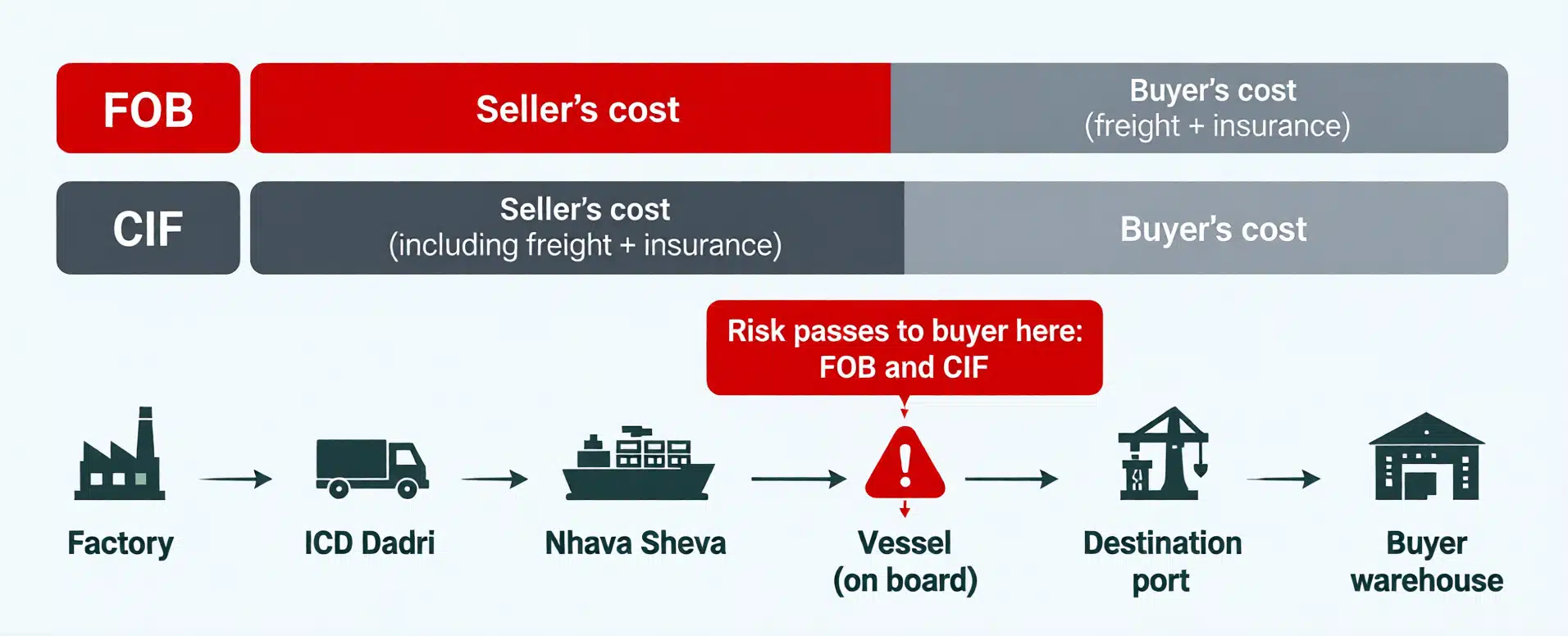
Because risk transfers at loading under both FOB and CIF, any loss at sea is your claim to make. Under CIF the seller must insure the goods for you, but Incoterms 2020 sets that cover at the minimum. The seller insures at least 110% of the contract value under Institute Cargo Clauses (C), unless you agree otherwise.
Clauses (C) is a named-perils policy. It covers events such as fire, sinking and collision, not all loss. For essential oils, the realistic losses are leaking drums, contamination and temperature damage, which sit outside that narrow cover.
If you buy CIF, ask the supplier to quote Institute Cargo Clauses (A), or top up the cover yourself. If you buy FOB, your own policy or your forwarder’s open cover applies from loading.
How FOB and CIF change your landed cost
Landed cost is everything you pay until the oil is in your warehouse:
- product price
- inland transport and export clearance in India (in the price under both terms)
- ocean or air freight
- cargo insurance
- destination port and terminal charges
- customs duty and import tax
- customs broker fees
- delivery to your warehouse
Only freight and insurance change hands between the two terms. Everything after the destination port is yours either way.
Worked example on one essential oil consignment
The figures below are illustrative, not quotes or real tariff rates.
| Line | FOB route | CIF route |
|---|---|---|
| Supplier price | USD 20,000 FOB Nhava Sheva | USD 22,300 CIF destination port |
| Ocean freight booked by your forwarder | USD 1,800 | Included in price |
| Insurance, Clauses (A) | USD 60 | Included, Clauses (C) only |
| Cost to destination port | USD 21,860 | USD 22,300 |
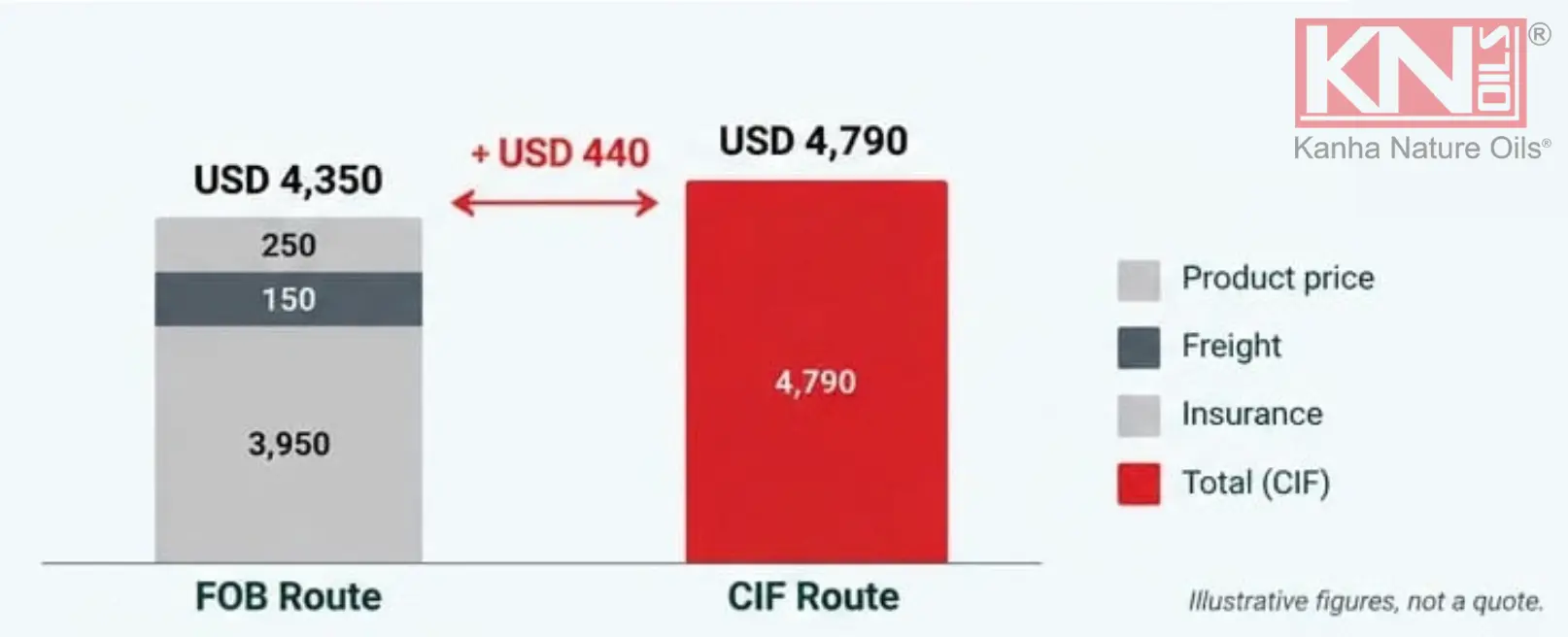
The CIF quote carries USD 440 more than the FOB route, plus thinner insurance. That gap is common, because the seller’s freight booking can include a margin you cannot see. It can also go the other way when the seller ships volume and has better contract rates. The point is to compare like with like: ask the CIF supplier to show freight and insurance as separate lines on the invoice.
The cost a CIF quote does not show
Under CIF the seller chooses the carrier, often a consolidator (NVOCC) that offers the seller a low freight rate. Some consolidators recover that margin at destination, billing the buyer for terminal handling, documentation, delivery order release and de-stuffing. You did not choose that carrier, so you have little room to negotiate, and those charges can exceed the saving the CIF quote appeared to offer.
Before accepting a CIF quote, ask which carrier or consolidator will be used and request an estimate of its destination charges at your port.
Your customs duty base depends on where you import
This is the part most generic Incoterms guides skip.
- United States. US Customs and Border Protection appraises most imports at transaction value, which excludes international freight and insurance under 19 CFR 152.103. If your invoice is CIF, those costs need to be shown separately to be deducted.
- European Union. Under the Union Customs Code, transport and insurance costs up to the EU border are added to the customs value. Duty is effectively charged on a CIF value, whichever term you bought on.
Take the FOB route from the example above and a hypothetical 5% duty rate. A US importer pays duty on USD 20,000 (USD 1,000). An EU importer on the same FOB route pays duty on roughly USD 21,860 (about USD 1,093), because freight and insurance to the border are added.
On the CIF route, the EU duty base is the full USD 22,300 (about USD 1,115). A US importer buying CIF can still deduct freight and insurance, but only if the invoice shows them separately. In both markets, import tax such as EU import VAT is then calculated on top. Check your own tariff line, usually under HS heading 3301 for essential oils, with your customs broker.
The question to ask first: are FOB and CIF the right terms for your shipment?
Under Incoterms 2020, FOB, CFR, CIF and FAS apply only to sea and inland waterway transport. That rules them out for two of the most common essential oil shipments.
Containers and inland depots
Containers are handed to the shipping line at a terminal or inland depot days before loading. Under FOB, risk only moves once the goods are on board, so damage in that gap is disputed. For containerised cargo the ICC recommends FCA, CPT or CIP instead of FOB, CFR or CIF.
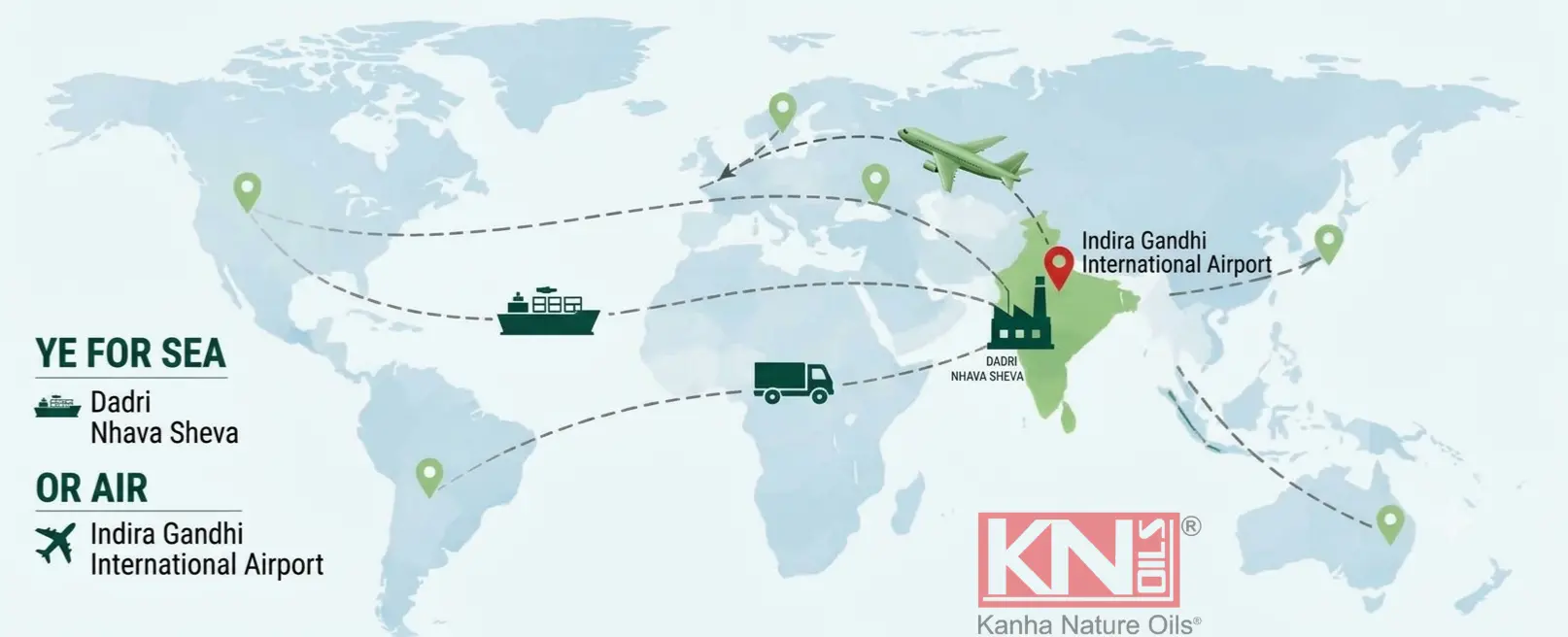
This matters for Delhi NCR suppliers. Their containers are usually stuffed at an inland container depot and railed to a western port. Kanha Nature Oils, for example, ships sea containers from ICD Dadri through Nhava Sheva (JNPT). “FOB Delhi” is not a valid FOB quote, because Delhi has no port. The valid equivalents are FCA ICD Dadri or FOB Nhava Sheva.
Air freight and small drum orders
A first order of a few 25 kg or 180 kg drums often goes by air. From Delhi NCR, air cargo leaves through Indira Gandhi International Airport (IGI), so the matching term is FCA New Delhi (IGI). FOB and CIF do not apply to air. Use FCA (the buyer arranges freight), CPT (the seller pays freight) or CIP (the seller pays freight and insurance). Under Incoterms 2020, CIP requires Clauses (A) all-risks cover, which is stronger protection than CIF.
Dangerous-goods freight changes the calculation
Many essential oils are flammable. Those with a flash point at or below 60 °C can ship as Class 3 flammable liquids under the UN extracts entries. That often includes citrus oils such as lemon and orange, conifer oils such as pine needle, and others such as eucalyptus. Not every oil is dangerous goods; the flash point on the Safety Data Sheet (SDS, formerly called MSDS) decides.
Dangerous-goods cargo costs more to move, needs a shipper’s declaration, and is refused by some carriers and services. A forwarder quoting you FOB freight without seeing the SDS will often quote too low. A supplier quoting CIF who has shipped the same oil before already knows the real rate.
Whichever term you choose, ask for the SDS before you compare freight quotes.
FOB or CIF for essential oil imports from India: which to choose
| Your situation | Better fit |
|---|---|
| You have a forwarder with India contract rates and your own cargo insurance | FCA ICD Dadri for containers, or FOB at the named port (e.g. Nhava Sheva) |
| You import into the US and want the cleanest duty base | FOB or FCA, with freight on a separate invoice |
| First order, no forwarder, small volume | CIF, or CIP if shipping by air or container |
| You want door delivery and no freight booking | DAP: the seller delivers to your door, you still clear customs and pay duty |
| High-value oils, such as floral absolutes like rose absolute or jasmine sambac absolute | CIP, or CIF with Clauses (A) agreed in writing |
| Payment by letter of credit | Either works; agree the documents the bank needs first |
DDP (seller pays your duty too) also exists, but it makes the Indian supplier the importer of record in your country. Agree that explicitly before using it.
Checklist before you accept a quote
- Is the named place a real port for FOB or CIF, or should the term be FCA, CPT or CIP?
- Under CIF, are freight and insurance shown as separate lines?
- Which Institute Cargo Clauses does the insurance follow, and at what percentage of value?
- Has the freight quote been priced against the SDS and dangerous-goods status?
- Who pays destination terminal and documentation charges under the carrier the seller chose?
- What value will your customs authority use for duty: FOB or CIF?
- Does the consignment arrive with COA, SDS and GC-MS, so customs and your QC can release it without delay?

Related buyer guides
- Before you compare freight, check the paperwork: COA, SDS, IFRA and allergen statements: the four documents to demand before you order
- Verify what is in the drum: How to read a GC-MS report for essential oils: a buyer’s guide
- The commercial terms that come before freight: Bulk lavender oil from India: MOQ, pack sizes, lead time and shipping terms
- Shortlisting suppliers: How to choose a reliable essential oil exporter from India: 7 things to check
- Importing into the US: How to choose a reliable essential oil bulk supplier for the USA market
Frequently asked questions
Is FOB or CIF cheaper for importing essential oils from India?
FOB is usually cheaper in total if you have a forwarder with good India rates, because you see and negotiate the freight yourself. CIF can be cheaper for small or occasional buyers when the supplier ships volume on the same lane. Compare both on a cost-to-destination-port basis, not on the headline price.
Who bears the risk if drums are damaged at sea under CIF?
The buyer. Under both FOB and CIF, risk passes once the goods are loaded on the vessel in India. Under CIF you claim on the insurance policy the seller bought for you, so check its cover before shipment.
Does the US charge import duty on the CIF value?
No. US Customs generally excludes international freight and insurance from the dutiable value. Show those costs as separate lines on a CIF invoice so they can be deducted.
Does the EU charge import duty on the CIF value?
Yes. EU customs value includes transport and insurance up to the point of entry into the EU, whatever Incoterm you bought on.
Can I use FOB for an air shipment of essential oils?
No. FOB and CIF are sea and inland waterway terms only. For air, use FCA, CPT or CIP.
Are essential oils dangerous goods for shipping?
Some are. Oils with a flash point at or below 60 °C can be classed as Class 3 flammable liquids. The supplier’s SDS states the flash point and transport classification for each oil.
Which Incoterm should I use for a full container from Delhi NCR?
For a container routed through ICD Dadri, use FCA ICD Dadri, or FOB or CIF named at the loading port, Nhava Sheva. Avoid any FOB quote named at an inland city.
About Kanha Nature Oils
Kanha Nature Oils manufactures and exports over 250 essential oils, attars, oleoresins, hydrosols, floral absolutes, spice oils and carrier oils from Bahadurgarh, India, and supplies buyers in more than 30 countries. Certificates, including ISO 9001, WHO-GMP, KOSHER and HALAL, are shared as applicable to each buyer’s product and market. COA, SDS and GC-MS are issued for the specific product and batch, in line with each buyer’s requirements.
We don’t ask you to trust us. We ask you to test us.
Sea shipments leave from ICD Dadri through Nhava Sheva, and air shipments from IGI Delhi. We quote FCA, FOB, CIF, CIP or DAP as applicable to your order. Tell us your oil, quantity and destination, and we will quote on the terms that fit.
About the author

Piyush Gupta is the Founder & CEO of Kanha Nature Oils, with 27 years in the fragrance and essential oils industry. He serves as Regional Secretary (North Zone) of FAFAI, Treasurer of EOAI, and Vice President of Sugandh Vyapar Sangh North Zone. More about Kanha Nature Oils
We don’t ask you to trust us. We ask you to test us.
Email: info@aromatherapyoil.in
Phone: +91 98108 05866
Unit-1: Adjoining HUDA Plot No. 682, M.I.E. Part-1, Bahadurgarh, Haryana – 124507
Unit-2: 677, M.I.E., Part-1, Bahadurgarh, Haryana – 124507

Pingback: Bulk Fragrance Oil Manufacturer & Exporter | Kanha Nature Oils