
COA, MSDS, IFRA and Allergen Statements: The Four Documents to Demand Before You Order
Before placing an order with an essential oil supplier, ask for four documents: a Certificate of Analysis, an MSDS/SDS, an IFRA statement, and an allergen declaration. Together, these four papers answer the questions that actually determine whether an oil is usable — what’s in it, how to handle it safely, whether it’s cleared for the application you have in mind, and what you’re legally required to put on a label. A supplier who can produce all four without delay is telling you something about how the business is run before you’ve spent a single dollar.
This isn’t a compliance formality. Buyers searching for essential oil COA MSDS IFRA documents supplier are usually a few weeks from placing a real order and want to know what each document actually proves — and what it doesn’t — before they commit to a shipment. It’s the same due-diligence instinct behind how Kanha Nature Oils runs its own manufacturing and export operation — testing before dispatch, not after a complaint.
The Four Documents, At a Glance
| Document | What It Proves | Who Usually Asks For It |
|---|---|---|
| COA (Certificate of Analysis) | Batch-specific identity and purity — GC-MS profile, physical parameters, sometimes microbial or heavy-metal data | Formulators, QA teams, resellers verifying authenticity |
| MSDS / SDS | Hazard classification, handling, storage, and emergency information | Freight forwarders, customs, warehouse and EHS teams |
| IFRA Statement | Confirms the oil complies with current IFRA usage restrictions for fragrance/cosmetic applications | Cosmetic, perfumery, and fragrance-compound manufacturers |
| Allergen Statement | Lists allergenic components present under the expanded EU list (Regulation (EU) 2023/1545), with concentrations where required | Anyone formulating a product sold in the EU/UK |
1. Certificate of Analysis (COA) — Proof of What’s Actually in the Drum
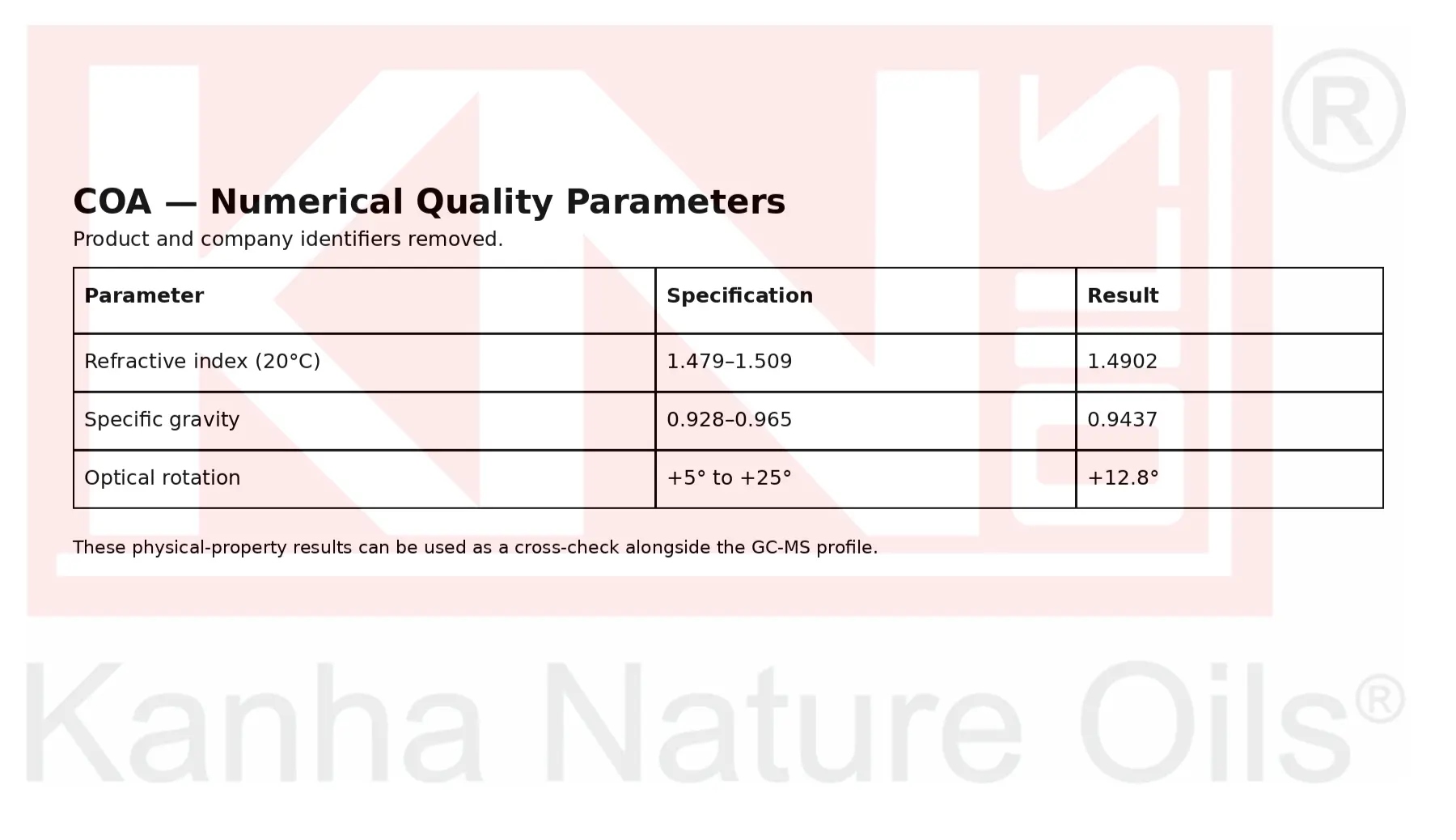
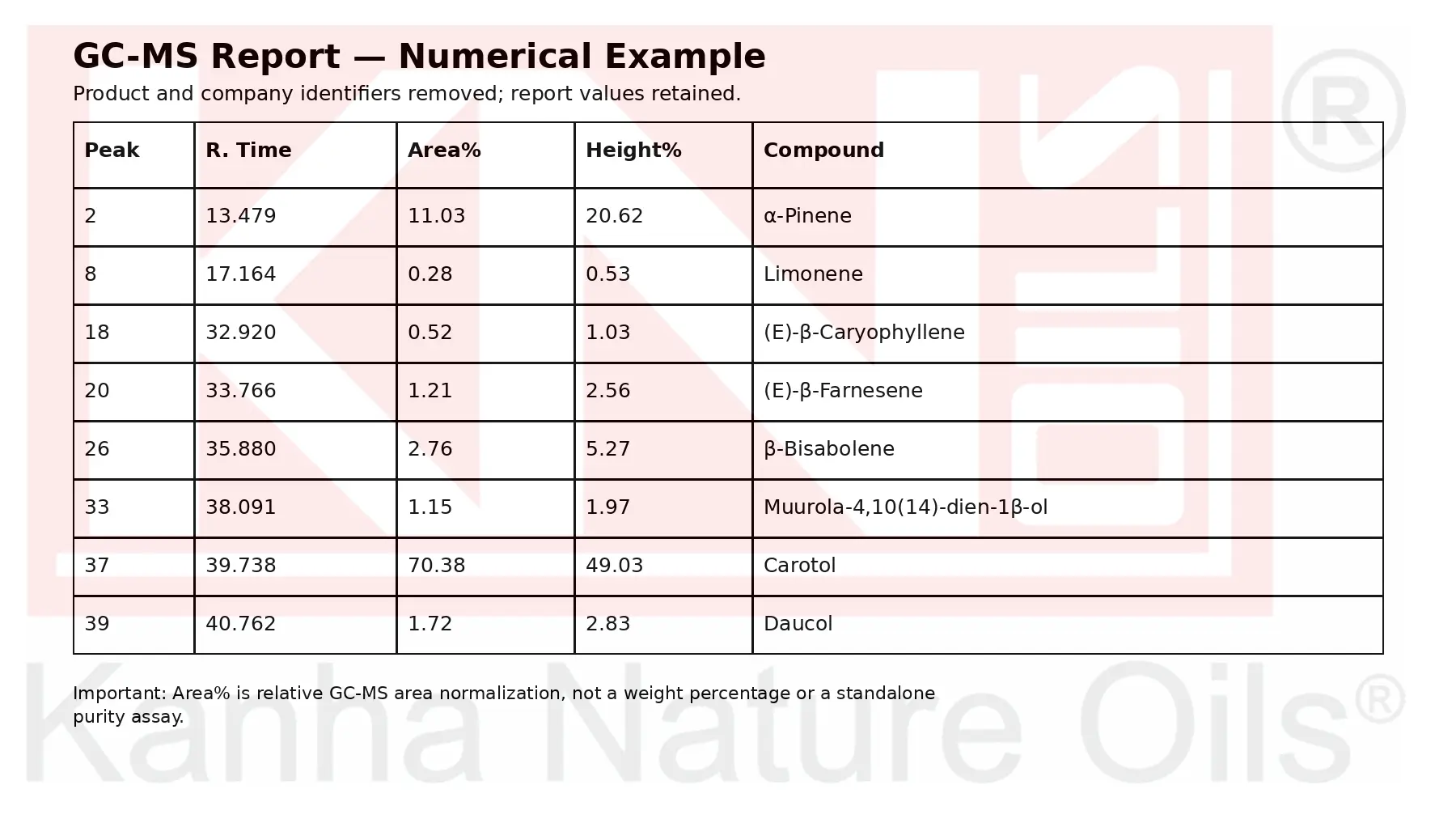
A COA is batch-specific. It should be tied to the exact batch or lot number on the drum you’re receiving, not a generic specification sheet reused across every shipment. A proper COA for an essential oil typically includes the GC-MS profile (the major constituents and their percentage ranges), physical parameters such as specific gravity, refractive index, and optical rotation, and — depending on the oil — microbial or heavy-metal data. If you want to go deeper on reading the chemical data itself, see how to read a GC-MS report for essential oils — the COA’s purity claim is only as good as the GC-MS behind it.
The batch number on the COA is what lets you trace a specific drum back to a specific production run if a quality question comes up later. A COA without a batch number tied to your shipment isn’t fully verifiable — ask the supplier to confirm the match before the goods ship.
2. MSDS/SDS — Proof It Can Be Handled and Shipped Safely
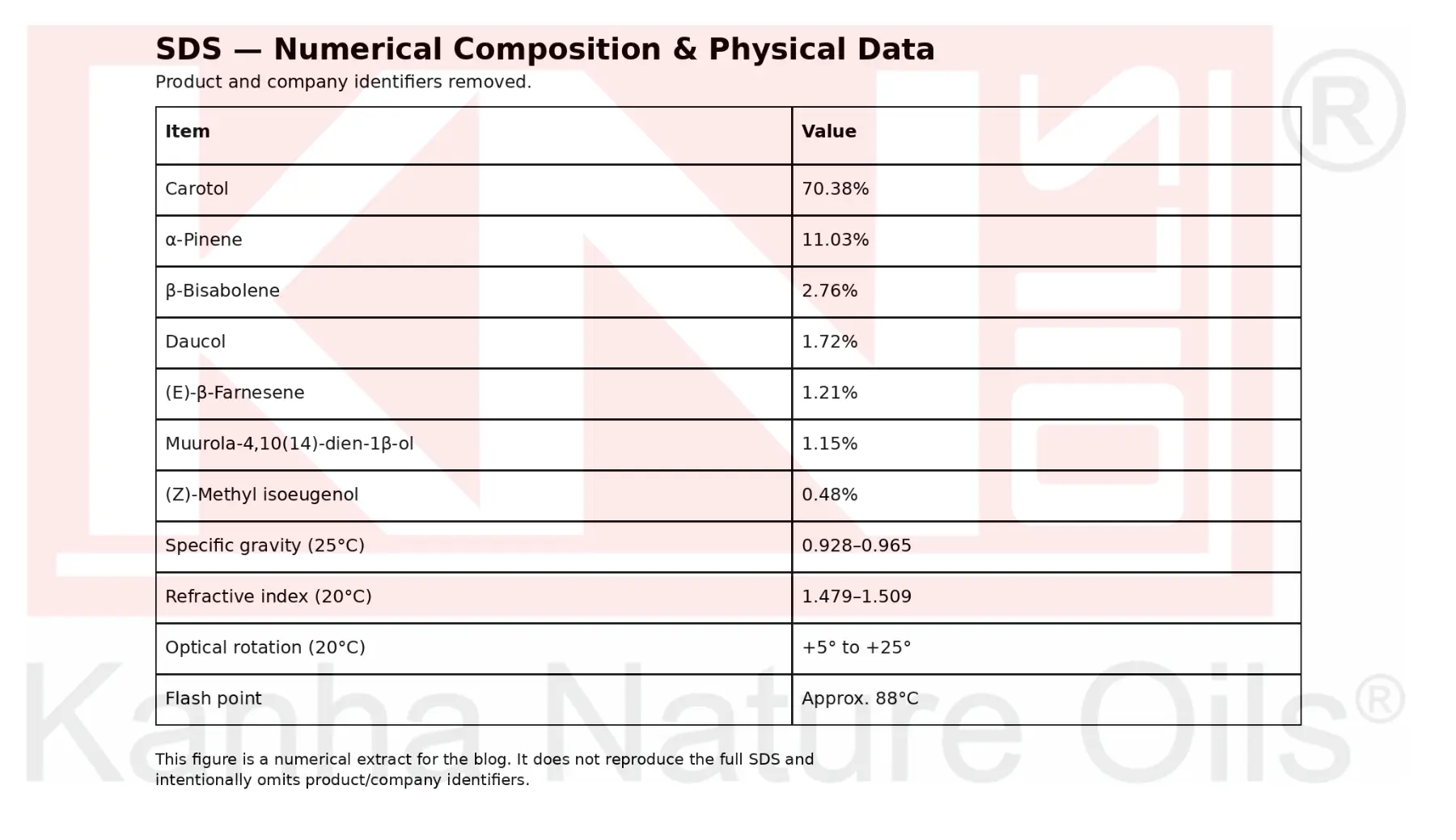
The Material Safety Data Sheet — now more commonly formatted as an SDS (Safety Data Sheet) under the GHS 16-section format — covers hazard classification, first-aid measures, fire-fighting guidance, handling and storage requirements, and transport information. This is the document your freight forwarder, customs broker, and warehouse team will actually use; it’s less about the oil’s aromatic or therapeutic properties and more about how it behaves as a chemical cargo.
Many essential oils are classified as flammable liquids or skin/eye irritants under GHS, which affects packaging, labeling, and shipping class. If your supplier’s paperwork is still labeled “MSDS” in the older format rather than the current 16-section SDS layout, it’s worth asking whether an updated version is available — some customs authorities now expect the current format.
3. IFRA Statement — Proof It’s Cleared for Use in Finished Products
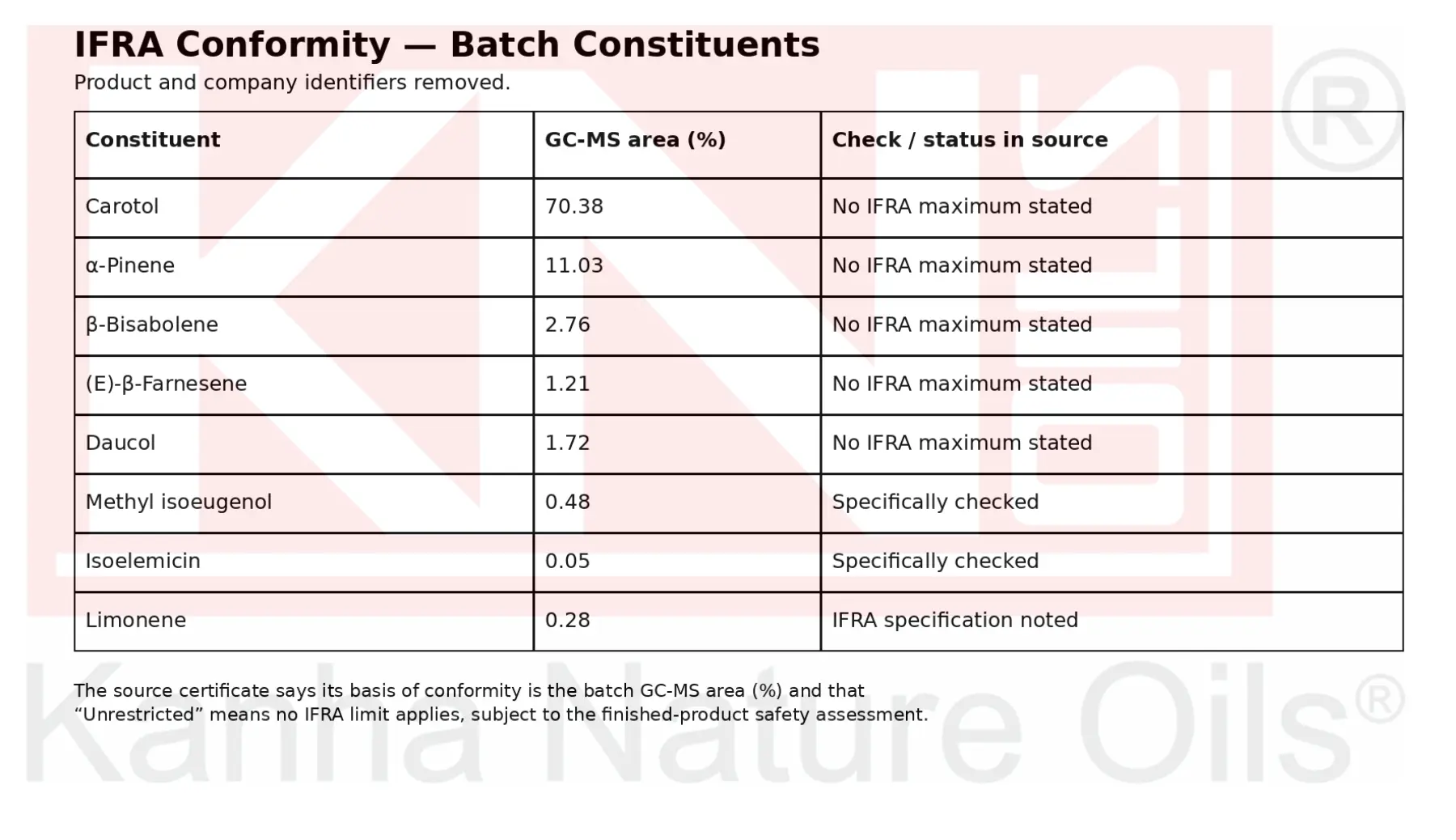
The International Fragrance Association (IFRA) publishes Standards that restrict or prohibit certain materials, or cap their concentration, in finished fragrance and cosmetic products. An IFRA Certificate or Statement of Conformity confirms that the oil, as supplied, is compatible with current IFRA Standards for the intended use category.
This matters most if you’re formulating perfumes, fine fragrance, cosmetics, or scented consumer products — an oil that’s perfectly fine as a raw material can still be restricted at certain usage levels in a finished product. If you’re buying purely for aromatherapy diffusion or as a raw trading commodity, an IFRA statement is less critical, but most reputable suppliers maintain one regardless, since it’s frequently the first document a downstream buyer will ask for.
4. Allergen Statement — Proof of What Must Be Declared on a Label
If your finished product will be sold in the EU, an allergen statement is not optional. Annex III of the EU Cosmetics Regulation (EC) No 1223/2009, as amended by Regulation (EU) 2023/1545, requires listed fragrance allergens to be named on the label when they exceed 0.001% in leave-on products or 0.01% in rinse-off products. The 2023 amendment expanded the list from 26 to more than 80 substances, with a transition period running to 2028 for products already on the market. Check that your supplier’s declaration covers the current expanded list, not the older 26. Kanha Nature Oils’ allergen declarations cover the full expanded list, analysed by GC-MS. Buyers selling into the UK should confirm the current UK requirement separately.
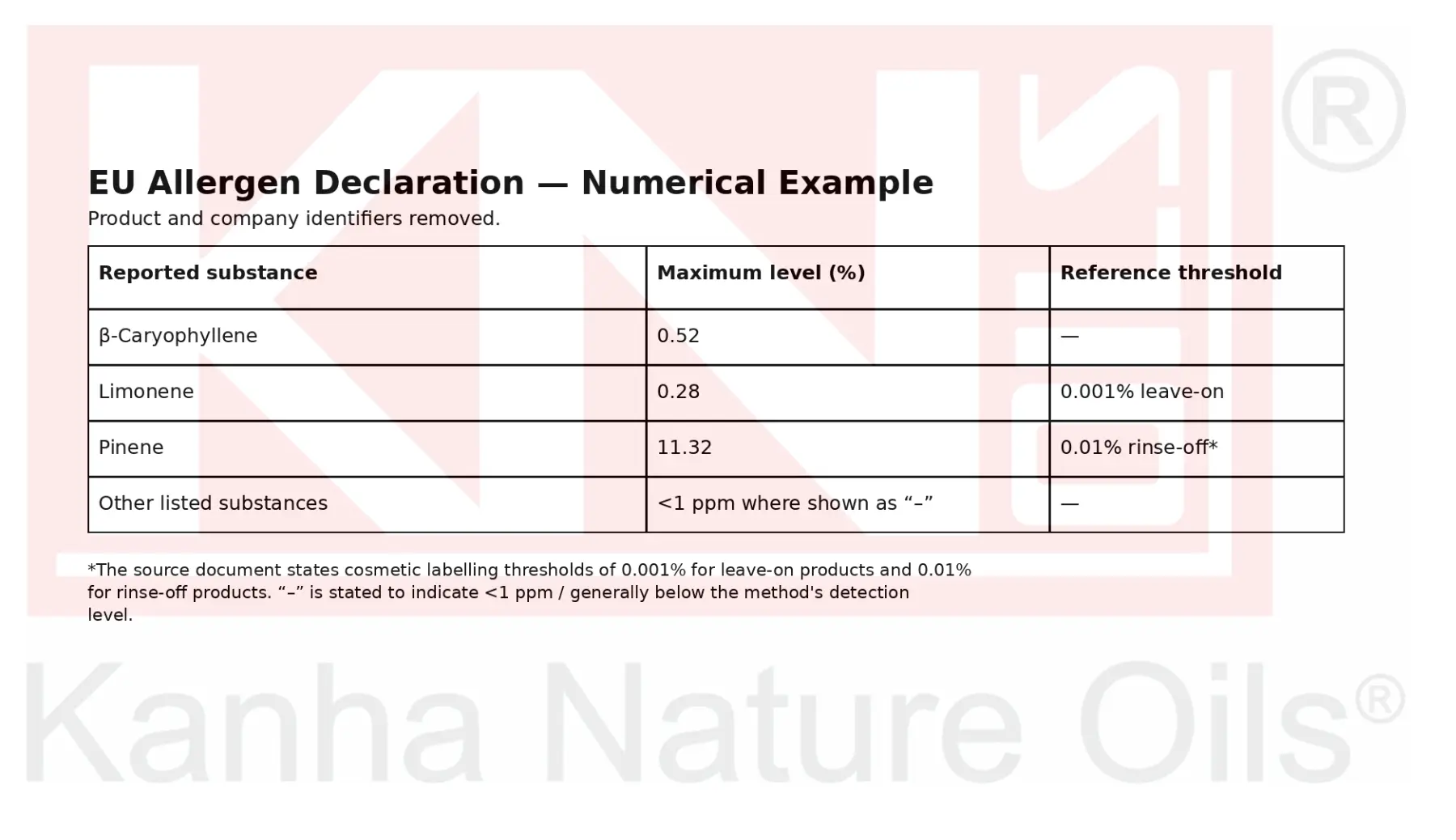
This is a naturally occurring-components declaration, not a claim that the oil contains added allergens — many of these compounds are simply part of the oil’s natural chemistry. But without this statement, you cannot correctly complete your own product’s labeling, and an incomplete label is a compliance gap that surfaces at the worst possible time — during a customs inspection or a retailer’s compliance audit.
Why These Four, and Not More or Fewer
Buyers sometimes ask for additional paperwork — ISO 9001:2015, ISO 14001:2015, WHO-GMP, HACCP, KOSHER, HALAL certificates, country-of-origin declarations — and those have their place depending on the product. But COA, MSDS/SDS, IFRA, and allergen statement form the baseline because each one answers a distinct question no other document covers: identity and purity (COA), handling safety (MSDS/SDS), fragrance-use compliance (IFRA), and label compliance (allergen statement). Asking for fewer than these four leaves a real gap in what you know about the shipment before it arrives.
What to Ask a Supplier Before You Order — A Short Checklist
- Is the COA specific to the batch/lot number that will ship, or a generic specification sheet?
- Is the safety data sheet a current 16-section SDS, or an older MSDS format?
- Does the IFRA statement reference the current IFRA Standards amendment?
- Does the allergen statement list concentrations, or only presence/absence?
- Can all four documents be provided before payment, not only after?
- Is there a single point of contact who can answer follow-up technical questions on any of the four documents?
Kanha Nature Oils can provide all four documents for every product it supplies: a COA with its GC-MS report, a 16-section SDS in the current EU format (Regulation (EU) 2020/878), an IFRA Certificate of Conformity against the 51st Amendment, and an EU allergen declaration covering the full expanded list under Regulation (EU) 2023/1545. All four are issued on request for the specific product and batch. Buyers vetting a supplier are welcome to request sample documentation directly before placing an order.
If a Supplier Can’t Produce One of These, Treat It as a Signal
A supplier who hesitates, delays, or offers a vague “we can arrange that” when asked for a COA, SDS, IFRA statement, or allergen declaration is telling you something about their internal quality and testing infrastructure. These documents aren’t generated on request from nothing — a supplier who tests batches and maintains current regulatory documentation as a matter of routine can usually produce them within a day or two. One who can’t may not be testing at all.
FAQ
What’s the difference between an MSDS and an SDS?
They cover the same information — hazard, handling, storage, and transport data — but SDS refers to the current 16-section GHS-aligned format, while MSDS is the older, less standardized format it replaced. Most regulators now expect the SDS format.
Do I need an IFRA statement if I’m only buying for aromatherapy use, not cosmetics?
Not strictly, since IFRA Standards govern fragrance and cosmetic use categories. But requesting one is still useful — it confirms the supplier maintains current regulatory documentation, which is a reasonable proxy for overall quality practices.
Is an allergen statement the same as an ingredient list?
No. It’s a declaration of which allergenic components under the expanded EU list (Regulation (EU) 2023/1545) are naturally present in the oil and at what approximate level, used to complete your own finished product’s label — not a general ingredient breakdown.
Should the COA match the exact batch I’m buying, or is a general spec sheet acceptable?
It should match the specific batch/lot number shipping to you. A general specification sheet describes what the oil is typically like, not what’s actually in your drum.
Can I request these documents before placing an order, or only after?
A supplier confident in its documentation should be able to share samples of COA, SDS, IFRA, and allergen-statement formats before you order, so you can review them as part of your supplier evaluation — not only after payment.
Get a Wholesale Fragrance Quote
Manufacturers looking for fragrance for candle, face cream, body lotion, hair oil, shampoo, or massage oil production can request a bulk sample or wholesale quote directly from Kanha Nature Oils:
- 🔗 Website: kanhanatureoils.com
- 📧 Email: info@aromatherapyoil.in
- 📞 Phone: +91 98108 05866
- 📍 Unit-1: Adjoining HUDA Plot No.682, M.I.E Part-1, Bahadurgarh, Haryana – 124507
- 📍 Unit-2: 677, M.I.E, Part-1, Bahadurgarh, Haryana – 124507
Kanha Nature Oils manufactures and exports over 250 essential oils, attars, oleoresins, hydrosols, floral absolutes, spice oils and carrier oils from Bahadurgarh, India. ISO 9001:2015, ISO 14001:2015, WHO-GMP, HACCP, KOSHER, HALAL certified. Supplying buyers in more than 30 countries. COA, SDS, IFRA certificate and allergen declaration issued on request for the specific product and batch.
We don’t ask you to trust us. We ask you to test us.