
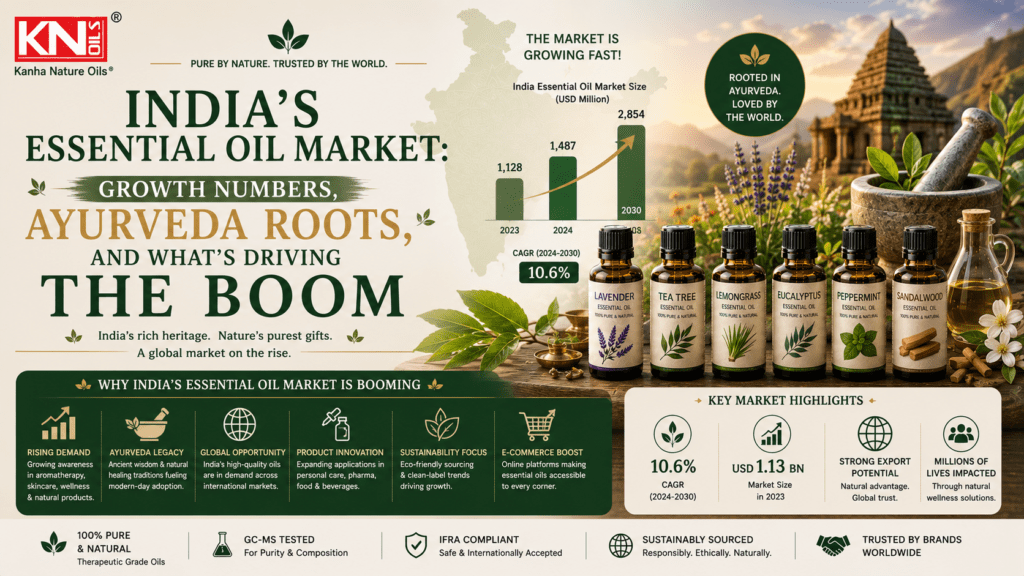
India’s Essential Oil Market: Growth Numbers, Ayurveda Roots, and What’s Driving the Boom
India’s relationship with essential oils isn’t new — it stretches back thousands of years to Ayurvedic texts and traditional aromatic practices. What is new is the pace at which this ancient category is turning into a modern, fast-growing commercial market. For anyone sourcing, selling, or building a brand around essential oils in India, the current numbers tell a clear story of sustained, structural growth.
The Numbers: How Big Is the Market, Really?
Market size estimates vary depending on the research firm and methodology, but the direction is consistent across all of them.
According to IMARC Group, India’s essential oil market reached USD 193.44 million in 2025, and separate IMARC data projects it will grow at a compound annual growth rate of 5.20% from 2026 to 2034, reaching USD 305.35 million by 2034. Transparency Market Research offers a more bullish outlook, placing the market at US$203.5 million in 2024 and forecasting growth to US$455.5 million by 2035 at a 7.6% CAGR. Bonafide Research’s outlook is more aggressive still, projecting the market to grow above 10.21% annually from 2026 to 2031, driven largely by Ayurveda adoption and export demand.
Regardless of which forecast proves most accurate, the underlying signal is the same: India is one of the fastest-growing essential oil markets globally, even if it remains a modest slice of the worldwide industry today.
What’s Actually Driving the Growth
- Ayurveda Is the Market’s Cultural Foundation, Not Just a Marketing Angle
Unlike many Western markets where essential oils are a relatively recent wellness trend, India’s use of aromatic plants and essential oils traces back to ancient texts like the Vedas and Ayurvedic scriptures, where they remain integral to treatments for both physical and mental health. This gives Indian brands a genuine cultural credibility that’s difficult for international competitors to replicate — and it’s a positioning advantage worth leaning into rather than treating essential oils as just another imported wellness fad.
- Eucalyptus Leads, But the Category Is Diversifying
Eucalyptus oil currently holds the largest share of the Indian market at 22% in 2025, driven by strong therapeutic use in respiratory care, aromatherapy, and demand from pharmaceutical manufacturers. At the same time, other reports note that peppermint oil holds the largest share within its own segment and is expected to grow at roughly 7.3% CAGR, and sandalwood — particularly Mysore sandalwood — remains highly prized in perfumery, skincare, and religious use. The takeaway for sellers: this isn’t a single-product category. Buyers are increasingly segmenting by specific oil and specific use case, not just “essential oils” as a blanket term.
- Cosmetics and Personal Care Are Pulling Demand Upward
Rising demand from the cosmetics and personal care sector is one of the clearest growth drivers identified across multiple reports. As Indian consumers shift toward natural and clean-label skincare and haircare, essential oils are increasingly formulated directly into finished products rather than sold only as standalone bottles — creating a second, parallel demand channel beyond direct-to-consumer aromatherapy sales.
- Export Demand Is a Structural Growth Lever
Growth isn’t purely domestic. Export demand is cited as one of the two primary drivers of India’s accelerating growth forecast, alongside Ayurveda-linked domestic adoption. For producers and wholesalers, this means the addressable market extends meaningfully beyond India’s borders, particularly for oils where India already has strong agro-climatic advantages.
- E-Commerce Is Lowering the Barrier for New Brands
Multiple reports point to expanding direct-to-consumer and e-commerce distribution channels improving product accessibility and enabling smaller brands to reach quality-conscious buyers. This matters particularly for India, where a smaller brand no longer needs a national retail footprint to build a real essential oil business — a well-run D2C Shopify or marketplace presence is often enough to compete.
Where India Sits Globally
It’s worth keeping this growth in context. India represented roughly 2.74% of the overall global essential oils market as of 2024, and remains a relatively small player compared to established markets. But that same modest current share is exactly why the growth rate matters more than the absolute size right now — India is still early in its essential oil market maturity curve, which is typically where the fastest percentage gains happen.
What This Means for Businesses in the Space
For wholesalers, formulators, and D2C brands operating in this category, three practical implications stand out:
Category depth beats category breadth. With eucalyptus, peppermint, and sandalwood each carving out distinct demand profiles, a strategy built around understanding specific oil-level demand will outperform a generic “essential oils” positioning.
Ayurveda credibility is a genuine differentiator, not just a marketing add-on — brands that can authentically connect their sourcing and formulation to Ayurvedic tradition have a real edge in a market where that heritage is deeply trusted.
Export readiness is worth building early. Given that export demand is already flagged as a core growth driver, businesses that get their documentation, traceability, and quality certification in order now will be better positioned to capture that upside as it scales.
India’s essential oil story right now is one of a traditional, culturally rooted category entering a genuinely modern growth phase — and the numbers suggest this is still the early part of that curve, not the peak.