
Private Label Essential Oils from India: MOQ, Packaging and Labelling Explained
If you are looking for a private label essential oil manufacturer in India, three things decide whether the project works: how the minimum order quantity (MOQ) is structured, how the oil is packed for both the shelf and the shipment, and who legally carries the label in your destination market. Below are the checks to make before you pay a deposit.
A note on where we stand: Kanha Nature Oils does not offer private labelling. We do not label or pack oils under any other company’s brand, whether the order is a single pack or bulk. Our oils are sold under the Kanha Nature Oils brand only. The checks below apply whichever supplier you choose.
Short answer: Private label essential oil from India is often quoted with separate minimums: one for the oil itself (kilograms per oil) and one for packaging and printed labels (units per bottle size and label design). Once your brand name is on the label, your company carries the labelling responsibility in the destination market, so request the safety documents (COA, SDS, GC-MS, and IFRA and allergen statements where relevant) before artwork is finalised.
What “private label” means, and what it does not
Private label means a manufacturer supplies oil, filled and packed, that you sell under your own brand. Three nearby arrangements are often confused with it:
- White label: the same ready-made product is offered to several brands with only the label changed.
- Contract blending: the manufacturer develops a blend to your brief, which adds formulation, safety assessment and IFRA work.
- Bulk supply: you buy the oil and handle filling and branding yourself.
Each changes the MOQ, lead time and responsibilities, so decide which you need before sending an enquiry.
How MOQ works with a private label essential oil manufacturer in India
An MOQ is rarely one number. Ask for each of these separately:
| MOQ type | What it covers | What to ask |
|---|---|---|
| Oil MOQ | Kilograms of each oil | Is it per oil or per order? Does the price change by quantity? |
| Packaging MOQ | Bottles, closures, cartons | Are stock bottles available, or is the packaging custom? |
| Label MOQ | Printed labels per design | Who pays for artwork and printing, and what is the minimum print run? |
| Sample or trial | Pre-commitment testing | Are samples charged, and are they drawn from a real batch? |
For reference, Kanha’s own minimum export order is 1 kg for every oil, across our essential oils and carrier oils ranges, with 100 ml trial packs for evaluation. That is a bulk-oil figure under our own brand. In private label, packaging and label print runs often set the real minimum, so a low oil MOQ alone does not tell you your cost per unit. You can see how we set out MOQ and pack sizes for a single oil in our bulk lavender oil guide.
Packaging: two layers to plan

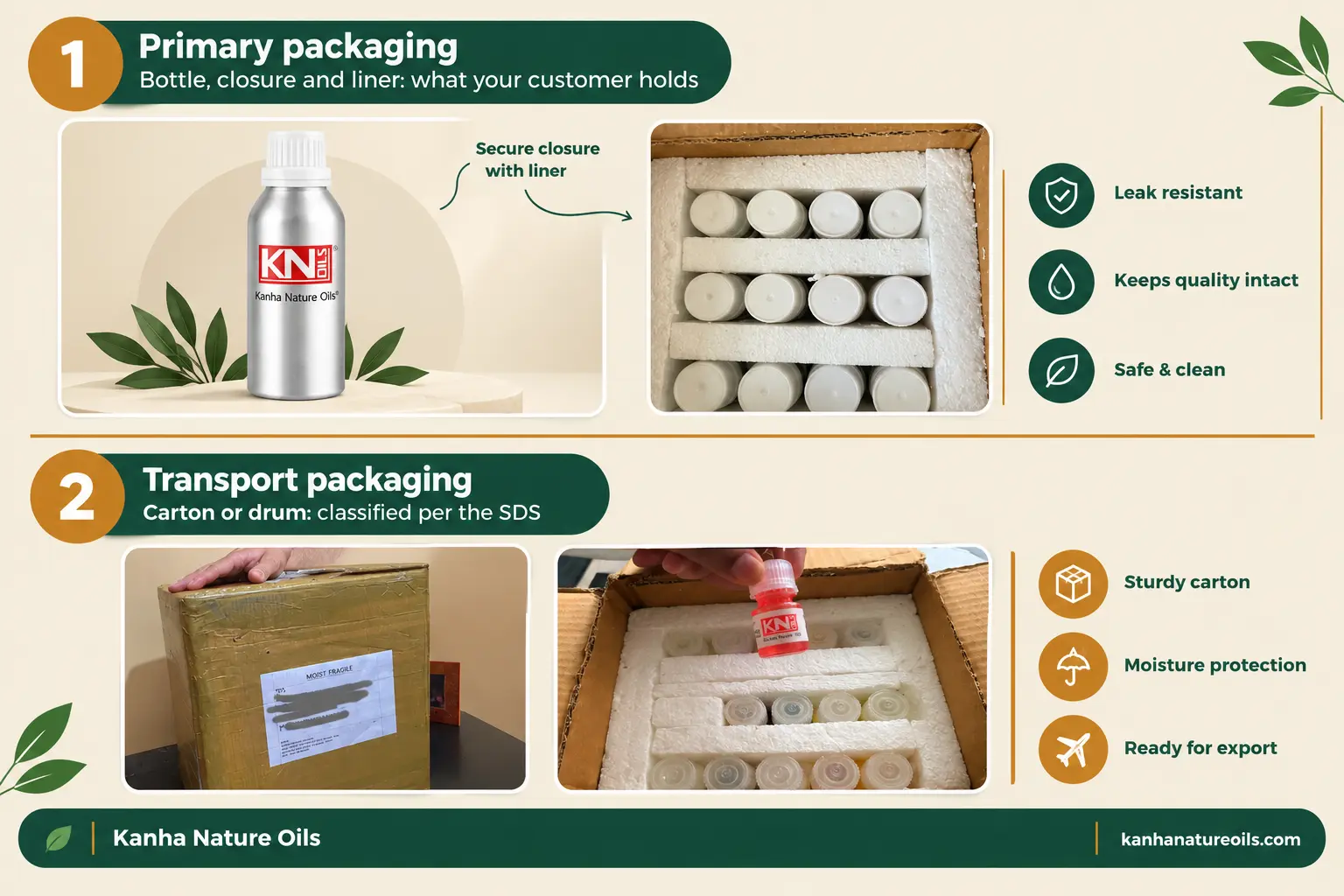
Primary packaging is what your customer holds: bottle material (amber glass and aluminium are common), closure type, tamper evidence and fill volume. Citrus and other terpene-rich oils can degrade some plastics and rubber, so ask which closure and liner materials the supplier has checked against your specific oil.
Transport packaging is where many first-time buyers are caught out. Many essential oils, especially those with a low flash point, are classified as flammable liquids (Class 3) in transport. Air freight can then require dangerous-goods packaging, marking and paperwork. The classification depends on the oil and the quantity, and it is stated in the transport section of the SDS. Confirm it with your freight forwarder before you commit to a shipping route, and settle your Incoterms early: our guide to FOB or CIF for essential oil shipments explains how the choice splits freight and risk.
Labelling: two label layers, and who is responsible

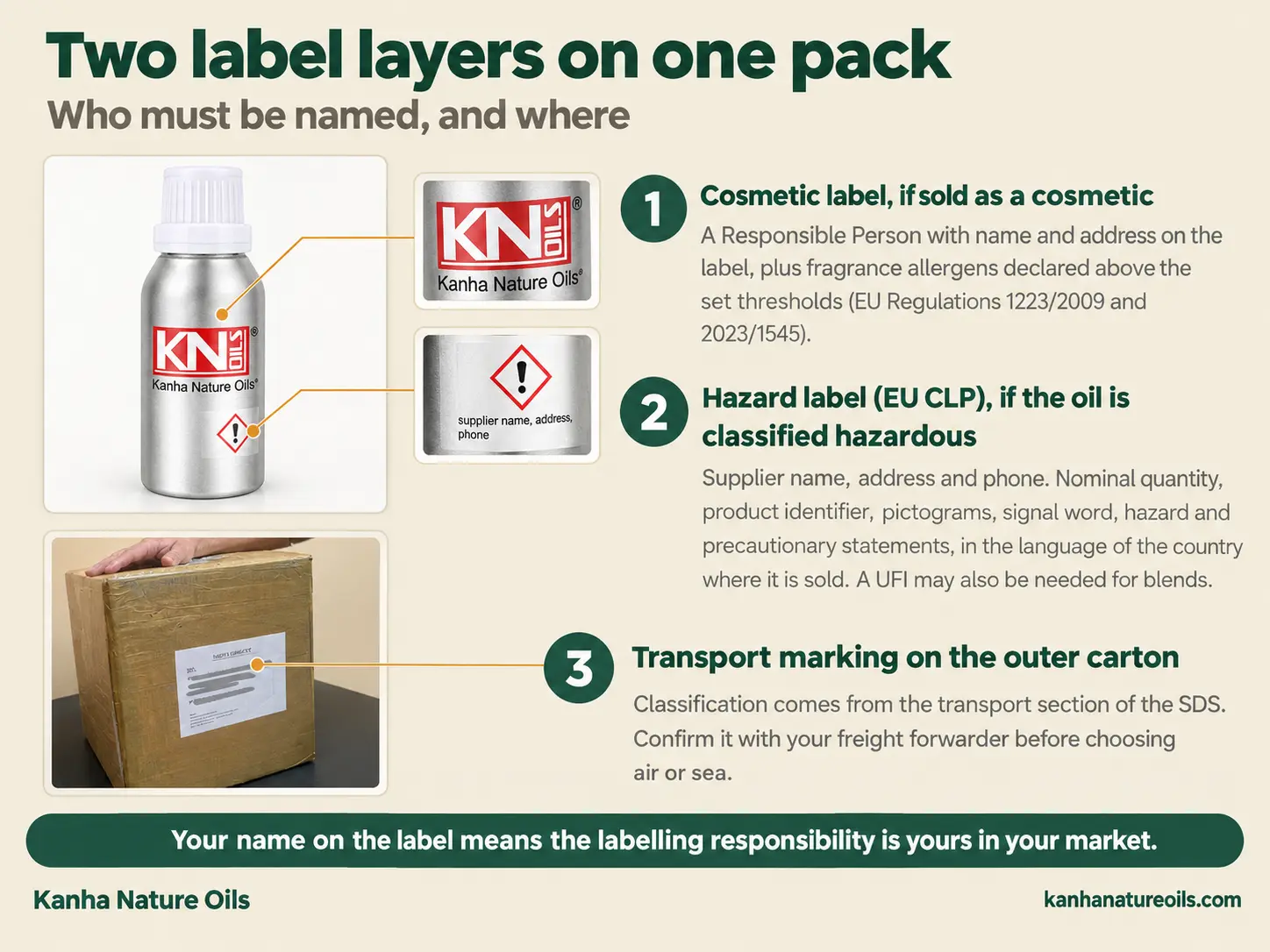
Most private label oils need two kinds of information on or with the pack.
| Label layer | What it covers | Rule |
|---|---|---|
| Hazard label (EU CLP) | Supplier name, address and phone, nominal quantity, product identifier, pictograms, signal word, hazard and precautionary statements, in the language of the member state where it is sold. Hazardous mixtures such as blends may also need a UFI. | Regulation (EC) 1272/2008 |
| Cosmetic label (if sold as a cosmetic) | A Responsible Person with a name and address on the label, plus declaration of fragrance allergens above set thresholds. | Regulation (EC) 1223/2009, Regulation (EU) 2023/1545 |
| US cosmetic label | FDA labelling rules under MoCRA, including a fragrance-allergen labelling rule that FDA is required to issue. Check its current status before finalising US artwork. | FDA MoCRA |
The central point for a private label buyer is that putting your name on the label moves responsibility to you:
- Under the EU Cosmetics Regulation, a distributor who places a product on the market under its own name or trademark becomes the Responsible Person.
- Under CLP, in force since 1 July 2026, a substance or mixture cannot be placed on the EU market unless an EU-established supplier is identified and meets the CLP obligations. CLP already requires the supplier’s name and address on the label.
- The EU allergen list was expanded from 26 to 82 substances by Regulation (EU) 2023/1545. It has applied to new products since 31 July 2026; products already on the market have until 31 July 2028. A new product shipped to the EU today must already comply.
Which regime applies depends on how you market the product. Therapeutic claims can move it into a stricter category, so settle your claims with a regulatory adviser first.
Documents to request before you approve artwork
Your label is only as accurate as the paperwork behind it. Ask for these for the batch you are buying:
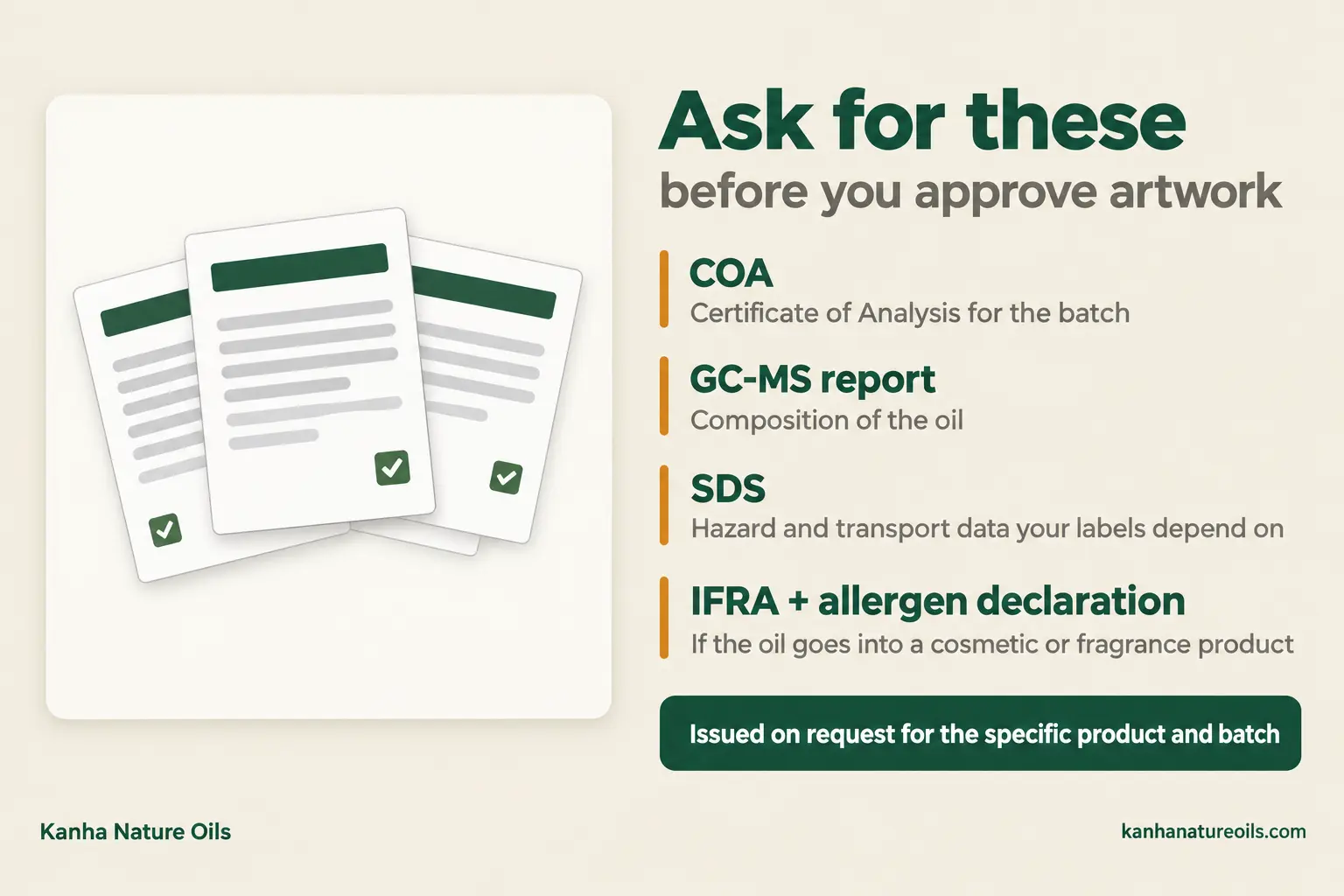
- COA (Certificate of Analysis) for the batch. Our guide to the four documents to demand before you order covers COA, SDS, IFRA and allergen statements together.
- GC-MS report, which shows the composition. Our guide to reading a GC-MS report explains what to look for.
- SDS (Safety Data Sheet, still widely called MSDS), which supplies the hazard classification and transport data your labels depend on.
- IFRA certificate and allergen declaration, if the oil goes into a cosmetic or fragrance product.
At Kanha Nature Oils, these documents are issued on request for the specific product and batch. If you plan to verify what arrives, seven tests that catch adulterated essential oil is a practical next read.
Seven questions to settle before you sign
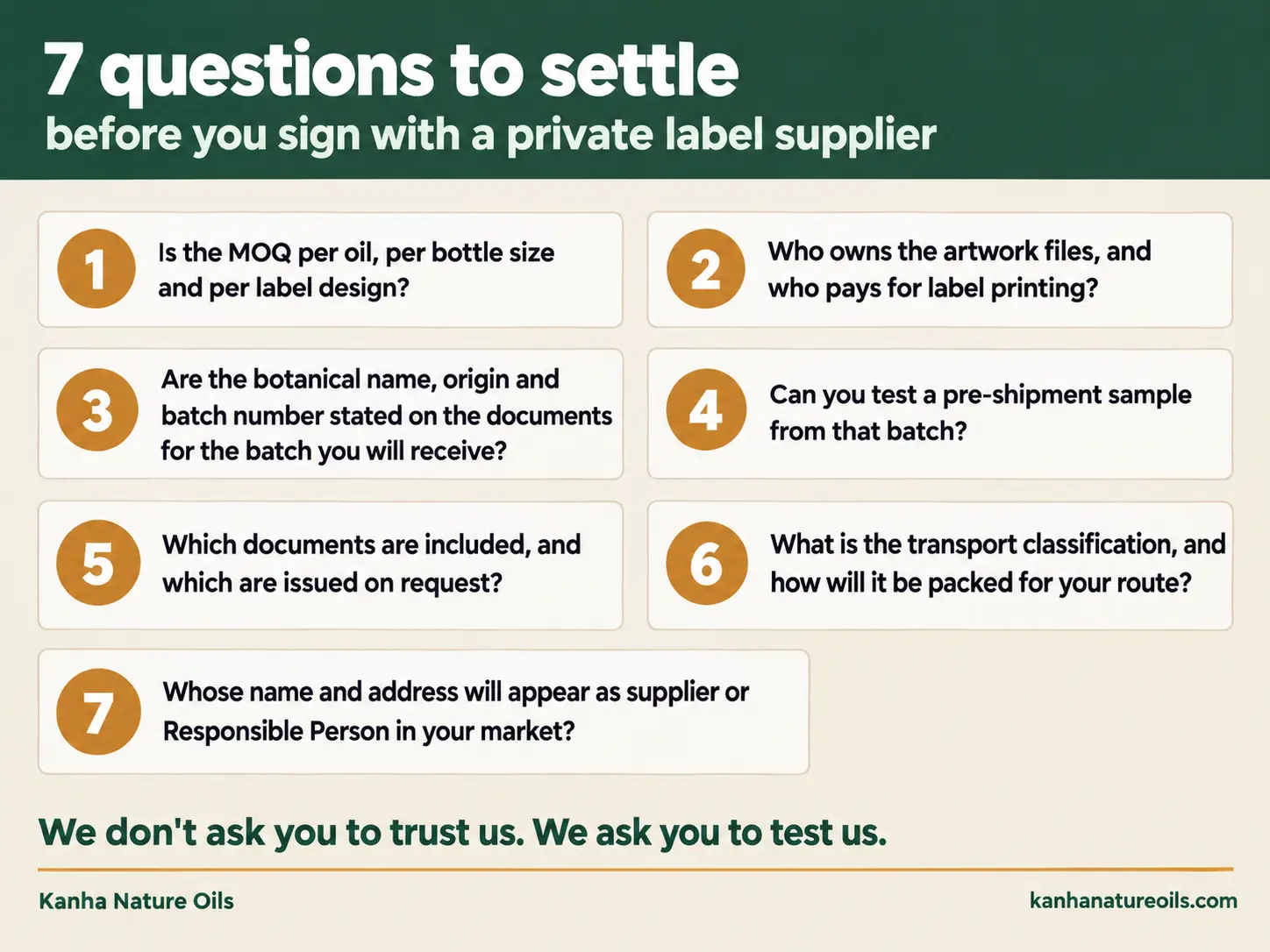
- Is the MOQ per oil, per bottle size and per label design?
- Who owns the artwork files, and who pays for label printing?
- Are the botanical name, origin and batch number stated on the documents for the batch you will receive?
- Can you test a pre-shipment sample from that batch?
- Which documents are included, and which are issued on request?
- What is the transport classification, and how will it be packed for your route?
- Whose name and address will appear as supplier or Responsible Person in your market?
Where Kanha Nature Oils fits
If you need your own brand on the bottle, put the seven questions above to any prospective supplier and test a sample first. If you want to evaluate Kanha oils under the Kanha Nature Oils name, bulk supply starts from a 1 kg export order, with 100 ml trial packs before you scale. Start from our products, read about Kanha Nature Oils, or send an enquiry. Our sister site aromatherapyoil.in lists the aromatherapy range, and bulk enquiries are handled through kanhanatureoils.com.
Related reading
- How to read a GC-MS report for essential oils: a buyer’s guide
- COA, MSDS, IFRA and allergen documents to demand before you order
- IFRA 51st Amendment: which oils it affects and what your supplier must send you
Frequently asked questions
What is a private label essential oil manufacturer?
A manufacturer that produces, fills and packs essential oils for you to sell under your own brand. It differs from bulk supply, where you handle filling and branding, and from custom blending, where the manufacturer formulates to your brief.
What is the usual MOQ for private label essential oils from India?
There is no single standard. MOQs are normally set separately for the oil, the packaging and the printed label, and they vary by supplier and product. Ask for each in writing.
Who is responsible for the label on a private label oil?
The company whose name is on the product in the destination market. In the EU, a brand placing a cosmetic on the market under its own name becomes the Responsible Person, and under CLP an EU-established supplier must be identified, with the supplier’s name and address on the label. The manufacturer’s documents support your label but do not transfer that responsibility.
Can I make health claims on a private label essential oil?
Be cautious. Treatment or cure claims can move a product into a stricter regulatory category in markets such as the EU and USA. Agree your wording with a regulatory adviser before printing labels.
About Kanha Nature Oils
Kanha Nature Oils manufactures and exports 700+ products across 12 categories, including 250+ essential oils, plus attars, oleoresins, hydrosols, floral absolutes, spice oils and carrier oils, from Bahadurgarh, India, to buyers in 60+ countries. Kanha Nature Oils is certified to ISO 9001:2015, ISO 14001:2015, WHO-GMP, HACCP, KOSHER and HALAL, and is a member of IFEAT (International Federation of Essential Oils and Aroma Trades), FAFAI and EOAI. COA with GC-MS report, SDS, IFRA certificate and EU allergen declaration (82-allergen list) are issued on request for the specific product and batch.
We don’t ask you to trust us. We ask you to test us.
To request a sample or a bulk quote, contact us:
Unit-1: Adjoining HUDA Plot No. 682, M.I.E. Part-1, Bahadurgarh, Haryana – 124507
Unit-2: 677, M.I.E., Part-1, Bahadurgarh, Haryana – 124507
- Website: kanhanatureoils.com | Contact page | Our presence
- Email: info@aromatherapyoil.in
- Phone: +91 9810805866
Pingback: IFRA 51st Amendment Essential Oils Compliance Guide - Kanha Nature Oils