
Seven Tests That Catch Adulterated Essential Oil Before You Pay
By Kanha Nature Oils · Published 12 October 2026
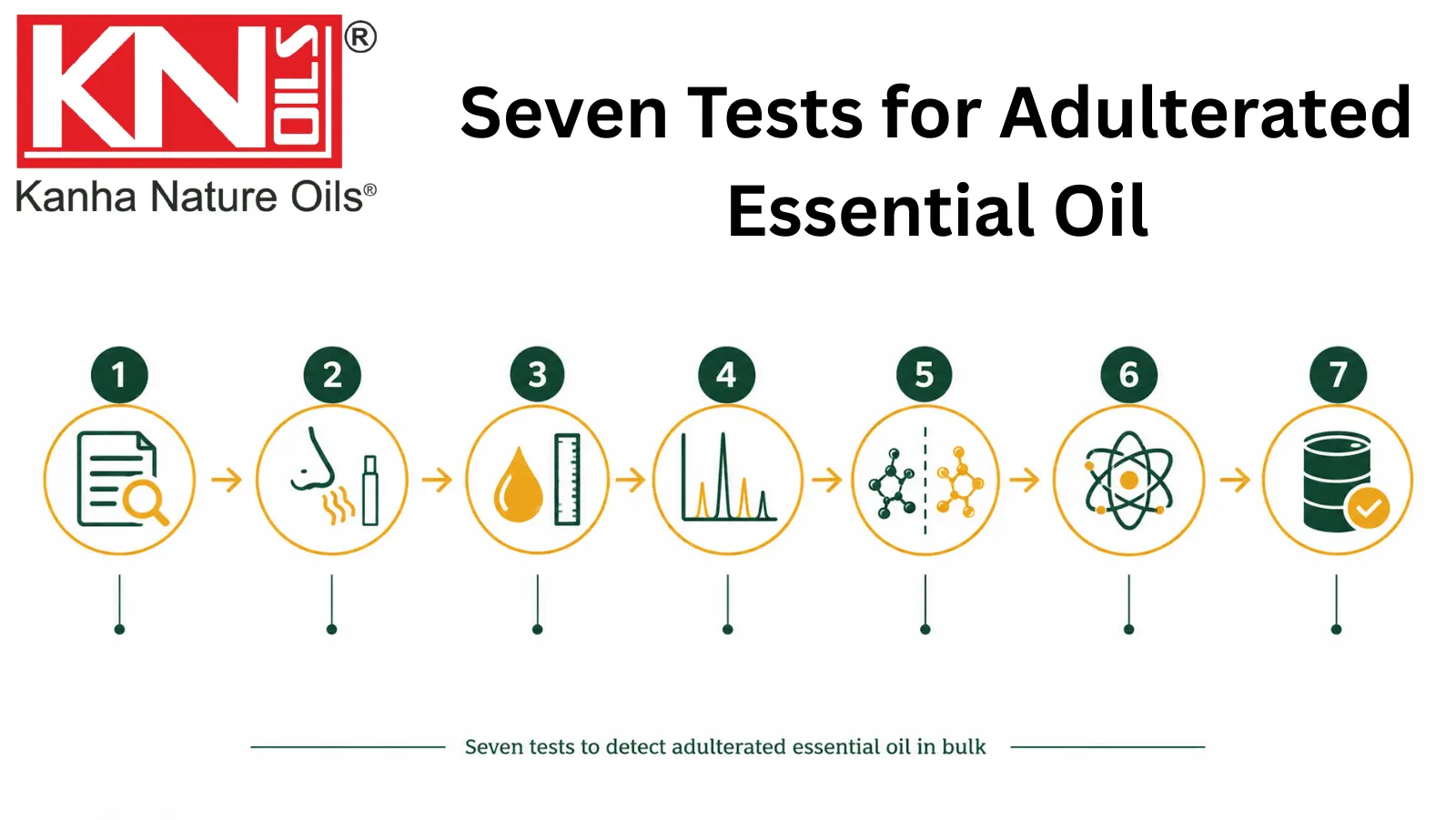
If you are working out how to test essential oil adulteration in bulk, the short answer is that no single test is enough. Smell and bench checks catch only crude cases. Reliable detection comes from layering batch documents, physical constants, GC-MS and, for high-value oils, chiral and isotope analysis, all run on a sample from the exact batch you will receive. This guide covers seven tests in the order a procurement team can run them, what each can and cannot detect, and how to tie payment to the results.
Quick answer: the seven tests at a glance
| # | Test | Best at catching | Relative cost |
|---|---|---|---|
| 1 | Batch-linked documents | Missing or mismatched batch records | Low |
| 2 | Sensory check against a reference | Obvious off-notes, gross substitution | Low |
| 3 | Physical constants (density, refractive index, optical rotation) | Dilution with carrier oil or solvent | Low–medium |
| 4 | GC-MS profile | Foreign peaks, wrong constituent ratios, cheaper oil mixed in | Medium |
| 5 | Chiral GC | Synthetic copies of natural compounds | Medium–high |
| 6 | Isotope ratio analysis | Synthetic or differently sourced carbon | High |
| 7 | Shipment-to-sample match | Switching between approved sample and delivered lot | Low–medium |
What adulteration looks like in a bulk lot
Adulteration usually takes one of four forms: a cheaper essential oil blended in, a synthetic or nature-identical compound added to lift a key constituent, a carrier oil or solvent used as diluent, or a reconstituted oil built from fractions and isolates. Each hides from different tests, which is why no single test covers all four.
The practical limit worth knowing: gas chromatography only sees volatile compounds. A non-volatile adulterant such as a vegetable oil stays in the injection port and never appears on the chromatogram, so GC-based methods have serious limits there (Biomed J Sci & Tech Res review). Synthetic copies of natural molecules pose the opposite problem: the molecule is identical, so standard GC-MS cannot separate it from the natural one.
Test 1: Check that every document is tied to the batch
Before any lab work, ask for the COA, the GC-MS report with full chromatogram and peak table, and the SDS (Safety Data Sheet — still widely called MSDS). Confirm that product name, botanical name, and batch number match across all of them and the drum labels.
Documents do not prove purity; they record what the supplier measured. A missing batch number, or an identical GC-MS report across different batches, is a reason to pause. For what each document should contain, see our guide to COA, SDS, IFRA and allergen documents.
Test 2: Compare smell and appearance against a sealed reference
Keep a sealed reference from a batch you have already approved. On a smelling strip, compare the new sample at top note, after a few minutes and at dry-down, then compare colour and clarity. Without a reference, smell is opinion, and skilled blending can fool it, so treat it as a screen, never a pass.
Test 3: Measure physical constants
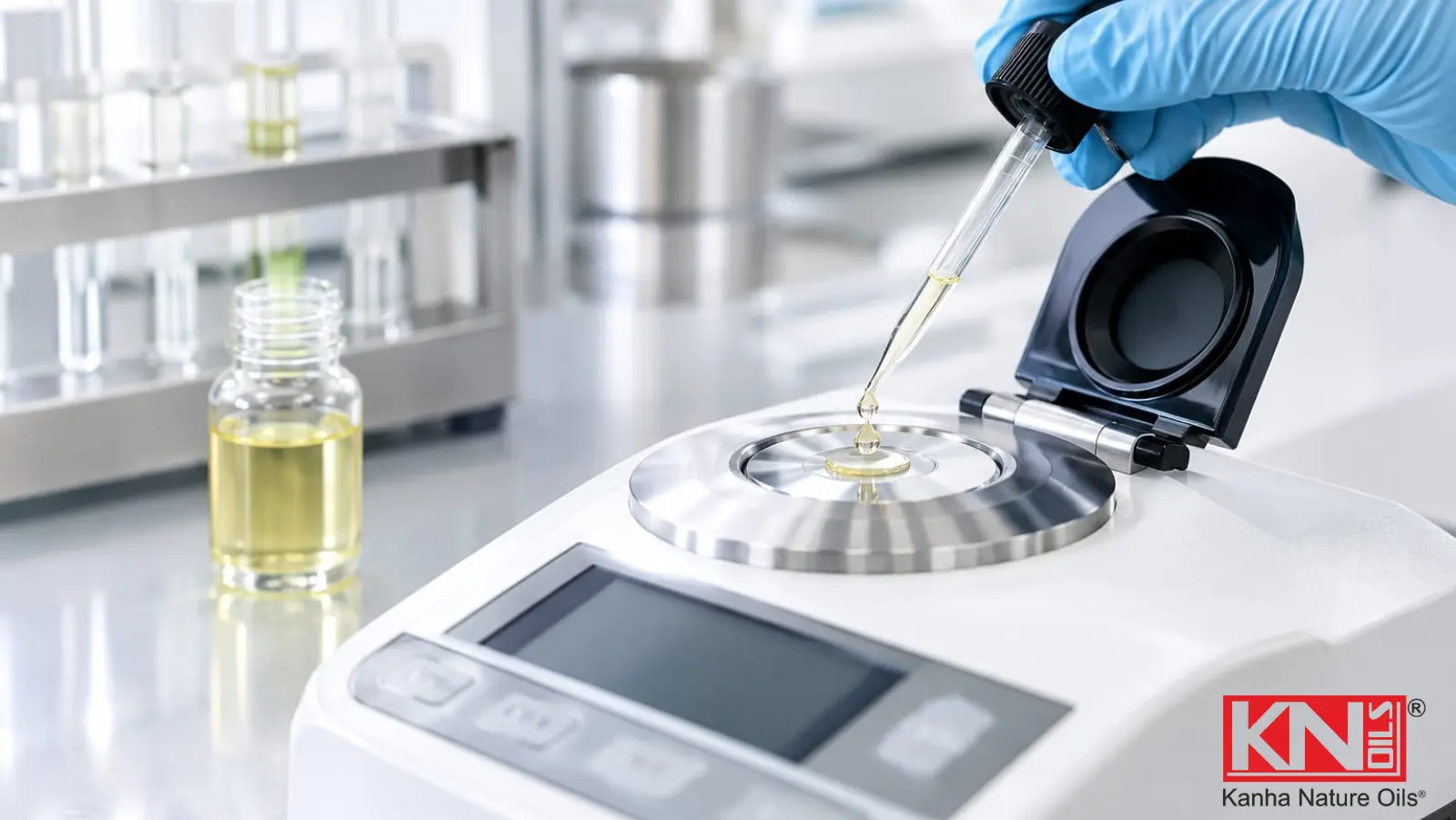
Relative density, refractive index and optical rotation are quick, inexpensive measurements. ISO publishes a method for each (ISO 279, ISO 280 and ISO 592; the older 1976 and 1981 editions are withdrawn, so cite the current ones), and the ISO standard for each oil lists the expected range (ISO essential oils catalogue). A result outside the range for that species suggests dilution or substitution. A carefully balanced adulterant can still land inside it, so a pass narrows the field but does not clear the lot.
Test 4: Run a GC-MS profile and read it against a reference
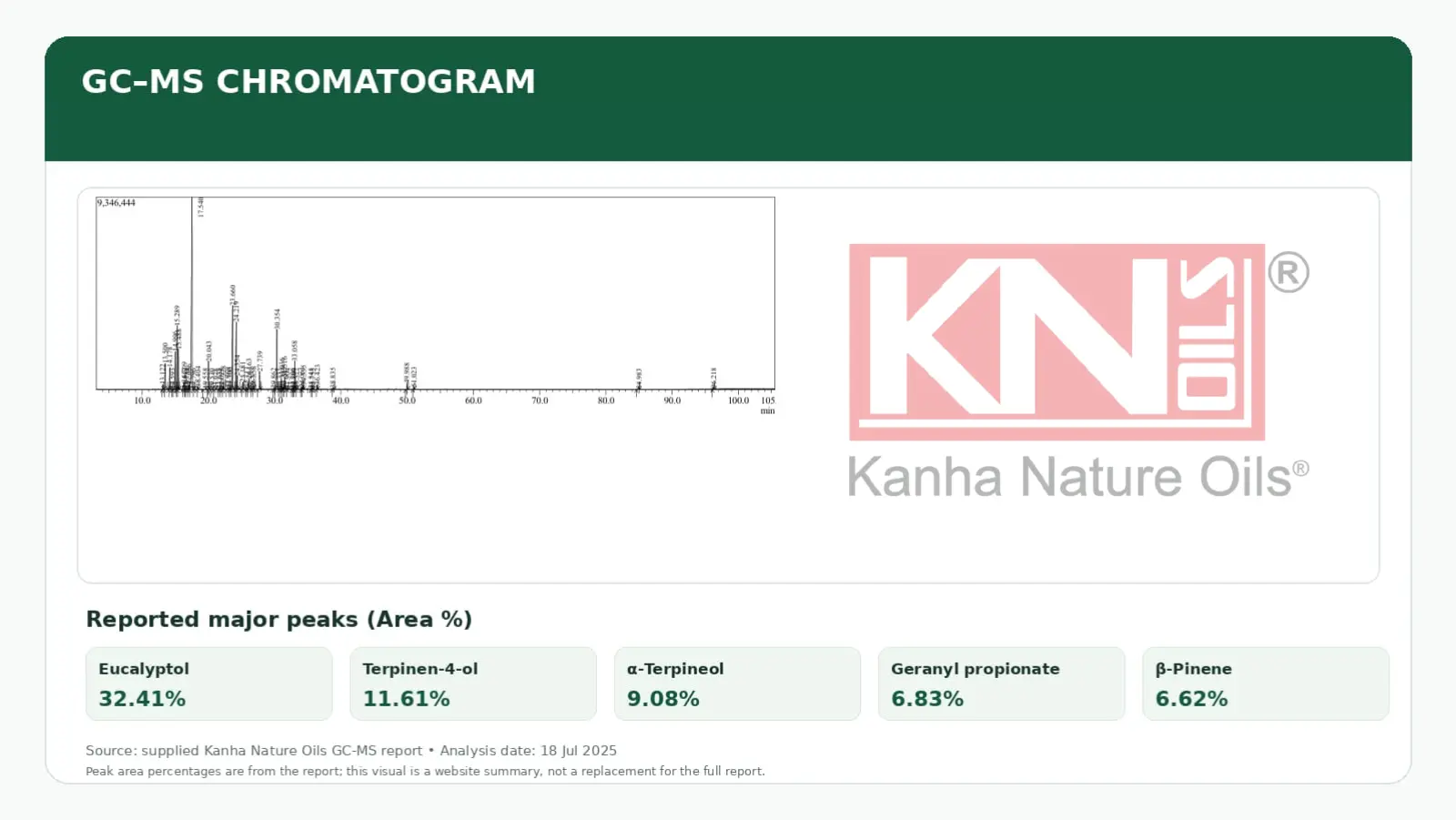
GC-MS is the backbone of essential oil quality control. ISO 11024 (currently under revision) explains that a chromatographic profile evaluates the relative proportions of constituents rather than their true concentrations, and that it sits alongside physico-chemical characteristics as a quality specification (ISO 11024-1). In practice, look for three things:
- Constituents that should be present but are missing or far outside the usual range
- Peaks that do not belong to the species, which can point to an added solvent or foreign oil
- Ratios between related compounds that look unnatural
A GC-MS report is only as useful as your ability to read it; our buyer’s guide to GC-MS reports walks through peak tables, co-elution and retention index.
Test 5: Use chiral GC for high-value oils
Many natural aroma compounds exist in one dominant mirror-image form, while synthetic versions are often a near 50:50 mix. Chiral GC separates the two forms and measures their ratio. A study of mastic oil products showed how this works: the (+)/(−) α-pinene ratio in authentic oil was characteristic, and several commercial products contained far more (−)-α-pinene, pointing to added racemic material (Planta Medica, 2008). The same approach is reviewed for bergamot and other citrus oils (Bonaccorsi et al.). It needs a laboratory with the right columns and reference data, so reserve it for high-value oils or cases where GC-MS looks right but something seems off.
Test 6: Add isotope ratio analysis when the stakes justify it
Isotope ratio mass spectrometry measures the carbon (and sometimes hydrogen) isotope signature of individual compounds. Synthetic compounds and natural ones formed through different plant pathways carry different signatures, so GC-C-IRMS can reveal added material that GC-MS cannot see. Published work combines chiral and isotope data for authenticity control of citral- and citronellal-containing oils (Anal Bioanal Chem). It is the most expensive test here and needs authentic reference data, so use it for premium oils, large contracts or a disputed lot.
Test 7: Match the delivered lot to the approved sample
An approved sample only protects you if the delivered drums match it, so the gap between the two is a real risk. Before releasing final payment:
- Draw a representative sample from the delivered containers following ISO 212:2007 (Essential oils — Sampling).
- Run the fast tests on it: relative density, refractive index, optical rotation and a GC fingerprint.
- Compare the results with your approved pre-shipment sample and the batch COA.
- Use an independent laboratory if the result will be used in a dispute.
How to test essential oil adulteration in bulk: a risk-based plan
This is our recommendation, not a standard. Scale testing to risk:
| Situation | Suggested tests |
|---|---|
| Low-value oil, repeat supplier, stable history | 1, 3, 4, 7 |
| New supplier, any oil | 1 to 4, then 7 on delivery |
| High-value oil or one with a known adulteration history | 1 to 7 |
To make results enforceable, write the specification, test methods, tolerances, right to reject and a named referee laboratory into the purchase terms, and release the balance only after Test 7.
Test on a trial pack before you commit
The prices shown on our product pages are for 100 ml trial packs, not bulk. The minimum export order is 1 kg, so a buyer can order a trial pack and run Tests 2 to 6 on it before committing to quantity. COA, GC-MS report and SDS are issued on request for the specific product and batch. Browse the essential oil range or contact the team with the oil, quantity and destination.
Frequently asked questions
Can I test essential oil purity at home?
You can do a sensory comparison against a reference and a blotting-paper check: most essential oils evaporate from paper, so a lasting oily ring can hint at a fixed-oil diluent. Some naturally viscous or heavily coloured oils also leave marks, so treat the result as a hint, not proof. Home checks only screen out crude cases; lab testing is needed for any commercial decision.
Is GC-MS enough to prove an oil is pure?
No. GC-MS shows volatile constituents and their relative proportions. It can miss non-volatile diluents and cannot tell a synthetic molecule from its natural twin. Pair it with physical constants and, for high-value oils, chiral or isotope analysis.
Does a COA prove the oil is unadulterated?
A COA records what the supplier measured on a specific batch. It is evidence, not independent verification. Check that it carries the batch number and compare it with your own test results.
Which lab should I use?
An independent laboratory experienced in essential oils, ideally ISO/IEC 17025 accredited for the methods you need. Agree the test methods in advance.
How often should I test repeat orders?
Run at least a GC fingerprint and physical constants on every new batch, and test more when the supplier, origin or price changes.
About Kanha Nature Oils
Kanha Nature Oils manufactures and exports 250+ essential oils, attars, oleoresins, hydrosols, floral absolutes, spice oils and carrier oils from Bahadurgarh, India, and supplies buyers in 30+ countries. The company is ISO 9001:2015, ISO 14001:2015, WHO-GMP, HACCP, KOSHER and HALAL certified. COA, GC-MS report and SDS are issued on request for the specific product and batch.
We don’t ask you to trust us. We ask you to test us.
Request a 100 ml trial pack or a bulk quote: kanhanatureoils.com · info@aromatherapyoil.in · +91 9810805866