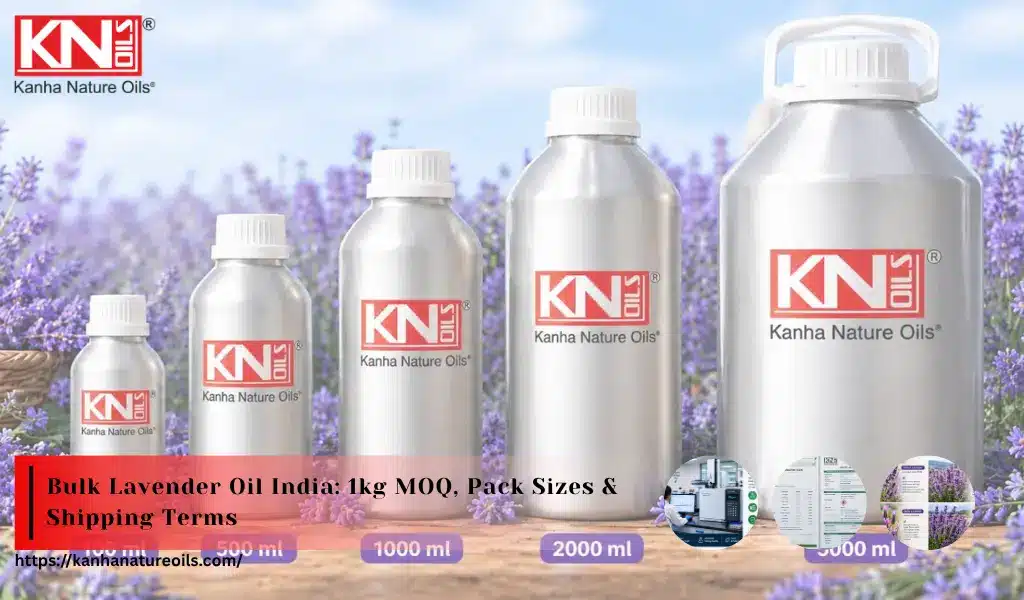
Bulk Lavender Oil, Manufactured and Exported from India: MOQ, Pack Sizes, Lead Time and Shipping Terms By Kanha Nature Oils · CEO: Piyush Gupta · Last reviewed 30 September 2026 If you have typed “bulk lavender oil supplier India MOQ” into Google, you need four things before you can compare quotes: the minimum order quantity, the pack size, the lead time and the shipping term. The short answer: our minimum order quantity is 1 kg, with higher volumes as per your requirement. If you want to test the oil before committing even to that, we ship 100 ml trial packs, both within India and for export. Pack sizes are flexible and based on order volume, including bulk quantities above 25 kg. Lead time is 2 working days from order confirmation to dispatch, with shipping and transit time on top. Our lavender oil is sourced from Bulgaria, processed and manufactured at our facility in Bahadurgarh, Haryana, and exported from India. This guide explains how each of the four terms works, what changes them, and what to put in your RFQ so the first reply is a usable quote. Quick Reference Term What we offer Confirm in your quote Origin Sourced from Bulgaria; processed and manufactured in Bahadurgarh, Haryana; exported from India Species and lot for your quote Trial pack 100 ml, ships within India and for export — priced as a trial pack, not a bulk rate Whether it’s available for the grade you want MOQ 1 kg — higher volumes as per buyer requirement Pricing tiers for your target quantity Pack sizes Flexible, based on order volume — aluminium bottles, HDPE containers and industrial drums, including bulk quantities above 25 kg Exact pack size for your grade and quantity Lead time 2 working days from order confirmation to dispatch (shipping and transit time not included) Dispatch date and estimated arrival date Shipping Worldwide export. Sea: ICD Dadri – Nhava Sheva (JNPT). Air: Indira Gandhi International Airport, New Delhi Incoterm, transport mode, destination port Bulk Lavender Oil Supplier India MOQ: What to Expect Many bulk suppliers set high MOQs because filling, packing, batch analysis and paperwork carry fixed costs. We keep that bar low: our minimum order quantity is 1 kg, with higher volumes as per buyer requirement — we don’t add a separate step-up MOQ. This applies whether you want French lavender, Bulgarian lavender, spike lavender or lavandin. A practical way to start: Order a 100 ml trial pack if you want to test before committing even to 1 kg. Place your first order — 1 kg minimum — once you’ve confirmed the specification and batch documents for your grade. Scale up to drums once the result is repeatable in your process. For repeat or larger orders, ask about pricing tiers — the entry point stays 1 kg. Pack Sizes: From Bottles to 200 kg Drums Pack format Where it usually fits (general guidance) What to confirm Aluminium bottles (incl. 100 ml trial pack) Trial runs, small-brand batches, R&D Available sizes for your grade HDPE containers Mid-volume production Compatibility with your process Industrial drums (up to 200 kg) Regular manufacturing, repeat supply, bulk quantities above 25 kg Exact size for your grade and quantity Pack sizes are flexible and based on order volume, including bulk quantities above 25 kg — there is no single fixed list. Confirm the exact size for your lavender grade and quantity in your quote. Once a large pack is opened, decanting into smaller airtight containers limits air exposure. Store sealed, cool and away from light. Lead Time: What “Processing Time” Does and Does Not Cover Our lead time is 2 working days from order confirmation to dispatch. That figure covers order preparation and dispatch only — shipping and transit time are not included and come on top. A full lead time has six stages: Order and payment confirmation Stock check or lot allocation Batch QC and documents (COA, GC-MS, SDS — Safety Data Sheet, still widely called MSDS) Packing, with dangerous-goods packaging if required Export clearance and handover to the forwarder Transit and import clearance Stages 1 to 5 sit mostly with the supplier. Stage 6 depends on transport mode, route and destination customs. Ask the supplier for a ready-to-ship date and ask your forwarder for transit time separately. Lavender is a seasonal crop distilled after the summer harvest, so availability of a particular origin or lot can vary through the year. Ask whether the quoted oil is in stock. Shipping Terms: Choosing an Incoterm for Lavender Oil Incoterms are the International Chamber of Commerce’s standard trade terms. Incoterms 2020 is the current edition. They set who pays for freight, who clears customs and where risk passes from seller to buyer. Rule Mode Who arranges main freight Risk passes to buyer Suits EXW Any Buyer (including export clearance) At the supplier’s premises Buyers with their own forwarder and export know-how FCA Any Buyer On handover, export-cleared, to buyer’s carrier Any transport mode, including containers CPT Any Seller (freight only) On handover to the first carrier Buyers who want the seller to book freight, no insurance needed CIP Any Seller, with all-risk insurance On handover to the first carrier Container cargo where the seller books freight and insurance DAP Any Seller At the named destination Delivery to the buyer’s door, duties unpaid DPU (formerly DAT) Any Seller At the named destination, unloaded Buyers who need the goods unloaded at destination DDP Any Seller (including import duties) At the named destination Buyers who want a fully landed, duty-paid price FAS Sea only Buyer Alongside the vessel Bulk or break-bulk sea cargo, rarely used for drums FOB Sea only Buyer Once loaded on the vessel Sea freight only CFR Sea only Seller (freight only) Once loaded on the vessel Sea freight when the seller books freight but not insurance CIF Sea only Seller, with minimum insurance Once loaded on the vessel Sea freight when the seller books freight and light insurance FOB, CFR and CIF apply only

essential oils
COA, MSDS, IFRA and Allergen Statements: The Four Documents to Demand Before You Order Before placing an order with an essential oil supplier, ask for four documents: a Certificate of Analysis, an MSDS/SDS, an IFRA statement, and an allergen declaration. Together, these four papers answer the questions that actually determine whether an oil is usable — what’s in it, how to handle it safely, whether it’s cleared for the application you have in mind, and what you’re legally required to put on a label. A supplier who can produce all four without delay is telling you something about how the business is run before you’ve spent a single dollar. This isn’t a compliance formality. Buyers searching for essential oil COA SDS IFRA documents supplier are usually a few weeks from placing a real order and want to know what each document actually proves — and what it doesn’t — before they commit to a shipment. It’s the same due-diligence instinct behind how Kanha Nature Oils runs its own manufacturing and export operation — testing before dispatch, not after a complaint. The Four Documents, At a Glance Document What It Proves Who Usually Asks For It COA (Certificate of Analysis) Batch-specific identity and purity — GC-MS profile, physical parameters, sometimes microbial or heavy-metal data Formulators, QA teams, resellers verifying authenticity MSDS / SDS Hazard classification, handling, storage, and emergency information Freight forwarders, customs, warehouse and EHS teams IFRA Statement Confirms the oil complies with current IFRA usage restrictions for fragrance/cosmetic applications Cosmetic, perfumery, and fragrance-compound manufacturers Allergen Statement Lists allergenic components present under the expanded EU list (Regulation (EU) 2023/1545), with concentrations where required Anyone formulating a product sold in the EU/UK 1. Certificate of Analysis (COA) — Proof of What’s Actually in the Drum A COA is batch-specific. It should be tied to the exact batch or lot number on the drum you’re receiving, not a generic specification sheet reused across every shipment. A proper COA for an essential oil typically includes the GC-MS profile (the major constituents and their percentage ranges), physical parameters such as specific gravity, refractive index, and optical rotation, and — depending on the oil — microbial or heavy-metal data. If you want to go deeper on reading the chemical data itself, see how to read a GC-MS report for essential oils — the COA’s purity claim is only as good as the GC-MS behind it. The batch number on the COA is what lets you trace a specific drum back to a specific production run if a quality question comes up later. A COA without a batch number tied to your shipment isn’t fully verifiable — ask the supplier to confirm the match before the goods ship. 2. MSDS/SDS — Proof It Can Be Handled and Shipped Safely The Material Safety Data Sheet — now more commonly formatted as an SDS (Safety Data Sheet) under the GHS 16-section format — covers hazard classification, first-aid measures, fire-fighting guidance, handling and storage requirements, and transport information. This is the document your freight forwarder, customs broker, and warehouse team will actually use; it’s less about the oil’s aromatic or therapeutic properties and more about how it behaves as a chemical cargo. Many essential oils are classified as flammable liquids or skin/eye irritants under GHS, which affects packaging, labeling, and shipping class. If your supplier’s paperwork is still labeled “MSDS” in the older format rather than the current 16-section SDS layout, it’s worth asking whether an updated version is available — some customs authorities now expect the current format. 3. IFRA Statement — Proof It’s Cleared for Use in Finished Products The International Fragrance Association (IFRA) publishes Standards that restrict or prohibit certain materials, or cap their concentration, in finished fragrance and cosmetic products. An IFRA Certificate or Statement of Conformity confirms that the oil, as supplied, is compatible with current IFRA Standards for the intended use category. This matters most if you’re formulating perfumes, fine fragrance, cosmetics, or scented consumer products — an oil that’s perfectly fine as a raw material can still be restricted at certain usage levels in a finished product. If you’re buying purely for aromatherapy diffusion or as a raw trading commodity, an IFRA statement is less critical, but most reputable suppliers maintain one regardless, since it’s frequently the first document a downstream buyer will ask for. 4. Allergen Statement — Proof of What Must Be Declared on a Label If your finished product will be sold in the EU, an allergen statement is not optional. Annex III of the EU Cosmetics Regulation (EC) No 1223/2009, as amended by Regulation (EU) 2023/1545, requires listed fragrance allergens to be named on the label when they exceed 0.001% in leave-on products or 0.01% in rinse-off products. The 2023 amendment expanded the list from 26 to more than 80 substances, with a transition period running to 2028 for products already on the market. Check that your supplier’s declaration covers the current expanded list, not the older 26. Kanha Nature Oils’ allergen declarations cover the full expanded list, analysed by GC-MS. Buyers selling into the UK should confirm the current UK requirement separately. This is a naturally occurring-components declaration, not a claim that the oil contains added allergens — many of these compounds are simply part of the oil’s natural chemistry. But without this statement, you cannot correctly complete your own product’s labeling, and an incomplete label is a compliance gap that surfaces at the worst possible time — during a customs inspection or a retailer’s compliance audit. Why These Four, and Not More or Fewer Buyers sometimes ask for additional paperwork — ISO 9001:2015, ISO 14001:2015, WHO-GMP, HACCP, KOSHER, HALAL certificates, country-of-origin declarations — and those have their place depending on the product. But COA, MSDS/SDS, IFRA, and allergen statement form the baseline because each one answers a distinct question no other document covers: identity and purity (COA), handling safety (MSDS/SDS), fragrance-use compliance (IFRA), and label compliance (allergen statement). Asking for fewer than these four leaves
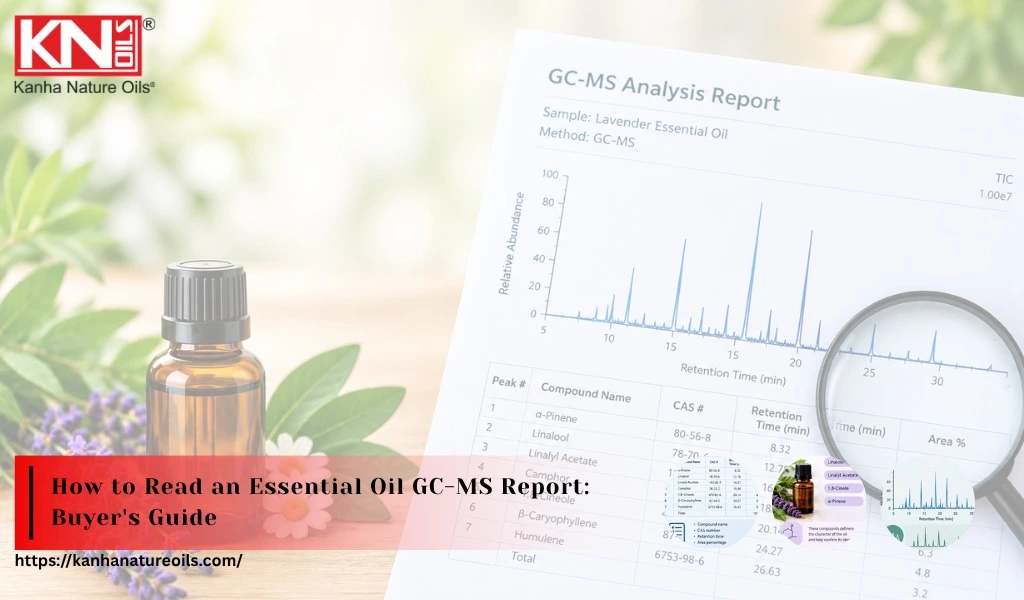
How to Read a GC-MS Report for Essential Oils: A Buyer’s Guide Last reviewed: September 2026 · By Piyush Gupta, Founder & CEO, Kanha Nature Oils · 27 years of industry experience · FAFAI Regional Secretary, North Zone · EOAI Treasurer How to read a GC-MS (Gas Chromatography–Mass Spectrometry) report for an essential oil, in short: look at the peak table, identify the compounds expected to be characteristic of that particular oil, compare their reported levels with appropriate published specifications or reference ranges, and confirm that the report’s botanical name, batch number and date match the material you are actually receiving. A GC-MS report helps show which volatile compounds are present and their approximate relative abundance. It does not, by itself, prove geographical origin, extraction method, organic certification, overall purity, or safety. This guide explains how to read a GC-MS report step by step so you can evaluate an essential-oil supplier’s documentation more intelligently. What Does a GC-MS Report Actually Tell You? GC-MS combines gas chromatography, which separates volatile compounds, with mass spectrometry, which helps identify those separated compounds from their mass-spectral characteristics. The result is a report listing compounds detected in the sample, their retention times and their estimated relative abundance. For a buyer, this matters because an essential oil’s chemical profile should be consistent with the botanical species, plant part, origin and production characteristics claimed for the material. For example, genuine lavender oil is expected to contain characteristic levels of compounds such as linalool and linalyl acetate. If a report for a product sold as lavender shows an unusual profile, that is a reasonable reason to ask the supplier for an explanation. MS vs. FID: Identification and Quantification A common misconception is that MS identifies while FID always quantifies. In practice, the mass spectrometer is primarily used for compound identification, while quantitative work may be performed using the MS detector itself or, in many laboratory workflows, with a separate flame ionization detector (FID). FID is widely used for quantitative GC analysis because its response to many organic compounds is useful for relative quantification. However, the exact detector configuration and calculation method depend on the laboratory and analytical method. So when reading a report, do not assume that the words “GC-MS” automatically tell you which detector was used for quantification. If the quantitative method matters to your purchase, ask the laboratory or supplier for the analytical method. A GC-MS report is a chemistry document, not a marketing document. The useful question is not simply whether a report exists, but whether the reported chemistry is appropriate for the specific botanical material being supplied. What Are the Main Parts of a GC-MS Report? Most essential-oil GC reports contain several core elements. What Is the Chromatogram? The chromatogram is the graph showing peaks across a retention-time axis. Each peak represents a detected component or, in some cases, more than one component if compounds co-elute under the analytical conditions. For quantitative interpretation, peak area is generally more useful than peak height. Peak area represents the integrated detector response over the time that the compound elutes. Peak height alone can give a misleading impression because two peaks with different widths can have very different areas. However, peak area should not be interpreted as an exact weight percentage unless the analytical method and calibration support that conclusion. In many essential-oil reports, area percentage is used as an estimate of relative composition. A Large Peak Is Not Automatically a Red Flag Some genuine essential oils naturally have one strongly dominant constituent. For example: Wintergreen oil is typically dominated by methyl salicylate. Cassia and cinnamon bark oils are commonly rich in cinnamaldehyde. Eucalyptus globulus oil is commonly rich in 1,8-cineole. Carrot seed oil can have a high proportion of carotol. Therefore, a chromatogram with one very large peak is not, by itself, evidence of adulteration. The correct question is: Does the overall profile match the expected chemistry of this particular botanical material? What Is the Peak Table? Below the chromatogram is normally a table listing the detected peaks. Common columns include: Peak number Retention time Compound name CAS number, where available Area % Sometimes Height % Sometimes Retention Index (RI) Sometimes identification quality or library-match information The peak table is usually more useful to a buyer than simply looking at the chromatogram. Co-elution: One Peak Can Contain More Than One Compound Closely related compounds can sometimes co-elute, meaning that they leave the GC column at nearly the same time and appear as a single chromatographic peak. This can happen even with commonly used analytical columns. If separating individual isomers is important for your application, ask the laboratory whether a different column, confirmatory method, or more advanced technique was used. What Is Retention Time? Retention time (RT) is the time taken for a compound to travel through the GC system before being detected. RT can be useful when comparing results generated using the same or closely matched analytical conditions. However, raw retention time should not be treated as a universal identifier across laboratories. It can change depending on factors such as: Column chemistry Column dimensions Carrier-gas flow Oven-temperature programme Instrument configuration Other analytical conditions Therefore, the same compound can legitimately have different retention times on two laboratories’ reports. For cross-laboratory comparison, buyers should pay more attention to retention indices (RI), together with mass-spectral identification and the expected chemical profile, rather than comparing raw RT values alone. What Are the Compound Name and CAS Number? The compound name identifies the substance detected in the analysis. Examples include: Linalool Linalyl acetate Eugenol Limonene Citral 1,8-Cineole A CAS number is a standardized registry identifier that can help cross-check chemical identity. CAS numbers are useful because compound names can sometimes vary slightly between laboratories, software libraries or reporting conventions. What Is Peak Area Percentage? Peak area percentage represents the relative detector response contributed by a particular peak compared with the total integrated peak area used in the calculation. It is widely used to estimate the relative composition of essential oils, but
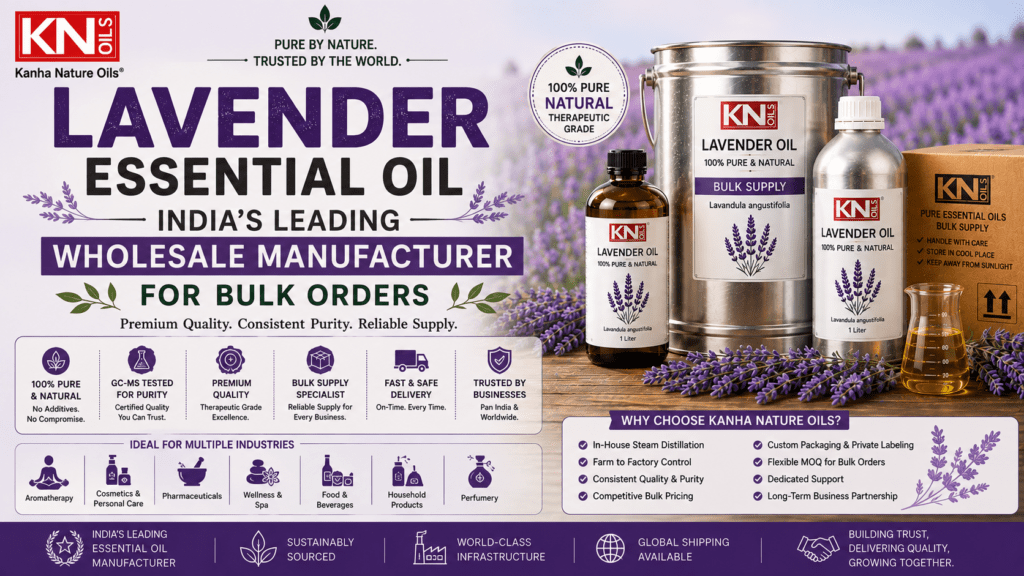
If you’re searching for a trusted wholesale lavender oil manufacturer to supply bulk essential oil for your business, you’ve likely already discovered how confusing the wholesale essential oil market can be. This guide covers everything you need to know about sourcing lavender oil wholesale, in bulk, directly from a certified manufacturer — and why Kanha Nature Oils has become a preferred wholesale essential oil manufacturer for bulk lavender oil buyers across India and abroad. Why Lavender Oil Is the #1 Choice for Wholesale and Bulk Buyers Lavender is the most widely purchased essential oil in the world, making it the top priority for any wholesale essential oil manufacturer’s bulk catalog. As a wholesale manufacturer, we see consistent bulk demand for lavender oil across skincare, haircare, aromatherapy, candle-making, and wellness industries — which is exactly why every serious bulk essential oil buyer should have a dependable wholesale lavender oil supplier locked in. What Makes a Trustworthy Wholesale Lavender Oil Manufacturer When you’re buying lavender oil in bulk, not every wholesale manufacturer offers the same level of quality. Here’s what to look for before placing a bulk wholesale order: Direct-from-manufacturer sourcing. Buying wholesale lavender oil directly from the manufacturer — rather than a reseller — means better bulk pricing and full transparency over how your bulk essential oil order is produced. Kanha Nature Oils manufactures every drop of our wholesale lavender oil at our own certified facility, so bulk buyers get true manufacturer-direct pricing. Batch-tested purity for every bulk order. Because lavender oil is one of the most commonly adulterated oils in the wholesale essential oil trade, a reliable bulk manufacturer must provide GC/MS batch testing documentation for every wholesale order — not just a generic bulk purity claim. Certified wholesale manufacturing standards. A genuine wholesale essential oil manufacturer should hold recognized certifications. Kanha Nature Oils, as a certified bulk manufacturer, operates under ISO 9001, ISO 14001:2015, WHO-GMP, HACCP, Kosher, and Halal certifications — giving bulk and wholesale lavender oil buyers verified assurance with every order. Flexible bulk order quantities. Whether you need a small wholesale trial order or a large-scale bulk manufacturing contract, a good wholesale manufacturer offers flexible MOQs so growing businesses can scale their bulk lavender oil purchases at their own pace. Industries That Buy Lavender Oil Wholesale in Bulk Skincare and cosmetic manufacturers sourcing bulk lavender oil for calming, anti-inflammatory formulations Haircare brands buying wholesale lavender oil for scalp and hair care products Candle and home fragrance makers requiring consistent bulk supply for scent formulation Spas and wellness centers stocking wholesale lavender oil for aromatherapy and massage services Private label brands partnering with a bulk manufacturer for custom lavender oil product lines Distributors and resellers sourcing wholesale lavender oil at manufacturer-direct pricing for resale True Lavender vs. Lavandin: What Wholesale Buyers Should Know Not all lavender oil sold wholesale is the same. True lavender (Lavandula angustifolia) is generally preferred for premium, therapeutic-grade bulk formulations, while lavandin (a higher-yield hybrid) is common in cost-efficient wholesale candle and soap applications. A transparent wholesale manufacturer will always specify exactly which type you’re buying in bulk — this is a detail many resellers gloss over, but a genuine manufacturer never should. Why Choose Kanha Nature Oils as Your Wholesale Lavender Oil Manufacturer As an established wholesale essential oil manufacturer since 2010, Kanha Nature Oils has built a reputation for reliable bulk lavender oil supply, backed by our own in-house R&D testing lab and a certified manufacturing facility in Bahadurgarh, Haryana. Under the leadership of Founder and CEO Piyush Gupta, who brings over two decades of hands-on experience in the wholesale essential oil and perfumery manufacturing industry, we supply bulk lavender oil and wholesale essential oils to buyers across 20+ countries — with flexible MOQs, sample availability, and private label manufacturing options for bulk buyers who want to build their own brand. Whether you’re a first-time bulk buyer or an established wholesale distributor, Kanha Nature Oils is the manufacturer built to support your lavender oil sourcing at every stage of growth. Request a Wholesale Lavender Oil Bulk Quote Ready to source lavender oil wholesale from a certified bulk manufacturer? Contact Kanha Nature Oils today for a sample, batch testing documentation, MOQ details, or a full bulk pricing quote. 📧 info@aromatherapyoil.in | 📞 +91 9810805866 📍 Plot No. 682, M.I.E, Adjoining HUDA, Bahadurgarh, Haryana 124507, India
Introduction Lavender oil is one of the most popular essential oils in the world, celebrated for its calming properties and versatile applications. As the demand for lavender oil continues to rise, many businesses are looking to wholesale suppliers to source this valuable product. If you’re considering purchasing wholesale lavender oil, there are several important factors to keep in mind to ensure you’re making an informed decision. This blog will guide you through the essential aspects of buying lavender oil from a wholesale lavender oil supplier. Section 1: Understanding Lavender Oil 1.1 What is Lavender Oil? Lavender oil is derived from the flowers of the lavender plant (Lavandula angustifolia) through steam distillation. Known for its soothing and relaxing fragrance, it is widely used in aromatherapy, cosmetics, personal care products, and even culinary applications. 1.2 Benefits of Lavender Oil Aromatherapy: Promotes relaxation and reduces anxiety and stress. Skincare: Known for its antibacterial properties, making it effective for treating minor burns and skin irritations. Sleep Aid: Often used to improve sleep quality and combat insomnia. Section 2: Choosing a Wholesale Lavender Oil Supplier 2.1 Research and Reputation Before placing an order, research potential wholesale lavender oil suppliers. Look for companies with a solid reputation in the industry, positive reviews, and testimonials from other buyers. A reputable supplier is more likely to provide high-quality products and reliable service. 2.2 Quality Assurance Quality is paramount when it comes to essential oils. Ensure that the supplier provides information on the sourcing and production methods of their lavender oil. Look for suppliers who offer: Certificates of Analysis (COA): This document verifies the purity and quality of the oil. Organic Certification: If you prefer organic products, confirm that the supplier offers certified organic lavender oil. 2.3 Pricing and Minimum Order Quantities Compare prices from different suppliers to find the best deal. Be aware that the lowest price may not always indicate the best quality. Additionally, inquire about minimum order quantities (MOQs) and whether they align with your purchasing needs. Section 3: Packaging and Shipping Considerations 3.1 Packaging Ensure that the lavender oil is packaged properly to maintain its quality during transportation. Look for suppliers that use dark glass bottles to protect the oil from light exposure, which can degrade its quality. 3.2 Shipping Options Discuss shipping options with your supplier. Consider factors such as shipping costs, delivery times, and tracking capabilities. Reliable shipping ensures that your order arrives in good condition and on time. Section 4: Legal and Regulatory Compliance 4.1 Import Regulations If you are importing lavender oil from another country, familiarize yourself with the import regulations and requirements of your country. Ensure that the supplier complies with all necessary legal standards to avoid any issues with customs. 4.2 Labeling Requirements Understand the labeling requirements for essential oils in your region. Proper labeling is crucial for consumer safety and compliance with regulations. Conclusion Purchasing wholesale lavender oil can be a rewarding endeavor for businesses looking to enhance their product offerings. By choosing a reputable wholesale lavender oil supplier, ensuring quality assurance, and understanding packaging and shipping considerations, you can make informed decisions that benefit your business. As the demand for lavender oil continues to grow, taking the time to research and select the right supplier will set you on the path to success in the essential oil market. Embrace the calming benefits of lavender oil and elevate your products with this cherished essential oil.
What Is An Oil Diffuser And How To Use It? A Complete Guide Essential oils and aromatherapy have surged in popularity in recent years as people search for natural ways to promote wellness, reduce stress, and enhance the atmosphere in their homes. Oil diffusers sit at the center of this trend—versatile, attractive, and effective tools for dispersing aromatic essential oils into the air. Whether you’re new to essential oils or you’re looking to get more out of your diffuser, this complete guide will explain everything you need to know: what an oil diffuser is, how it works, the benefits, how to choose the right one, safety tips, cleaning instructions, and practical usage ideas. What Makes An Aroma Diffuser Useful? The use of essential oils in an aroma diffuser can assist to rapidly and naturally relieve ✔️ stress, ✔️ anxiety, ✔️ despair, ✔️ tension, and other ✔️ negative emotions. They can also aid in ✔️ digestion, ✔️ ease headaches and ✔️ respiratory problems, ✔️ encourage relaxation and ✔️ general well-being, and do so much more. Additionally, essential oils have inherent antibacterial, antiviral, and antifungal qualities that can enhance our well-being and keep the air clean and healthy. How Does Using an Oil Diffuser Help You? 1- They Make You Feel Better Your mood and brain chemistry will benefit from using essential oils. Some essential oils, like lavender oil, have been thoroughly researched and are well known for being relaxing and for reducing stress, sleeplessness, and anxiety. Other essential oils, like citrus oils, are well-known for their uplifting properties and are excellent for naturally reducing the symptoms of depression and elevating your mood. 2- Essential Oil Diffusers Promote Relaxation The ability of the essential oils to promote relaxation is one of the key advantages of utilizing an essential oil diffuser. In reality, many people utilize particular essential oils to help them unwind at night, relax their muscles, or calm their minds. Numerous essential oils produce a calming environment that promotes relaxation, decreases blood pressure, reduces tension, and signals to the brain that it’s time to be quiet or go to sleep. 3- Diffusers Can Help Boost the Quality of Indoor Air Your indoor environment can become a sanctuary of aromatherapy by releasing essential oils into the air. The majority of homes include a lot of harmful chemicals from things like synthetic smells, pet dander, building materials, and chemical cleaning products. Air that is stagnant and unpleasant to breathe results from this. To minimize the chemical load on your body, natural, non-toxic alternatives to household fragrances are crucial. Freshening the air and providing a natural aroma while diffusing essential oils has a number of positive impacts on the body, mind, and emotions. 4- You Can Improve Concentration and Maintain Focus with Aromatherapy Diffusers You can increase your focus and enhance your concentration, thinking clarity, and productivity by diffusing essential oils that aid in focus, such as peppermint oil or rosemary essential oil. Focus is increasingly important in today’s world! For instance, peppermint oil has been shown to enhance memory and cognitive performance. Additionally, it aids in boosting alertness and vitality, and there are other additional oils that improve attention and concentration. 5- Aromatherapy Diffusers Promote a Calm and Relaxed Environment By enabling us to conveniently enjoy the advantages of aromatherapy, essential oils can help us manage stress and improve our daily well-being. Bergamot and lavender essential oils are recognized relaxants that can help soothe tension, calm anxiety, and reduce stress. Rose oil has a reputation for assisting in the restoration of equilibrium and balance, especially affective balance. 👉 How To Use An Oil Diffuser? An oil diffuser is typically used by pouring water into the machine’s container, adding a few drops or more of the desired essential oils, and turning the machine on. If you want to enjoy the scent, the unit should be placed in any room. Select A Diffusing Location Select a space with a solid surface or tabletop that is open in a room or office. It must be plugged into an outlet. A placemat or towel should also be put down if you are using the item on a wooden surface because water will be used. I have a diffuser by my bedside on my nightstand, and I also have one in my family room on a sturdy table. Avoid placing it in bright sunlight or close to a fan for best use. Fill Your Diffuser With Water Once you’ve chosen a location, fill your diffuser water tank with clean, room-temperature tap water until it reaches the fill line of the water reservoir. Refer to your diffuser manual for the suggested water amount your diffuser needs. The majority of diffusers include a water level line on the interior of the water reservoir or a measuring cup to fill up and then add to the reservoir. Add Aromatherapy Oils The water should then contain 3–10 drops of essential oils. Use a single essential oil, such as lavender, or a combination of essential oils. The suggested diffuser oils are listed below. Usually, 6 drops of oil are sufficient, but occasionally, additional oil may be needed for a stronger aroma. You can experiment with different essential oil concentrations to find your favorite. Turn On Depending on what your diffuser demands, replace the cap or top. If your model includes choices, such as a nightlight or color-changing LED lights, choose the features you want. Turn on the beautiful aroma and savor it! Different models of aromatherapy diffusers provide different possibilities, so shop around before buying one. You might be able to program the diffuser to run for a specific amount of time or select from a variety of time cycles, such as on for 30 seconds and off for 15 seconds. ESSENTIAL OILS IN AROMATHERAPY Conclusion Stepping into the world of essential oils is like opening the door to a beautiful sensory experience. All you really need are a few oils
Top 7 Carrier Oils Proven to Boost Hair Growth Naturally Thick, shiny, and healthy hair has always been considered a sign of beauty and vitality across cultures. Unfortunately, in today’s world, hair loss, thinning, and scalp issues have become increasingly common due to stress, pollution, chemical-based hair products, and nutritional deficiencies. While there are countless products on the market promising quick fixes, many people are turning back to nature for safe, effective, and sustainable hair care solutions. One of the most trusted natural remedies includes using Top 7 Carrier Oils Proven to Boost Hair Growth, as they not only nourish the scalp but also strengthen hair follicles, improve circulation, and restore overall hair health. Carrier oils, often derived from seeds, nuts, and kernels, have gained immense popularity for their ability to nourish the scalp, strengthen hair follicles, and promote hair growth naturally. Unlike essential oils, which are highly concentrated, carrier oils are mild and safe to use directly on the scalp or when blended with other oils. They are packed with vitamins, fatty acids, and antioxidants that repair damage, improve circulation, and create the perfect environment for healthy hair growth. In this blog, Kanha Nature Oils we’ll explore the top 7 carrier oils proven to boost hair growth naturally, their unique benefits, and how you can use them effectively in your hair care routine. The top 7 carrier oils proven to boost hair growth naturally There are many carrier oils that are known to be the best carrier oil for hair growth. But remember that everyone’s experience can be different. Think about your hair type and any allergies you have when picking an oil for hair growth. Daily use of that is the best thing for hair growth. Here are a few list of carrier oils: Here are some oils that can be good for best hair regrowth for men and women: 1. Coconut Oil People like using coconut oil for hair because it can get into your hair and stop it from losing important stuff. It’s got good things called fatty acids that can make your hair strong and healthy. But be careful, because if you don’t wash it out well, it might feel heavy and sticky. 2. Castor Oil Some folks suggest castor oil for hair growth because it has something called ricinoleic acid. This acid might help your hair grow by sending more blood to your scalp and giving it important stuff. Castor oil is thick and sticky, so people mix it with other oils or lighter stuff. 3. Jojoba Oil Jojoba oil is like the oils your scalp makes. It can help keep the right amount of oil on your head, moisturize your scalp, and make your hair grow better. It also stops your scalp from being too red and irritated. 4. Argan Oil Argan oil has lots of good things like vitamin E and fatty stuff. This can make your hair feel better, strong, and maybe stop it from breaking too much. It’s also good for dry and damaged hair. 5. Rose Hip Oil Sometimes people add rose hip oil to other oils like jojoba or coconut oil. This can help your hair grow by making your scalp better and your hair places wake up. 6. Olive Oil Olive oil is like a friend to your hair. It can give your hair important stuff and make it strong. If your hair is dry or damaged, olive oil can help. 7. Sweet Almond Oil Sweet almond oil is full of good stuff like vitamin E. It’s light, so it won’t make your hair heavy. It can make your hair feel nice and soft. For more information, contact us. We are a natural carrier oil manufacturer based in India. We can provide you with the best hair oils for hair growth. How Carrier Oils Boost Hair Growth (Scientifically Explained) Understanding how these oils work helps you choose the right one: 1. Deep Conditioning Carrier oils penetrate the hair shaft, reducing protein loss that leads to breakage. Stronger hair holds onto length longer, which appears as faster growth. 2. Scalp Nourishment Hair grows from the follicle, not the strand. Oils improve blood circulation and supply the follicles with essential nutrients, creating a better environment for growth. 3. Sebum Regulation Some oils like jojoba mimic natural sebum, balancing oil levels. A healthy scalp without excessive dryness or oiliness reduces hair fall from irritation. 4. Damage Protection Antioxidants (like vitamin E) help protect hair from environmental stressors such as UV rays and pollution—both of which can weaken hair and slow growth. Tips for Using Carrier Oils for Hair Growth Consistency is key: Regular application (2–3 times a week) yields the best results. Massage for circulation: Always massage oils into the scalp to stimulate blood flow. Combine with essential oils: Pair with oils like rosemary, peppermint, or lavender for enhanced benefits. Patch test first: To avoid allergic reactions, always test on a small area before applying. Healthy lifestyle: Oils work best when combined with a balanced diet, hydration, and stress management. Conclusion Nature has gifted us with powerful carrier oils that can transform hair care routines. Whether you struggle with thinning hair, dryness, or slow growth, oils like coconut, castor, jojoba, argan, olive, grapeseed, and almond can restore health and vitality to your hair naturally. By incorporating these oils into your regular hair care regimen, you not only stimulate growth but also nurture your scalp and strands with essential nutrients. Remember, patience and consistency are vital—natural remedies may not give overnight results, but with time, you’ll notice stronger, healthier, and more beautiful hair. ESSENTIAL OILS IN AROMATHERAPY You May Also Like: Rosemary Oil Recipe for Hair Growth: A Complete Guide to Hair Pistachios oil for Skin and Hair: Natural Beauty Benefits of This Nut Oils For Straightening Hair—Choose Your Best Natural Oils Kanha Nature Oils For more information contact: info@aromatherapyoil.in Mobile Number: 9810805866
Oils For Straightening Hair—Choose Your Best Natural Oils In the world of hair care, the market is filled with dozens of chemical straightening treatments promising sleek, glossy locks in minutes. How ever, these treatments often come with harsh ingredients that can damage hair over time, strip it of natural oils, and even lead to breakage. For those seeking a natural, nourishing way to achieve smoother and straighter hair, plant-based oils have become increasingly popular. Because hair health begins with proper nourishment from the roots to the tips, using natural oils offers a gentler, safer alternative to intensive chemical procedures. This comprehensive guide from Kanha Nature Oils covers the best natural oils for straightening hair, how they work, and how you can incorporate them into your hair care routine. We’ll also answer common questions about oil application, methods of use, and tips for achieving long-lasting results. Why Natural Oils? Understanding the Benefits Natural oils have been used for centuries in traditional hair care practices around the world, especially in regions of Asia, Africa, and the Middle East. These oils contain essential fatty acids, vitamins, proteins, and antioxidants that support overall hair health. Key Benefits of Using Natural Oils Moisturization Oils penetrate the hair shaft, sealing in moisture and preventing dryness. Heat Protection Oils form a protective barrier against heat damage from styling tools like straighteners. Smoother Texture Many oils help reduce frizz and add shine by smoothing the hair cuticle. Scalp Health Oils nourish the scalp, reduce dandruff, and stimulate hair growth. Stronger Hair Nutrients in oils strengthen hair from the root, reducing breakage and split ends. Using natural oils regularly can lead to hair that feels not only straighter but also healthier and more resilient. Top 8 Natural Oils For Straightening Hair Finding a hair straightening oil among the many options available might feel like searching for a needle in a haystack. The inappropriate oil may cause your hair to get weighed down or, worse still, may not adequately protect it while being styled. We’re here to help! We’ve created a ranking of the top hair straightening oils. 1. Argan Oil For Hair Straightening There is no comparison for our Moroccan Argan Oil when it comes to acting as a heat protectant, which is why we advise using argan oil just before styling. All in all, it’s the best you can get for straight hair! It is prepared with 100% organic Moroccan argan seeds to ensure no additional chemicals or pesticides, making it extremely light. Additionally, pure argan oil has a high smoking point, which guards against the tool’s intense heat from burning down your hair strands. 2. Virgin Coconut Oil For Straightening Hair Virgin coconut oil is a powerful heat protector, so we have added it to our list. If you still need to get a jar of cold-pressed coconut oil at home, you need to get it today! This cold-pressed coconut oil, made from fresh organic coconuts, may be used as a skin moisturiser, a hair mask, and a heat styling tool. It has no aroma at all and is even suitable for cooking. 3. Virgin Olive Oil For Hair Straightening Virgin olive oil has earned a spot on our list due to its excellent properties and speedy ability to repair dry, frizzy, and breakable hair. Additionally, there are no additives or free radicals in this natural oil. This olive oil is devoid of all chemicals and pesticides to give its consumers the cleanest and healthiest hair oil possible. Your damaged hair will receive exceptional quality hydration and moisturization from 100 percent pure and organic oil. 4. Castor Oil For Hair Straightening Castor oil if you prefer a simple, fragrance- and additives-free hair straightening oil but your hair doesn’t respond well to coconut oil. However, it is always best to test the oil on a small skin area before using more. This smooth, golden-yellow oil has a nutty aroma and a natural texture. It is unlikely to produce an adverse response because it doesn’t include any additional preservatives or smells. Hair, skin, and nails are all moisturized with pure Castor Oil. 5. Sweet Almond Oil For Hair Straightening Many women use almond oil to maintain straight hair. Some women swear by it since they start their teens. We’re not sure about you, but we don’t have the time to flat iron my hair every day. Only recently have people begun to understand its many advantages! This special heat-protective oil maintains a silk press straight and frizz-free for up to three days, right until your next shampoo. Fortunately, due to the amazing almond oil, we don’t have to! 6. Avocado Oil For Straightening Hair When undergoing extensive heat treatment, the damage is just as much. Avocado oil works miraculously in protecting your hair from damage and keeping that straight look for longer. You will love how it penetrates your strands deeply. Avocado oil is renowned for its healing benefits and moisturising qualities. Use it immediately following a hair wash and just before flat-iron styling. Its lightweight formulation and enlivening oil qualities make it ideal for hair spa treatments. 7. Jojoba Oil For Straightening Hair Jojoba oil can also cure hair damage brought on by chemical and heated styling equipment. If you use jojoba oil after a straightening session, you can control this breakage and make your press longer. Using jojoba oil on your hair can counteract heat damage and build a layer of protection. This occurs as jojoba oil is impermeable, in contrast to other oils. When using hair straighteners, you may prevent the hair shaft from breaking by doing this. 8. Amla Oil For Straightening Hair The fact that amla oil is 100% amla oil makes it exceptional for straight hair. Other vital ingredients for hair sustenance found in the essence of this oil include Vitamin E, phenols, carotenes, squalene, and essential fatty acids. They work by rebuilding the structure of the hair, repairing damaged hair, boosting elasticity, and