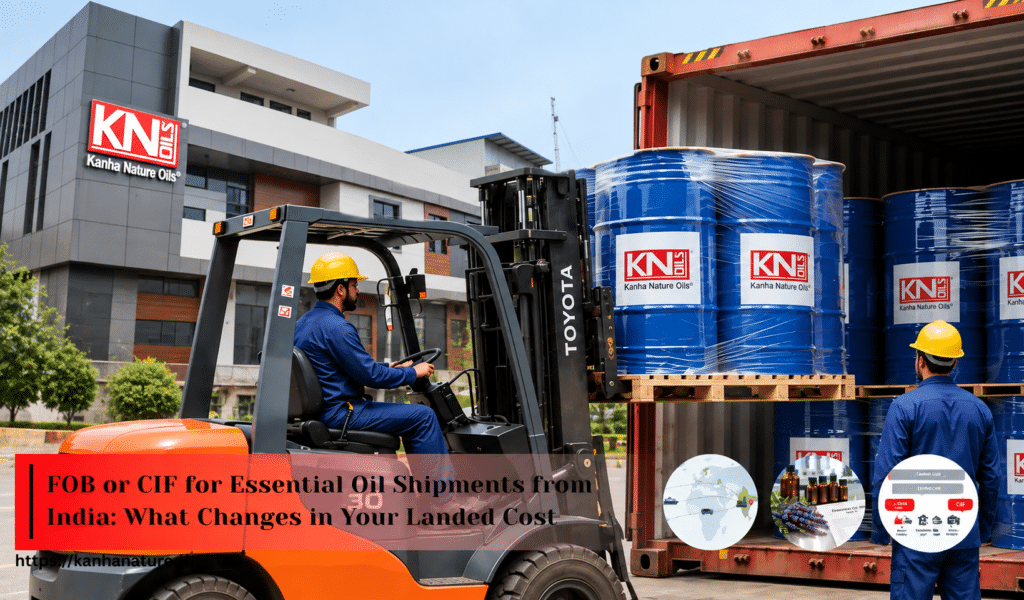
FOB or CIF for Essential Oil Shipments from India: What Changes in Your Landed Cost By Piyush Gupta, Founder & CEO, Kanha Nature Oils · 27 years in the fragrance and essential oils industry · Regional Secretary (North Zone), FAFAI · Treasurer, EOAI · Vice President, Sugandh Vyapar Sangh North Zone Two Indian suppliers quote you for the same bulk lavender oil. One says FOB, the other says CIF, and the CIF price looks higher. Which is cheaper once the drums reach your warehouse? For most buyers comparing FOB and CIF on an essential oil import from India, the short answer is this. FOB gives you control of freight, insurance and the carrier, and usually the lower total if you have a reliable forwarder. CIF is simpler when you do not, but you pay for freight you cannot see and get only minimum insurance. Where you import also matters: the US charges duty on a value that excludes freight, while the EU charges it on a value that includes it. This guide shows exactly what each term covers, where risk moves, how each one changes your landed cost, and when neither is the right term at all. FOB vs CIF at a glance Both are Incoterms 2020 rules published by the International Chamber of Commerce. The cost split is the main difference. FOB vs CIF: who handles what Item FOB (Free On Board) CIF (Cost, Insurance and Freight) Named place Port of shipment in India, e.g. FOB Nhava Sheva Port of destination, e.g. CIF Rotterdam Inland transport to Indian port Seller Seller Indian export clearance Seller Seller Loading on the vessel Seller Seller Ocean freight Buyer Seller Cargo insurance Buyer’s choice Seller, at minimum cover Who chooses the carrier Buyer Seller Destination port charges, import clearance, duty, tax Buyer Buyer Risk passes to buyer When goods are on board in India When goods are on board in India The last row surprises many buyers. Under both terms the risk is yours from the moment the drums are loaded in India. CIF moves cost, not risk. Where risk moves, and why CIF insurance may not be enough Under both FOB and CIF, risk passes to the buyer once the goods are on board in India. Because risk transfers at loading under both FOB and CIF, any loss at sea is your claim to make. Under CIF the seller must insure the goods for you, but Incoterms 2020 sets that cover at the minimum. The seller insures at least 110% of the contract value under Institute Cargo Clauses (C), unless you agree otherwise. Clauses (C) is a named-perils policy. It covers events such as fire, sinking and collision, not all loss. For essential oils, the realistic losses are leaking drums, contamination and temperature damage, which sit outside that narrow cover. If you buy CIF, ask the supplier to quote Institute Cargo Clauses (A), or top up the cover yourself. If you buy FOB, your own policy or your forwarder’s open cover applies from loading. How FOB and CIF change your landed cost Landed cost is everything you pay until the oil is in your warehouse: product price inland transport and export clearance in India (in the price under both terms) ocean or air freight cargo insurance destination port and terminal charges customs duty and import tax customs broker fees delivery to your warehouse Only freight and insurance change hands between the two terms. Everything after the destination port is yours either way. Worked example on one essential oil consignment The figures below are illustrative, not quotes or real tariff rates. Illustrative cost to destination port: FOB route vs CIF route Line FOB route CIF route Supplier price USD 20,000 FOB Nhava Sheva USD 22,300 CIF destination port Ocean freight booked by your forwarder USD 1,800 Included in price Insurance, Clauses (A) USD 60 Included, Clauses (C) only Cost to destination port USD 21,860 USD 22,300 In this example, the CIF quote costs USD 440 more and carries thinner insurance. The CIF quote carries USD 440 more than the FOB route, plus thinner insurance. That gap is common, because the seller’s freight booking can include a margin you cannot see. It can also go the other way when the seller ships volume and has better contract rates. The point is to compare like with like: ask the CIF supplier to show freight and insurance as separate lines on the invoice. The cost a CIF quote does not show Under CIF the seller chooses the carrier, often a consolidator (NVOCC) that offers the seller a low freight rate. Some consolidators recover that margin at destination, billing the buyer for terminal handling, documentation, delivery order release and de-stuffing. You did not choose that carrier, so you have little room to negotiate, and those charges can exceed the saving the CIF quote appeared to offer. Before accepting a CIF quote, ask which carrier or consolidator will be used and request an estimate of its destination charges at your port. Your customs duty base depends on where you import This is the part most generic Incoterms guides skip. United States. US Customs and Border Protection appraises most imports at transaction value, which excludes international freight and insurance under 19 CFR 152.103. If your invoice is CIF, those costs need to be shown separately to be deducted. European Union. Under the Union Customs Code, transport and insurance costs up to the EU border are added to the customs value. Duty is effectively charged on a CIF value, whichever term you bought on. Take the FOB route from the example above and a hypothetical 5% duty rate. A US importer pays duty on USD 20,000 (USD 1,000). An EU importer on the same FOB route pays duty on roughly USD 21,860 (about USD 1,093), because freight and insurance to the border are added. On the CIF route, the EU duty base is the full USD 22,300 (about USD 1,115). A US importer buying CIF can still deduct freight
bulk essential oils india
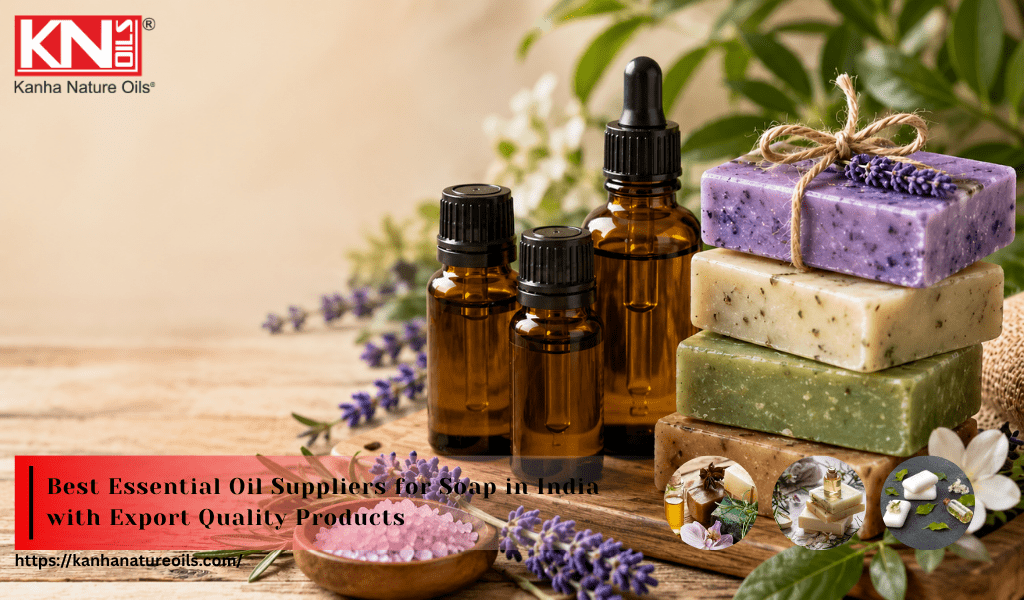
The global demand for handmade, herbal, and organic soaps is growing rapidly, and India has become one of the leading sourcing destinations for premium essential oils. From lavender and tea tree to lemongrass and peppermint, Indian suppliers are known for offering high-quality oils at competitive prices. For soap manufacturers, choosing the right supplier is essential because the quality of essential oils directly impacts fragrance retention, skin benefits, and product consistency. If you are a soap brand owner, private label manufacturer, or wholesale buyer, finding reliable essential oil suppliers in India with export-quality standards can help your business scale globally. One trusted name in this industry is Kanha Nature Oils, known for supplying premium-quality essential oils for soap and cosmetic manufacturing. Why Essential Oils Matter in Soap Manufacturing Essential oils are one of the most valuable ingredients in soap making. They provide natural fragrance, therapeutic benefits, and skin-friendly properties that synthetic fragrances often lack. Consumers today prefer soaps made with pure botanical extracts because they are considered safer, eco-friendly, and chemical-free. Different essential oils serve different purposes in soap formulations: Lavender oil helps promote relaxation and skin soothing. Tea tree oil is popular for acne and antibacterial soaps. Peppermint oil provides a refreshing cooling sensation. Lemongrass oil adds a fresh citrus aroma and cleansing benefits. Rosemary oil is widely used in herbal and hair care soaps. The purity and concentration of these oils play a major role in the final soap quality. This is why selecting a trusted supplier is extremely important. Growing Demand for Indian Essential Oil Suppliers India is one of the world’s largest producers and exporters of natural essential oils. The country has favorable climatic conditions, abundant medicinal plants, and a long history of Ayurveda and herbal extraction. Indian suppliers now serve soap manufacturers in the USA, Europe, the Middle East, and Southeast Asia. Many Indian manufacturers provide: Steam-distilled and cold-pressed oils GC/MS tested products Bulk packaging options Export documentation Private labeling services Organic and natural certifications Several suppliers in India now focus heavily on export-grade production standards and international compliance. What to Look for in Essential Oil Suppliers for Soap Before choosing a supplier, soap manufacturers should evaluate several important factors. 1. Purity and Testing Standards Always choose suppliers that provide: ISO certification GMP compliance HACCP Organic certifications (if required) Halal or Kosher (depending on market) Some Indian suppliers publicly mention GMP, ISO, HACCP, and HALAL credentials for their production facilities. Reliable suppliers maintain strict quality control to ensure the oils remain pure and unadulterated. Export-focused manufacturers often provide international compliance documents for global buyers. 2. Wide Range of Oils A good supplier should offer multiple essential oils suitable for soap making, including: Lavender oil Tea tree oil Peppermint oil Eucalyptus oil Lemongrass oil Rosemary oil Orange oil Cedarwood oil Having access to multiple oils from one supplier simplifies sourcing and ensures consistency. 3. Export-Quality Packaging Bulk soap manufacturers need secure packaging to maintain oil freshness during transportation. Export-quality suppliers usually provide: Aluminium bottle HDPE containers Food-grade packaging White label supply- Choose a supplier who can grow with your business requirements. Packaging quality is essential for preserving aroma and preventing oxidation during international shipping. 4. MOQ Flexibility Some suppliers only deal in large quantities, while others support small and medium businesses with lower minimum order quantities. Flexible MOQ options are useful for startups and private label brands. 5. Sustainable and Ethical Sourcing Modern consumers prefer ethically sourced products. Suppliers who maintain sustainable farming partnerships and eco-friendly extraction methods often have better credibility in international markets. Best Essential Oil Suppliers in India for Soap Manufacturers India has many reputed suppliers serving the soap and cosmetic industries. Some well-known names These companies are recognized for supplying essential oils in bulk quantities with testing and export support. However, businesses looking for reliable sourcing, competitive pricing, and customized solutions often prefer working with specialized suppliers like Kanha Nature Oils. Why Choose Kanha Nature Oils for Soap Manufacturing Kanha Nature Oils has emerged as a trusted supplier of essential oils, carrier oils, and herbal extracts for soap and cosmetic manufacturers. The company focuses on purity, consistency, and customer satisfaction. High-Quality Essential Oils Kanha Nature Oils offers a wide range of essential oils suitable for soap production, including: Lavender Essential Oil Tea Tree Essential Oil Rosemary Essential Oil Peppermint Essential Oil Lemongrass Essential Oil Eucalyptus Essential Oil Orange Essential Oil These oils are carefully processed to preserve their natural aroma and therapeutic properties. Bulk Supply and Export Support The company supports bulk orders for: Soap manufacturers Cosmetic brands Aromatherapy companies Private label businesses International importers Export-ready packaging and documentation help global buyers streamline their sourcing process. Competitive Pricing One major advantage of sourcing from India is cost efficiency. Kanha Nature Oils provides competitive wholesale pricing without compromising product quality, making it ideal for both startups and large-scale manufacturers. Customized Packaging Solutions The company offers customized packaging options based on business requirements. Buyers can choose from various bottle sizes, drums, and private labeling solutions. Consistent Product Quality Consistency is critical in soap manufacturing. Kanha Nature Oils focuses on maintaining batch-to-batch consistency through strict quality checks and standardized extraction methods. Popular Essential Oils Used in Soap Making Lavender Essential Oil Lavender oil is widely used in handmade and luxury soaps due to its calming aroma and soothing properties. It is ideal for sensitive skin formulations. Tea Tree Essential Oil Tea tree oil is known for its antibacterial and antifungal properties. It is commonly used in acne-control and herbal cleansing soaps. Peppermint Essential Oil Peppermint oil creates a cooling sensation and refreshing fragrance, making it popular in summer soaps and spa products. Lemongrass Essential Oil Lemongrass oil adds a fresh citrus scent and works well in detox and herbal soaps. Rosemary Essential Oil Rosemary oil is commonly used in hair and scalp-focused soap formulations due to its stimulating properties. Export Opportunities for Soap Brands The global natural soap market continues to grow as consumers move toward clean beauty and herbal skincare products. International buyers increasingly

